
November 2026 Night Sky: Mars and Jupiter, Leonids and a Near-Perigee Full Moon
A practical guide to the November 2026 sky: Moon phases, Mars and Jupiter, Venus and Mercury at dawn, Taurid and Leonid meteors and a full Moon close to perigee.
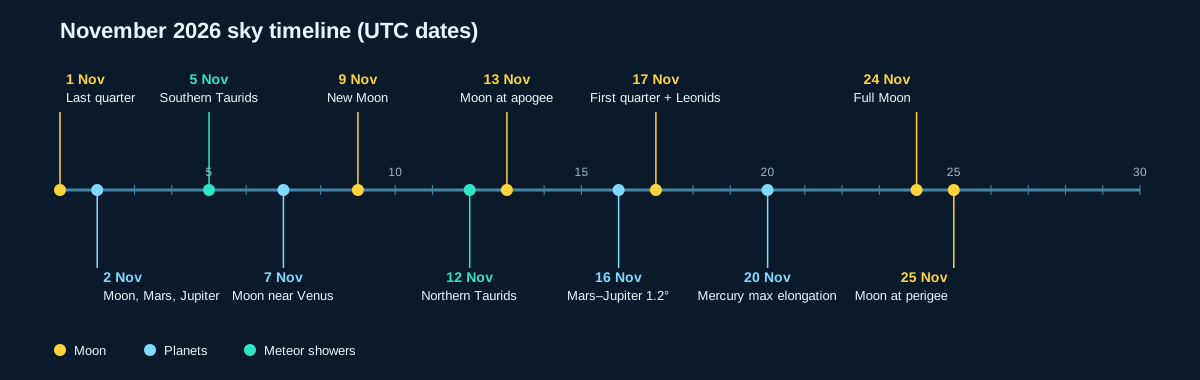
November is one of the most rewarding months for casual observers in the northern hemisphere, and it is far from dull in the south. Nights are long, the Moon steps out of the way for the best meteor nights, and the morning sky hosts a tight pairing of Mars and Jupiter. This guide walks through what to look for, when to look, and how to check each event against your own location rather than a generic forecast. All dates are given in UTC, so convert them for your time zone before you plan a session.
The month at a glance
The table below collects the dates worth marking. Moon phase times and planet separations were calculated for this article, and meteor shower peak dates follow the American Meteor Society calendar. Peak nights can shift by a day, so treat each date as the centre of a window rather than a deadline.
| Date | Event | Best time |
|---|---|---|
| 1 Nov | Last quarter Moon (20:28 UTC); US clocks go back an hour | Late-night and pre-dawn Moon |
| 2–3 Nov | Moon passes Mars (2 Nov) and Jupiter (3 Nov) in the morning sky | Pre-dawn, east |
| 4–5 Nov | Southern Taurids fireball-rich peak | Evening to midnight |
| 7 Nov | Thin crescent Moon near Venus | Just before sunrise |
| 9 Nov | New Moon (07:02 UTC) | Darkest skies of the month |
| 11–12 Nov | Northern Taurids peak | Dark, Moon-free sky |
| 16 Nov | Mars and Jupiter closest, about 1.2° apart | Pre-dawn, east to south-east |
| 16–17 Nov | Leonids peak, roughly 40% lit Moon | After midnight |
| 20 Nov | Mercury at greatest western elongation, 19.6° | Low in the dawn sky |
| 24 Nov | Full Moon (14:54 UTC), 360,754 km away | All night |
Moon phases and the dark windows
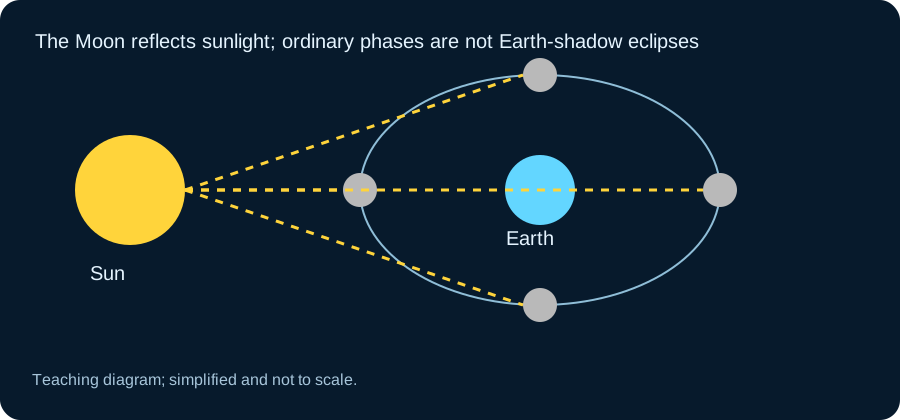
The Moon is at last quarter on 1 November, reaches new Moon on 9 November, first quarter on 17 November and full Moon on 24 November. The days around the 9th are the darkest of the month, which makes them the best choice for faint objects such as the Milky Way or dim star clusters. Plan anything that needs dark skies for roughly 5 to 13 November, then switch to bright targets such as planets and the Moon itself once the crescent grows.
The full Moon on 24 November falls about a day before perigee, the Moon's closest point to Earth on 25 November at about 359,000 km. At full phase it is roughly 360,754 km away, which makes it the second-closest full Moon of 2026 after the one on 24 December. The difference in apparent size from an average full Moon is small and hard to judge by eye, but a rising full Moon near the horizon can look impressive. Use the Moon Phase Today page for the live illumination and the Moonrise and Moonset times page to see when it clears your horizon.
Mars and Jupiter in the morning sky
Both planets are morning objects this month. Jupiter is the brighter of the two at about magnitude −2.1, easy to spot as a steady, cream-white light. Mars is much dimmer at about magnitude +0.7 and has a warm orange tint. Over November they move closer together, and the gap is smallest around 16 November, when they are roughly 1.2° apart, less than three full-Moon widths. Both fit easily in one binocular field, and the pair is a good test of how well you can tell a planet from a star by colour and steadiness.
The Moon visits them first. Depending on your longitude, the Moon passes close to Mars on 2 November and to Jupiter on 3 November. From the Americas the closest Mars approach (about 1.8°) happens in the pre-dawn of 2 November. In India and nearby regions the Moon sits only about 1° from Jupiter in the pre-dawn of 3 November. Because the Moon moves its own width roughly every hour, the exact gap changes with your position, so check the planet near the Moon tonight page for your sky. The Planets Visible Tonight tool shows altitude and direction for the right time.
Venus, Mercury and Saturn
Venus is the brilliant morning "star" of the month, brightening from magnitude −4.3 to −4.9 as it pulls away from the Sun. Its angular distance from the Sun grows from about 14° at the start of the month to roughly 41° at the end, so it climbs a little higher each week. Around 7 November a very thin crescent Moon, only about 4% lit, passes close to Venus. From the Americas and Europe the pair is roughly 1° apart; from Asia it is a few degrees apart, since the Moon has moved on. You need a clear eastern horizon and should look before sunrise.
Mercury is hard to catch early in the month, then swings into the dawn sky and reaches greatest western elongation, 19.6° from the Sun, on 20 November. It is best in the days around that date, low in the east shortly before sunrise. Saturn is the main evening planet, shining at about magnitude +0.4 to +0.6 in the south-east to south after dark. Use the Saturn rings and moons page if you plan to observe it through a telescope.
Meteor showers: Taurids and Leonids
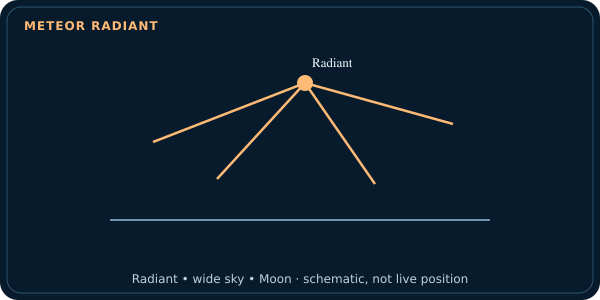
Two shower families are active. The Southern Taurids have a fireball-rich component that peaks around 4 to 5 November, with a waning crescent Moon of about 25% lit. The Northern Taurids peak around 11 to 12 November, just after new Moon, which gives them near-perfect dark skies. Taurid rates are low, but they are known for slow, bright fireballs that are worth the patience.
The Leonids peak around 16 to 17 November. In a normal year they are a modest shower, not the storm that earlier comet returns produced, and a roughly 40% lit Moon will wash out the faintest meteors until it sets after midnight. Plan to watch in the hours after the Moon has gone down, face the darker part of the sky and allow your eyes 20 to 30 minutes to adapt. The Meteor Shower Tonight page and the Meteor Shower Calendar help you pick the right night.
A simple plan for the month
- Early November: use the pre-dawn hours for the Moon, Mars and Jupiter, and for the thin crescent beside Venus.
- Around 9 to 13 November: take the darkest nights for faint objects and the Northern Taurids.
- Mid-month: look east before dawn for the Mars and Jupiter pairing, and watch for Leonids after the Moon sets.
- Late November: catch Mercury near 20 November, then enjoy the bright full Moon close to perigee.
Clocks in the United States go back one hour on 1 November, so evening sessions start earlier by the clock. If you are new to planning a session, the night sky planning guide explains how to combine twilight, Moon, cloud and horizon checks, and the Astronomy Calendar and Planetary Events Calendar list each event with a local time. For general observing advice from an authoritative source, see NASA's skywatching pages.
Set your location in the site header first. Every tool then shows rise, set and altitude for your own sky, which matters more than any global date list. If clouds spoil one night, most of these events last several days, so you will usually get a second chance.
Keep exploring
All guides → Skywatching GuidesCan You See ISS, Hubble and Starlink with the Naked Eye?Skywatching Guides · Aug 21, 2026Skywatching GuidesWhere to Look for Satellites: Azimuth and ElevationSkywatching Guides · Aug 21, 2026Skywatching GuidesISS vs Tiangong: Space Stations, Orbits and Local PassesSkywatching Guides · Aug 21, 2026
