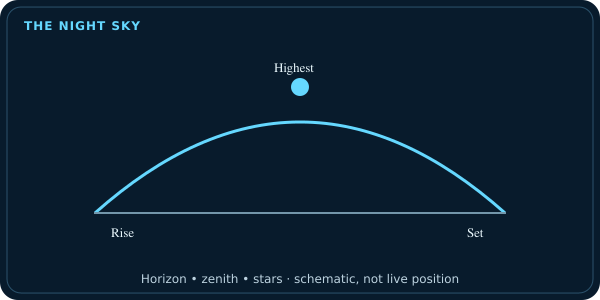
Can You See ISS, Hubble and Starlink with the Naked Eye?
Compare ISS, Hubble and Starlink visibility and learn how to check which satellites may be visible from your location tonight.
If you are looking for satellites visible tonight, start by separating “above the horizon” from truly visible. You can see some human-made spacecraft with the naked eye, but those two ideas are not the same thing. The ISS, Hubble and Starlink have very different typical brightness and viewing behavior. Use a location-based pass prediction first, then consider sunlight, sky darkness and local weather.
A pass prediction tells you when and where an object is expected above your horizon, but visibility still depends on illumination and sky conditions. Use the local pass page for timing, then check the object type and observing conditions before deciding whether a naked-eye sighting is realistic.
Which satellites are visible tonight?
The ISS is usually the easiest of these three targets during a favorable visible pass. Some Starlink satellites can also be visible, especially under favorable geometry or when satellites are still grouped after deployment. Hubble can be visible under the right conditions but is generally a more demanding target. Your exact opportunity changes with location and date.
Why the ISS is often easiest
The ISS is a large reflective spacecraft in low Earth orbit. During a favorable twilight pass it can appear extremely bright and move steadily across a large part of the sky. NASA notes that the station is visible because it reflects sunlight and that no telescope is required for suitable passes.
Can you see Starlink with the naked eye?
Yes, individual Starlink satellites can sometimes be seen, and a newly deployed group may be much easier to notice because multiple lights appear along a similar track. However, many predicted passes are not visually dramatic. Use the Starlink train guide to understand why the view changes after launch.
Can you see Hubble from Earth?
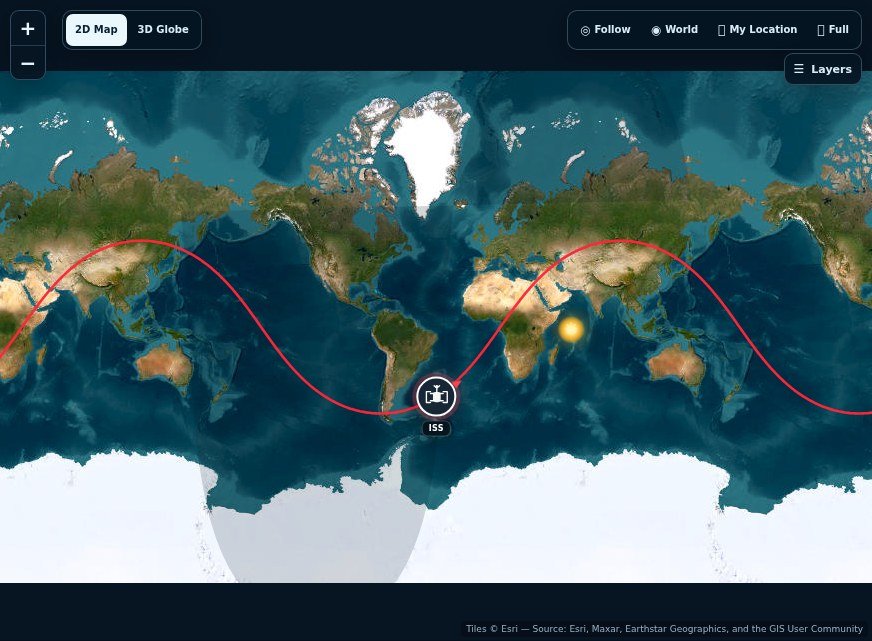
Hubble travels in low Earth orbit and can be visible to the naked eye during favorable passes, but it is not as consistently conspicuous as the ISS. Check the Hubble tracker, choose a useful pass and observe from a location with a clear sky.
What makes a satellite visible?
Three conditions matter most: it must be above your horizon, the sky must be dark enough for contrast, and the spacecraft must be illuminated strongly enough to reflect sunlight toward you. Cloud, haze, light pollution and low elevation can further reduce your chances.
How to check what is above you tonight
Start with the SpaceTracker.live home experience and individual trackers. Enter your observer location, inspect the next passes, then use the predicted direction and elevation to plan where to look. For interpreting those angles, see where to look using azimuth and elevation.
Brightness is not a fixed property of a satellite
A satellite does not shine like a lamp. Most objects you see with the unaided eye are reflecting sunlight, so apparent brightness depends on the spacecraft’s size and orientation, its distance from you, the Sun-spacecraft-observer angle and local sky conditions. This is why the same object can look bright on one pass and much fainter on another.
The ISS is often conspicuous because of its large reflective structure. Hubble can be visible on favorable passes but is usually less dramatic. Starlink visibility varies widely: recently deployed groups can attract attention, while many operational spacecraft are difficult to notice from a bright city sky.
Choose the pass before you choose the equipment
For the ISS and other bright satellites, binoculars are usually unnecessary and can actually make acquisition harder because they show a narrow field of view. Start with your unaided eyes, a clear horizon and an accurate time. If you want to photograph a pass, first learn the track visually and use a stable camera setup rather than trying to follow the object at high magnification.
Check Pass Predictions for your location and use the azimuth and elevation guide to translate the numbers into sky directions. The Starlink identification guide can help when a moving light is ambiguous.
Confirm a sighting with time, direction and motion
If you are unsure what you saw, record the exact local time, your location, the direction of travel, whether the light flashed, and approximately how long it remained visible. Comparing those details with a tracker is much more reliable than identifying an object from brightness alone.
Choose a target that suits your observing site
An open suburban park and a narrow city balcony offer very different opportunities. From a balcony, a predicted high ISS pass may be more promising than a faint object skimming the horizon. At a darker site, individual satellites become easier to notice, but you still need to know which direction their tracks cross. Start with the part of the sky you can actually see, then choose a target whose predicted path fits that view.
Treat the ISS as a good first practice target rather than a guarantee. Learn how a steady point crosses familiar stars before attempting Hubble or a less conspicuous constellation member. If one object is not visible, do not assume every satellite in the list is equally difficult. Spacecraft differ in size, surface orientation and orbital height, and a useful observation depends on the particular pass. A single unsuccessful evening tells you little about what another night can offer.
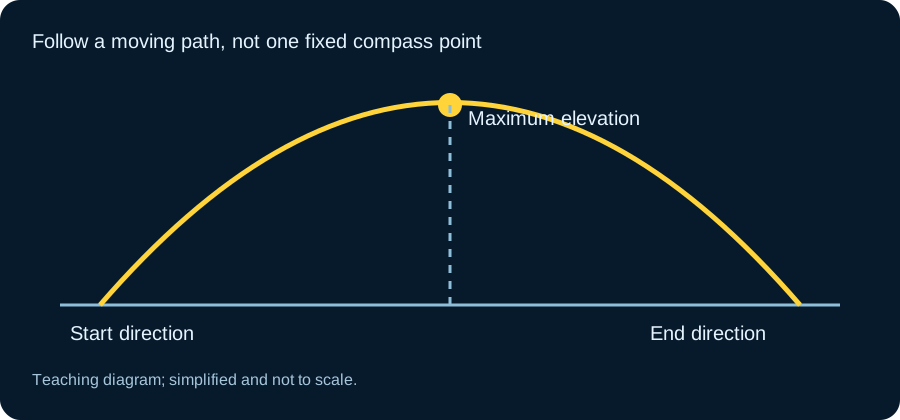
Naked-eye visibility depends on more than an object being above the horizon. Brightness, illumination, elevation, local sky conditions and timing all matter, so treat the tracker as a planning aid rather than a guarantee that every listed object will be visible.
Hubble has a different geographical reach
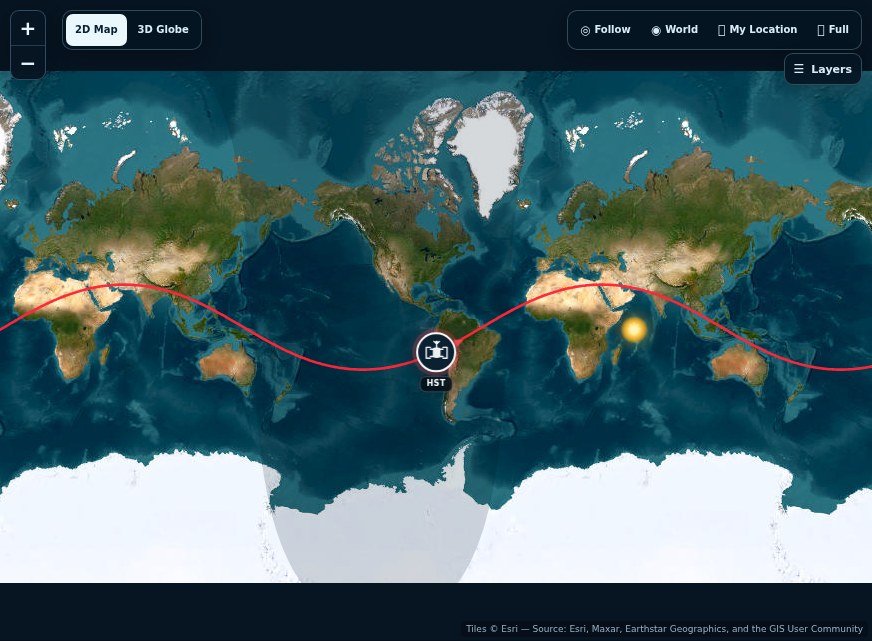
Hubble's orbital inclination is lower than that of the ISS. This changes how far north and south its ground track travels and how it appears from different latitudes. An observer should therefore check the Hubble page directly rather than reuse an ISS prediction or assume the two observatories cross the same sky. A spacecraft can be far from your ground location yet still lie above your horizon, but the angle and range matter.
The easiest way to compare is to use the same location and evening for both targets. Look at their maximum elevations and pass paths before judging expected brightness. A low Hubble opportunity may be hidden by trees while a high station pass is obvious. Keep the comparison about local viewing geometry. It does not tell you which scientific mission is more important, and a telescope's excellent astronomical images do not make the telescope itself easier to see from the ground.
A moving light needs more than one clue
Brightness is a weak identifier on its own. A plane approaching nearly head-on can appear steady, while a reflecting satellite can brighten or fade as its angle changes. Watch long enough to notice motion against the background stars. Record the time, approximate direction and whether the light follows a smooth path. Compare that sequence with the selected object's prediction rather than matching only the brightest point you remember.
For a possible Starlink group, look for repeated objects following broadly similar tracks, but do not identify every line of lights as the same launch. The apparent spacing can change across the sky, and a phone video can exaggerate brightness. A matching catalog entry and pass time are stronger evidence than a dramatic clip. If there is no suitable match, keep the observation unidentified. That is a more useful starting point for checking later than attaching a confident spacecraft name to incomplete information.
Make the first attempt comfortable
Arrive early enough to find the expected horizon gap, put the phone screen on a low brightness setting, and avoid spending the whole pass reading small numbers. Memorise the starting direction and approximate peak height. If you are observing with someone else, agree on a landmark so you can describe where the moving point appears without searching separate parts of the sky.
After the pass, compare what you saw with the predicted route. Note whether the object faded before reaching the horizon, whether a cloud intervened, and how long you could follow it. These observations help you distinguish illumination from obstruction on the next attempt. A successful naked-eye session is not measured by the number of satellites collected. Learning to recognise one correctly, with its time and direction confirmed, is a better foundation for identifying more difficult targets.
Frequently asked questions
Can you see satellites from New York or Los Angeles?
Yes, bright satellite passes can be visible from major cities, although darker skies improve the chance of detecting fainter objects.
Do satellites flash?
Some satellites can change brightness as their orientation changes, but regular colored blinking is more characteristic of aircraft.
Why is a satellite shown overhead but not visible?
The prediction may describe geometry only. If the spacecraft is in Earth’s shadow or the sky is too bright, you may not see it.
Do I need an app or telescope?
A tracker is useful for timing and direction, but many bright satellite passes can be observed with the naked eye.