About Next Rocket Launch
How SpaceTracker.live chooses the next launch
The Next Rocket Launch page sorts the current upcoming feed by the published no-earlier-than time and selects the earliest launch whose active window has not already passed. That sounds simple, but the identity of the “next” mission can change quickly. If the first mission is scrubbed or moved to another day, the following mission may immediately become the next event after the schedule refreshes. The page therefore reflects the latest cached operational order rather than a manually maintained list.
The large countdown is seeded on the server so visitors no longer see a temporary loading message. JavaScript then updates the countdown every second. When the target time is reached, the display changes to indicate that the launch window has been reached, and the page refresh cycle allows the schedule to advance to the next mission once the upstream record and local filter confirm that the previous window is over.
Reading date precision and launch status
Not every date has the same level of certainty. Some launch records represent an exact minute, while others represent a day, month or quarter used for planning. A precise timestamp can still change, but an approximate timestamp deserves even more caution. Status labels such as Go for Launch, To Be Confirmed or To Be Determined provide additional context. The page preserves those labels instead of making an uncertain target appear more definite than the source data supports.
Launch windows also matter. Some missions can lift off only during a very short interval because of orbital geometry, rendezvous requirements or lighting constraints. Others have longer windows. If a vehicle does not launch during the allowed period, teams may recycle for another opportunity. That is why an event can remain relevant briefly after the nominal T-0 while controllers determine whether the mission will proceed or move to another time.
What the launch card tells you
The next-launch card combines the mission name, rocket configuration, launch service provider, pad, broader location and current status. A launch-specific image is shown whenever the data source supplies one, with pad or location imagery used as a fallback. This visual context is especially useful when several missions use similar names or when the same rocket family operates from multiple launch sites.
The displayed clock time is converted to the timezone configured on your device. The underlying timestamp remains the same instant worldwide, but local conversion prevents common mistakes when a launch occurs near midnight UTC. If you are travelling or using a computer with an incorrect timezone, verify the device timezone before relying on the displayed local date.
What to do after the countdown reaches zero
A zero countdown does not by itself prove that the rocket has launched. Real countdowns can hold, recycle or stop entirely. The schedule page is therefore best used together with official launch-provider coverage near T-0. SpaceTracker.live focuses on the schedule and tracking context rather than replacing mission-control confirmation.
If the mission successfully deploys satellites, return later to Recently Launched Satellites or the Satellite Directory. If the spacecraft is bound for the Moon, a Lagrange point, another planet or interplanetary space, check the Deep Space tools. The launch page is the beginning of the tracking chain, not the end of it.
Practical checks before you rely on the countdown
Before making viewing or travel plans around the next launch, compare three pieces of information: the scheduled time, the status label and the precision of the date. A countdown can look exact even when the underlying mission is still marked To Be Determined. The closer the mission gets to liftoff, the more useful it becomes to confirm the operator’s official stream, mission update or launch-range notice. SpaceTracker.live is designed to make the schedule easy to follow, while the launch provider remains the authoritative source for a final go/no-go decision.
Also remember that the first mission in a global feed is not necessarily the most visible or important mission for every visitor. Some launches carry commercial satellites, some carry science payloads and others are development tests. The Next Rocket Launch tool intentionally answers only one question: which scheduled launch window comes first right now? Use the provider-specific pages, the full schedule and the launch-site directory when you need broader context.
For satellite objects that have already reached orbit, use Recently Launched Satellites. For wider orbital tracking, open the Satellite Directory or the Deep Space section.
Frequently asked questions
What counts as the next rocket launch?
The page uses the earliest future event in the current Launch Library 2 upcoming-launch feed.
Why can the next launch change suddenly?
Launches can be delayed, scrubbed or rescheduled, which can move another mission into the next-launch position.
What timezone is the countdown based on?
The countdown uses the launch timestamp itself, while the displayed clock time is converted to your device timezone.
Launch schedule and associated imagery: Launch Library 2, The Space Devs. SpaceTracker.live uses a shared server-side cache and retains image credits when provided by the source record.

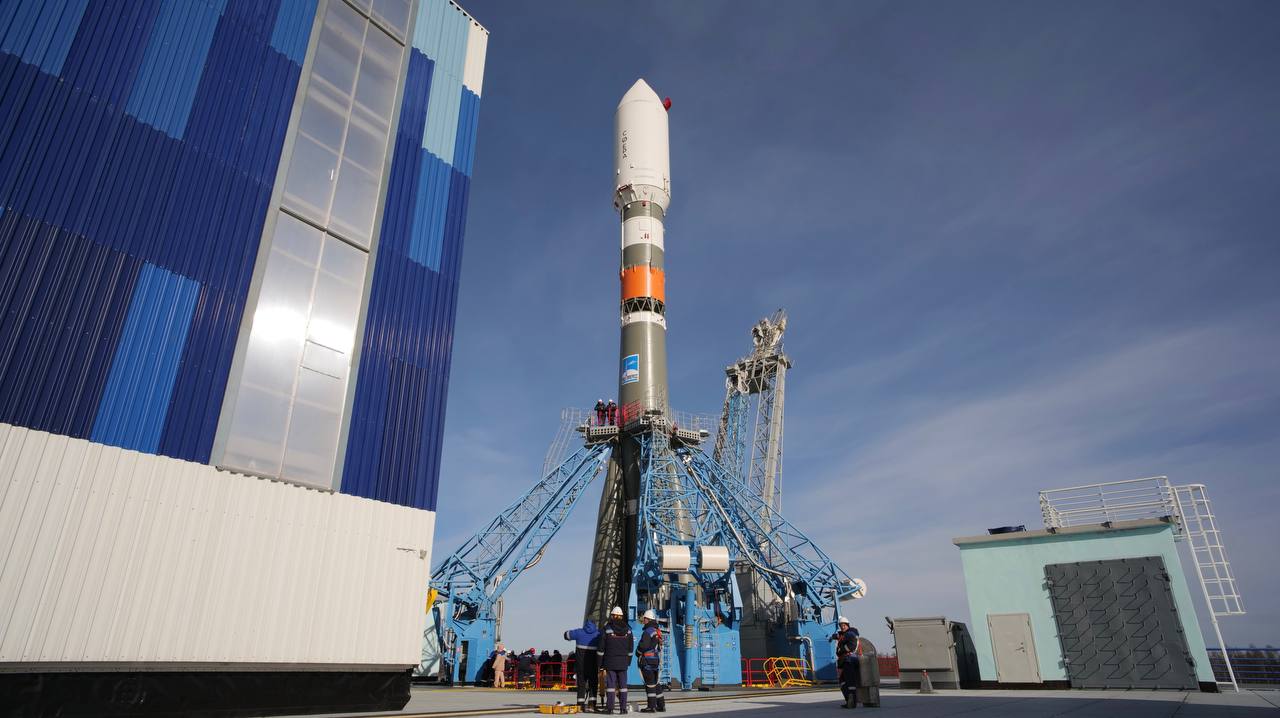 Image: Roscosmos