
Reading Saturn before you point the telescope
Saturn can look like a quiet, yellowish star until a telescope turns that point into a small globe surrounded by rings. The rewarding part is often what happens next: a faint dot appears beside the planet, another emerges farther out, and you start wondering which moon you are seeing. This Saturn rings and moons tracker gives that observation a reference. Choose your observing time, compare the projected moon pattern, and then use the sky view to check where Saturn sits above your own horizon. For the wider context, our planets visible tonight page helps you decide whether Saturn belongs in your evening plan at all.
The chart is a calculation, not a live camera image. Its dots represent predicted positions of eight major moons, while the ring ellipse represents the changing viewing geometry. That distinction matters when you compare it with a bright spacecraft photograph or a high magnification telescope view.
Start with the time and your saved location
The main time field uses UTC. Set it to the instant of your observation rather than leaving an old screenshot beside the eyepiece. The Now button brings the tool back to the current minute. Your observing location comes from the site's shared location control; there is no separate Saturn account or place selector to maintain. Location affects Saturn's altitude and direction in the Observer Sky View. The moon diagram, by contrast, is a geocentric projection of the Saturn system.
Try moving the time forward several hours and watching the arrangement change. Inner moons can move noticeably during a single observing session. Titan and especially Iapetus need a wider view, so switch between the inner and wide settings instead of assuming that an absent label means a moon has disappeared.
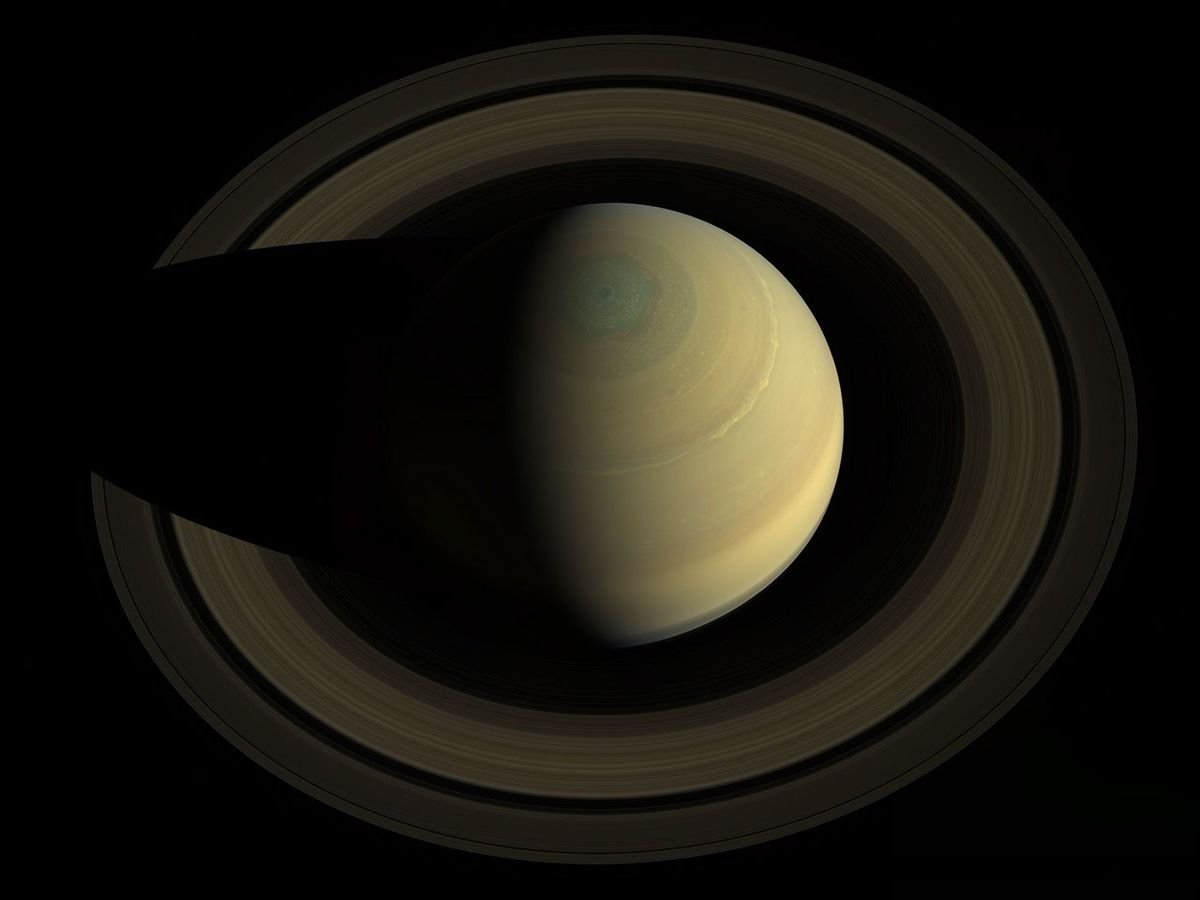
What the ring opening actually means
The ring opening, labelled B, describes Earth's latitude relative to Saturn's ring plane. A larger absolute angle presents a more open ellipse; an angle close to zero presents a thinner view. The sign identifies the side of the ring plane from which we see the system. It does not describe an increase or decrease in the amount of material in the rings. The rings keep their structure while our viewing direction changes.
The position angle tells you how the pole direction is tilted against celestial north. In this chart, north is up and east is to the left. That orientation is useful for comparison, but your telescope may invert or mirror the scene. NASA's Saturn overview is a good companion when you want the physical story behind the geometry.
Eight moons, with different observing challenges
Mimas, Enceladus, Tethys, Dione, Rhea, Titan, Hyperion and Iapetus are included in the numerical table. This is a major-moon model, not an inventory of every small satellite around Saturn. Titan is usually the most approachable starting point for a modest telescope. The closer inner moons can be much harder to separate from the planet's glare, even when the chart puts them outside the globe.
Do not read the size of a plotted dot as a moon's angular diameter or brightness. Dots are enlarged so that a useful pattern remains visible on a phone. The table's coordinates are measured in Saturn radii. X and Y describe the projected plane; Z records depth, with positive values directed away from the observer. Those numbers let you compare the model between dates without mistaking display scale for physical scale.
Why a moon can be listed but remain unseen
A position prediction answers where to look. It cannot promise that your telescope will show the object. Transparency, atmospheric steadiness, aperture, glare, focus and Saturn's altitude all affect the result. A moon sitting close to the rings may be much more difficult than another at a greater separation. A low planet is viewed through a longer path in the atmosphere, which often softens the image before any tracking error becomes important.
The globe alignment column identifies a projected overlap or a projected position behind the globe. It is not a contact-time service. This tool does not calculate a complete sequence of ring occultations, solar eclipses or shadow events. If a timed phenomenon matters to your session, use a specialist event prediction and keep a separate record of the source and uncertainty.
Use Observer Sky View for the local question
The sky view answers a different question from the moon diagram: where is Saturn from your location at the selected time? Altitude measures height above the mathematical horizon, and azimuth measures direction around it. A positive altitude does not guarantee a clear line of sight through a nearby roof or tree. The chart cannot know your garden's obstructions, so compare its direction with your actual surroundings.
Background stars come from real catalogues. Their dots provide orientation, rather than a simulation of every star your eye will detect. You can drag the chart, scroll to zoom and reset the whole-sky view. Both sections follow the same UTC field, which makes it easier to compare a moon arrangement with the planet's local direction for one planned observation.
Match the chart to your telescope image
Begin at a low enough magnification to include Saturn and its nearby companions. Identify the brightest plausible moon, compare its distance and side relative to the rings, and only then work inward. If the pattern seems reversed, check your diagonal and optical design before changing the time. A mirror reversal is common enough that it should be your first practical explanation for a left-right mismatch.
An easy test is to let the sky drift briefly with tracking turned off, when doing so is safe for your equipment. Note the drift direction, restore tracking, and sketch the arrangement in your notebook. Use our planet apparent size comparison to see why Saturn's small globe needs careful focusing even when its rings make it look visually distinctive.
Spacecraft portraits and an eyepiece view
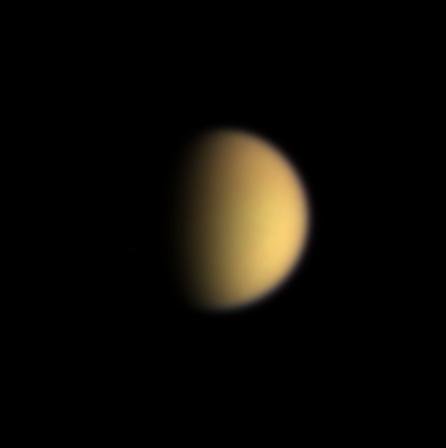
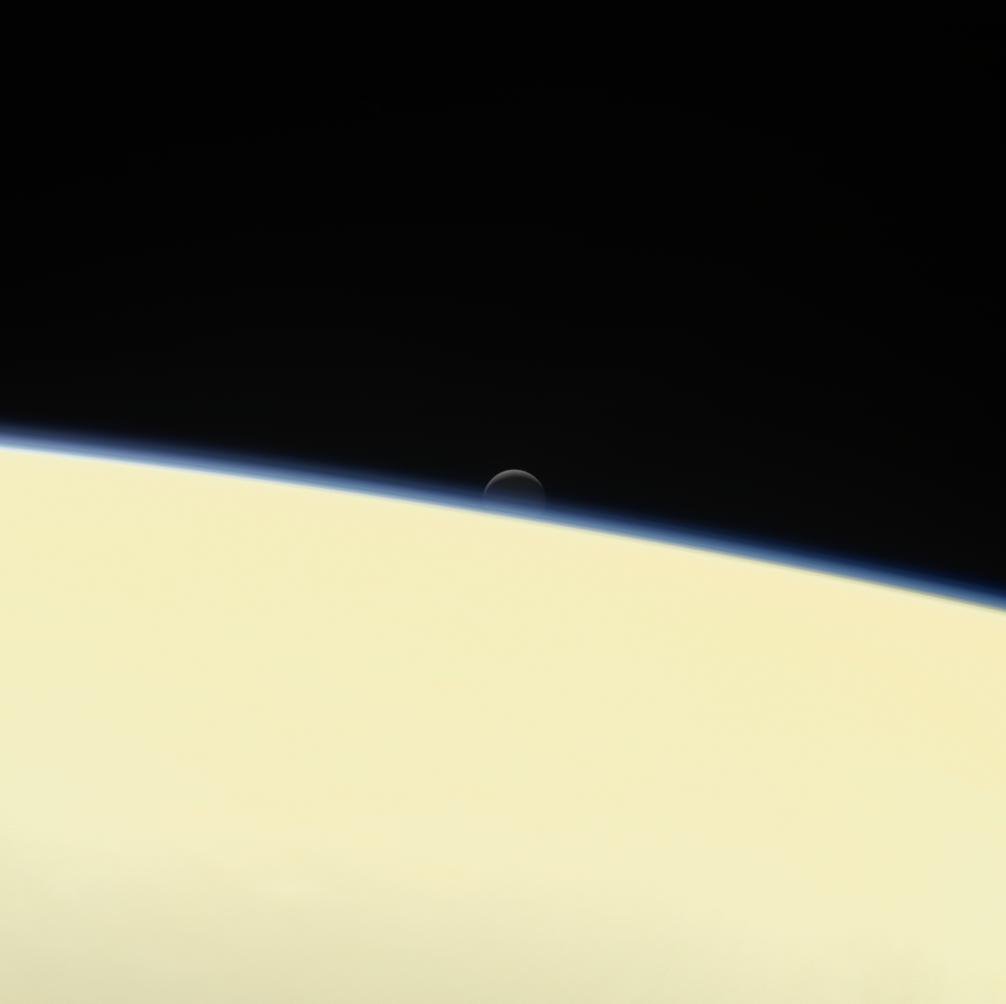
The three pictures in this guide are genuine NASA mission images with source links and credits. They show physical features that the tracker helps put in context, but they are not generated by today's calculation. Cassini could view Saturn and its moons from distances and angles unavailable to an observer on Earth. A close view of Enceladus therefore should not be used as an expectation for a backyard telescope.
Photographs may also use different exposures or processing to bring out faint structure. Your eye sees a changing image affected by turbulence and scattered light. Treat mission pictures as scientific references and the numerical diagram as an observing aid. Keeping those roles separate makes the comparison more informative than trying to make a small telescope reproduce a spacecraft portrait.
What powers the calculation
The ring and moon geometry uses the open Astronomia implementation of Meeus algorithms with VSOP87 Earth and Saturn positions. The model includes its own light travel and projection treatment. The tool feeds it ephemeris time rather than adding another arbitrary light-time shift. The local Saturn position is calculated separately with Astronomy Engine for the chosen observer.
This is an educational planning model with a restricted date interface, not a claim of spacecraft-navigation precision. The displayed decimals make comparisons convenient; they do not imply that all event contacts are known to the same number of digits. For mission-grade ephemeris work, consult NASA/JPL Horizons and understand its observer, frame and time settings.
A useful observing record
Write down the UTC time, equipment, magnification, estimated conditions and the pattern you actually saw. Include uncertainty: “possible Rhea” is more useful than a confident identification based on a single fleeting glimpse. Return a few hours or nights later and compare the change. That moving pattern is part of the appeal of observing a planetary system instead of a static photograph.
Before packing up, compare Saturn with our Jupiter moons tracker. The different scales and orbital arrangements make a worthwhile second observation when both planets are available. Keep the local sky position, the predicted moon geometry and your own visual record together. Those three pieces turn a quick look at the rings into a repeatable observation you can learn from.