
Crab Nebula: find M1 and understand the remnant
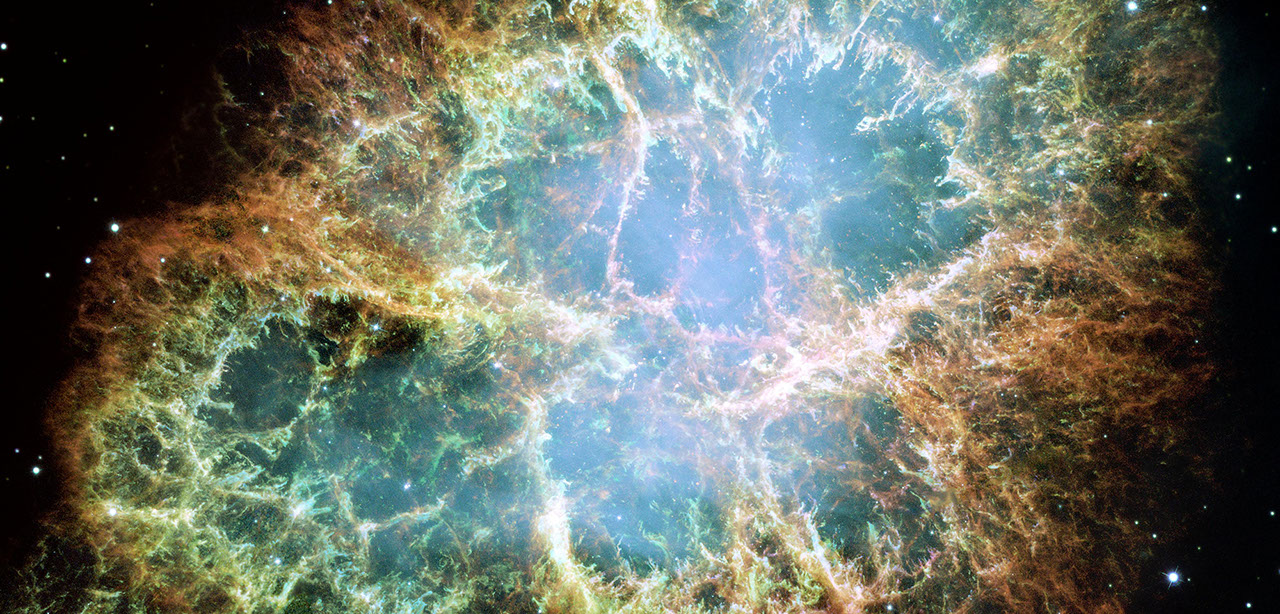
The Crab Nebula, also known as M1 and NGC 1952, is a famous supernova remnant in Taurus. Its history connects a stellar explosion observed in 1054 with an extended nebula studied by modern telescopes. This page locates the reference centre in your local sky and brings together three relevant scientific views. It does not animate the old explosion or treat the nebula as a newly discovered transient. Start with the symbol in Observer Sky View, then compare the source images with the practical observing discussion. The Hubble image record provides the context for the optical view, while the remnant directory places M1 beside other examples of stellar aftermath.
Several names identify the same reference target
M1 belongs to the Messier catalogue, while NGC 1952 is its New General Catalogue identifier. The name Crab Nebula is a familiar common label, not a separate object at a neighbouring coordinate. The tool keeps these names together to reduce confusion when you compare observing notes or search another database. Its position is the catalogue centre of an extended remnant, so it should not be mistaken for the exact coordinate of every filament. For narrow-field imaging, consult a detailed chart and the astrometric information attached to the reference observation. The selected crosshair is deliberately simple: it helps identify the direction among guide stars, while the photographs below carry the detailed structure and their own instrument-dependent scales.
Relate the field to the surrounding sky
Use the shared header location and select a suitable observing time. The map calculates altitude and azimuth for M1's reference direction and retains the site's ordinary guide-star display. Taurus provides a useful larger region for understanding the field, but recognising the constellation does not by itself identify the nebula in a telescope. Begin with a wider chart, confirm the field orientation and then work toward the target coordinates. A small error in a telescope's pointing can place a faint diffuse object outside the eyepiece even when the bright guide stars seem familiar. The broader constellation directory can help connect the object with its sky region. Remember that a below-horizon bearing marker is explanatory; it is not an indication that M1 can be observed at that moment.
The remnant contains more than visible filaments
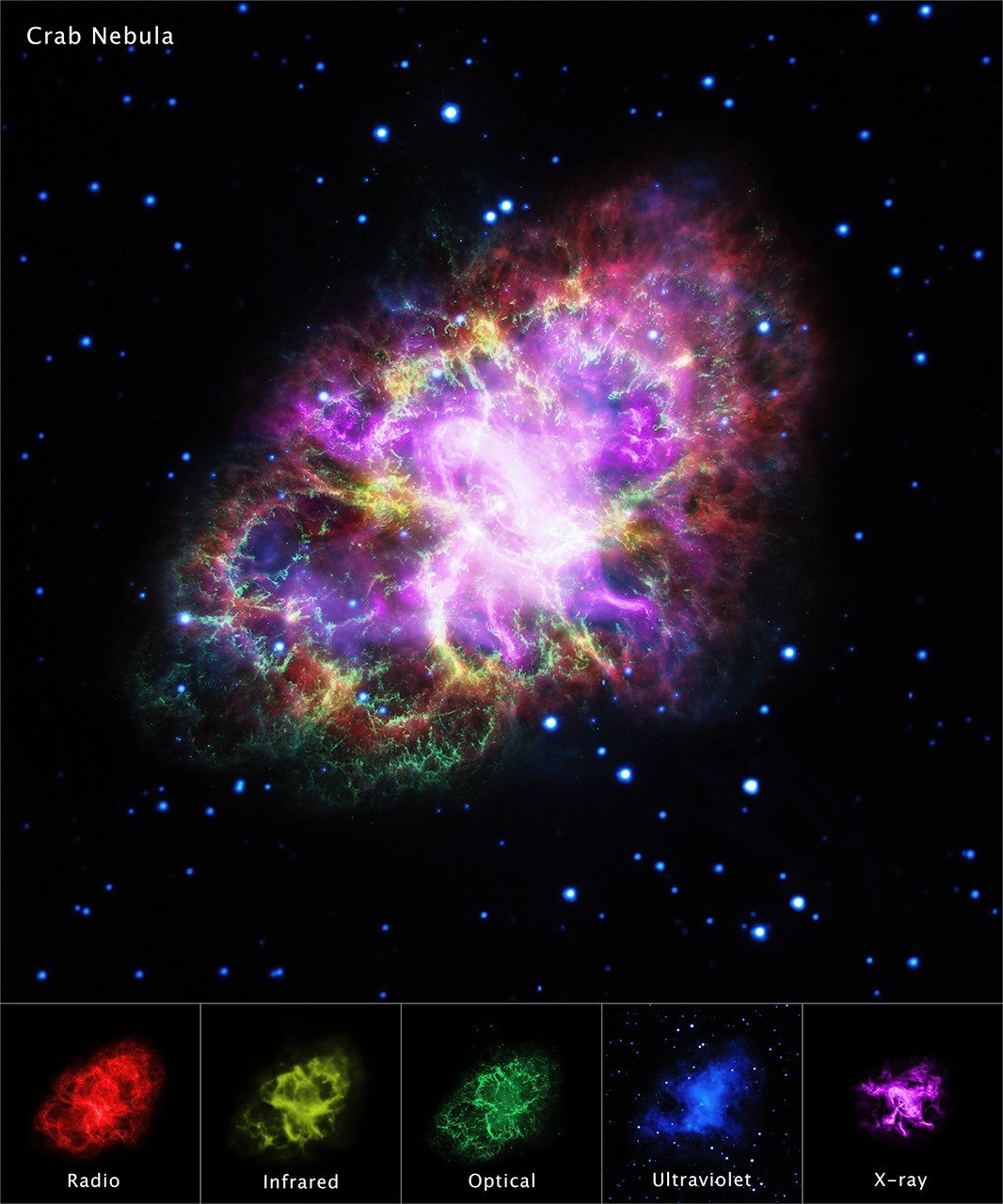
The Crab includes an energetic central pulsar and emission associated with particles and magnetic fields, as well as extended material visible in optical images. These components respond differently across wavelength bands. A photograph that highlights the filaments is not a complete account of the remnant's energy output, and a high-energy image may emphasize a much smaller region. The multiwavelength Crab observation is useful for seeing how several observatories contribute distinct information. Compare structures rather than assuming one instrument provides the only true picture. An ordinary optical observer should still plan for the visible nebula and the conditions of their instrument, rather than expecting the compact energetic features to resemble the processed composite.
Why the photographs do not predict an eyepiece view
Published images often combine long exposures, multiple filters and careful colour mapping. They can reveal faint filaments and contrast differences far beyond a quick visual glance. On a screen, an image may also be displayed at a size unrelated to its angular extent in the sky. Read the caption for the instrument and source before comparing it with what you see outdoors. The selected icon in the circle is a type symbol, not a tiny live photograph collected by the website. Its usefulness comes from marking the correct reference direction while keeping the surrounding chart readable. A visual observation, an amateur camera exposure and a space-telescope composite can all concern M1, yet legitimately show different levels of detail and different colours.
Choose sky conditions for diffuse contrast
For an extended nebula, contrast against the background can matter as much as total collected light. A bright Moon, urban light pollution or thin haze can make the field much less rewarding even when the object is high above the horizon. Give the target time to climb and compare the session with the Moon conditions. The tool's sampled dark-sky opportunity uses geometric thresholds; it does not inspect transparency or foreground obstructions. If the field is compromised, another night may be more useful than repeatedly increasing magnification. Start with a field wide enough to confirm the surrounding stars. Once you know you are on target, change the setup deliberately and record what improves or weakens the appearance rather than relying on one brief impression.
Keep imaging comparisons on a common scale
When comparing your exposure with a scientific reference, align orientation and field size first. Bright knots may become exaggerated by processing, while faint structures may disappear when contrast is compressed for display. Preserve the original frames, document filters and exposure time, and do not interpret a sharpening artefact as a new physical feature. Repeatability matters more than a dramatic final stretch. If you try to compare observations taken years apart, account for instruments and image registration before discussing motion. The nebula evolves, but a casual mismatch between two processed images is not itself a measured expansion. Use the credited references to define a realistic scientific question, then decide whether your data have the resolution and calibration needed to answer it.
Compare M1 with other remnants, not generic nebulae
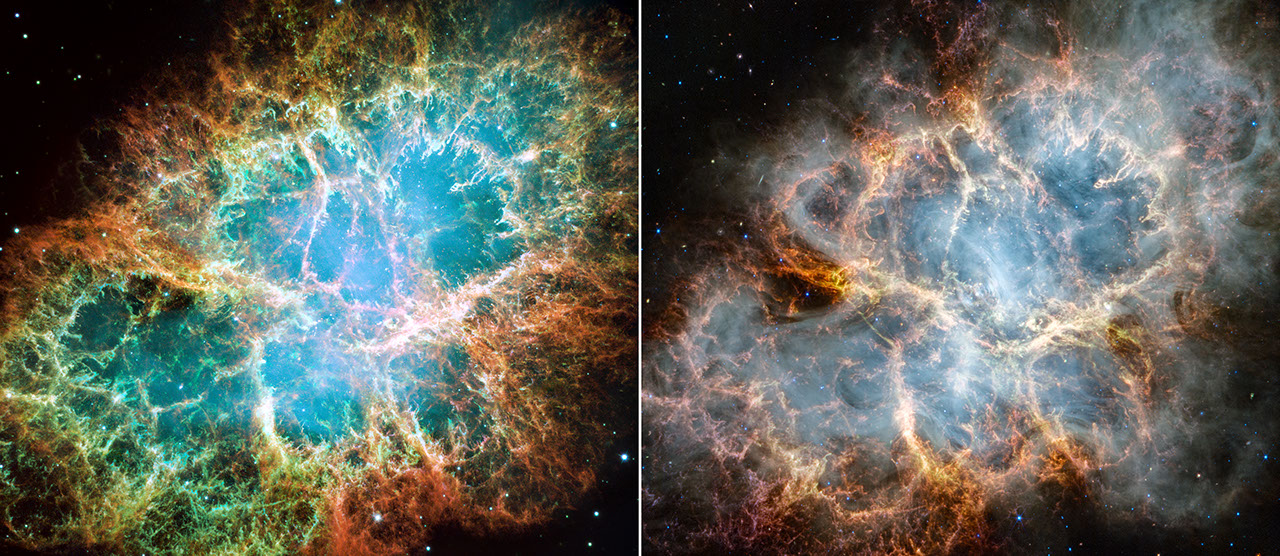
The word nebula covers many kinds of extended object. A star-forming cloud such as the Orion Nebula and a supernova remnant such as M1 may both look colourful in photographs, but their histories and energy sources differ. Compare the Crab with Cassiopeia A or SN 1987A when exploring explosion aftermath. The Webb and Hubble comparison also shows why changing the observational window can alter which structures stand out. A useful comparison names the instrument and the physical question rather than ranking images solely by apparent vividness. That approach makes the gallery an observing and learning resource, not a collection of interchangeable backgrounds.
Use the page as a repeatable field reference
Before a session, note the selected time, location, target centre and expected field orientation. Afterward, record the conditions and whether you identified the field, detected the diffuse nebula or obtained a useful image. Those outcomes require different levels of evidence, and all can be worthwhile. Return to the source materials when you want to interpret a particular filament or central feature. If you are looking for a recently reported unresolved explosion instead, open Supernovae Tonight; the historical Crab remnant is not a latest-discovery alert. Keeping the identification, observation and interpretation distinct lets you revisit M1 with clearer expectations and compare your own progress without turning archival photographs into promises about tonight's sky.