
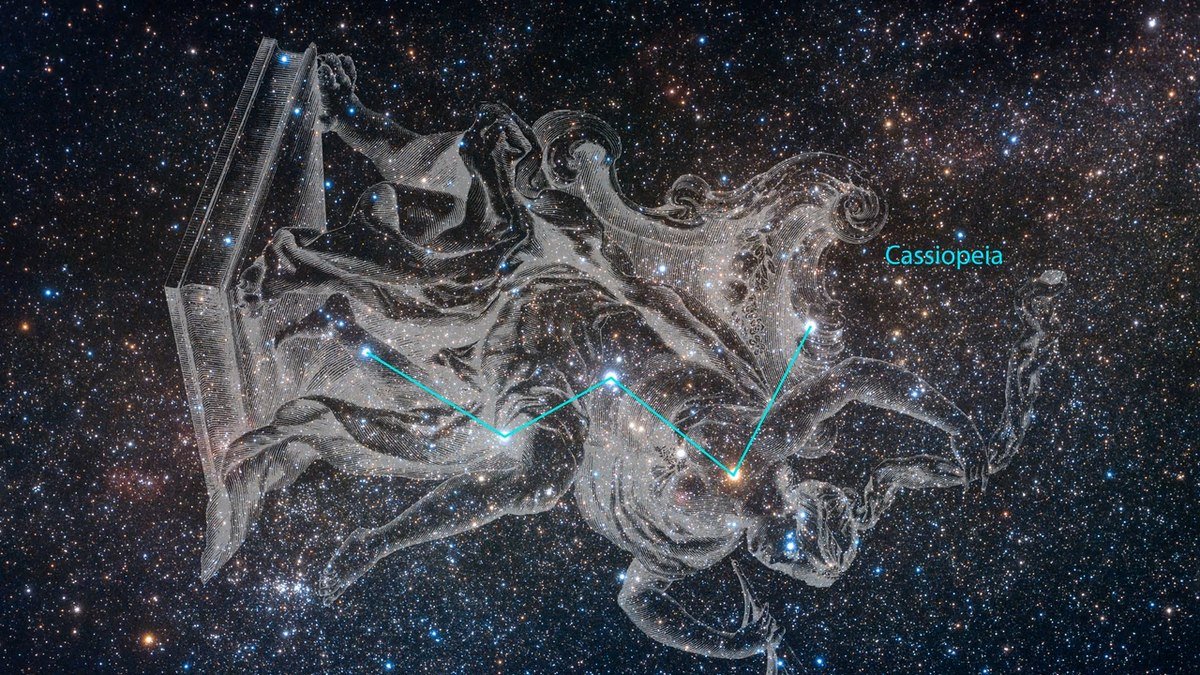
A memorable W in the northern sky
Cassiopeia is often introduced through five bright stars that form a zigzag resembling a W or an M. The letter-like appearance changes as the pattern rotates around the northern part of the sky. It is a convenient landmark, but the official constellation contains much more than those five stars. Use the map to compare the pattern with your saved observing location and selected time. The catalogue marks an approximate centre of the whole region, not a moving spacecraft or a physical centre of a star group. The Constellations & Deep Sky directory lets you compare Cassiopeia with other northern and southern regions without changing the site's location system.
Why its height depends strongly on latitude
Cassiopeia lies well north of the celestial equator. Observers at some northern latitudes can see its familiar stars remain above the horizon throughout a daily circuit, while observers farther south have a much more limited view. Whether an individual star is circumpolar depends on both its declination and your latitude. It is misleading to call the entire constellation always visible for everyone. The IAU constellation charts provide the official regional context. The live card gives a practical local estimate for the region's centre, while individual target coordinates are preferable when planning a telescope observation near your horizon.
Identify the pattern by its relationships
Caph, Schedar, Navi, Ruchbah and Segin are useful named guide stars for the familiar zigzag. If the pattern looks like an M rather than a W, do not discard the identification; compare the relative spacing of the stars and the nearby sky. Start with a whole-sky map to locate north, then enlarge the field gradually. Many photographs and finder charts rotate north away from the top of the page, so an image can appear unfamiliar even when it shows the correct stars. The Constellations Visible Tonight guide is a useful companion for recognising regional patterns before searching for a smaller object.
A route into richer star fields
Cassiopeia sits in a part of the sky associated with rich Milky Way star fields. Binoculars can reveal many more stars than you see without optical aid, especially under a darker sky. Begin by sweeping slowly between the visible zigzag stars rather than pointing immediately at a demanding nebula. A wide field helps you preserve the pattern while noticing smaller concentrations. Nearby clusters and clouds have their own catalogue coordinates and should be selected individually. The Deep Sky Object Explorer can search object entries by the Cassiopeia abbreviation Cas, allowing you to move from the constellation as a broad address to a particular cluster or nebula as an observing destination.
The constellation and Cassiopeia A are different
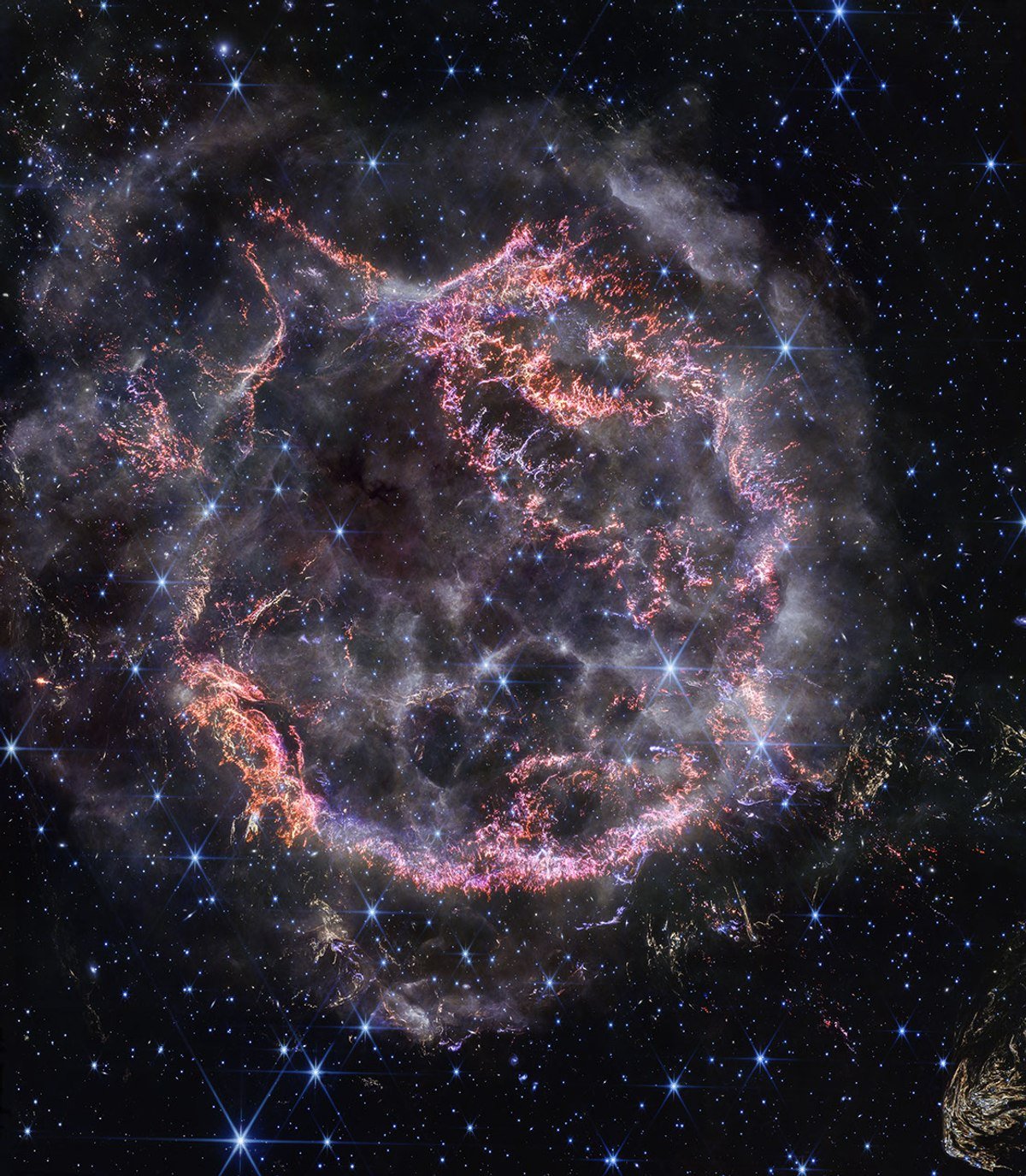
Cassiopeia A is a supernova remnant located in this sky region. It is not the W-shaped constellation, and it is not a newly announced explosion that can be assumed to be visible tonight. Scientific images show material associated with an exploded star, using instruments and wavelengths that reveal structure far beyond a simple visual chart. The NASA Webb Cassiopeia A feature explains the infrared observations illustrated here. These images help describe the science of the region. They should not lead a beginner to expect a bright colourful ring in binoculars while looking at the five familiar stars.
What infrared colours mean
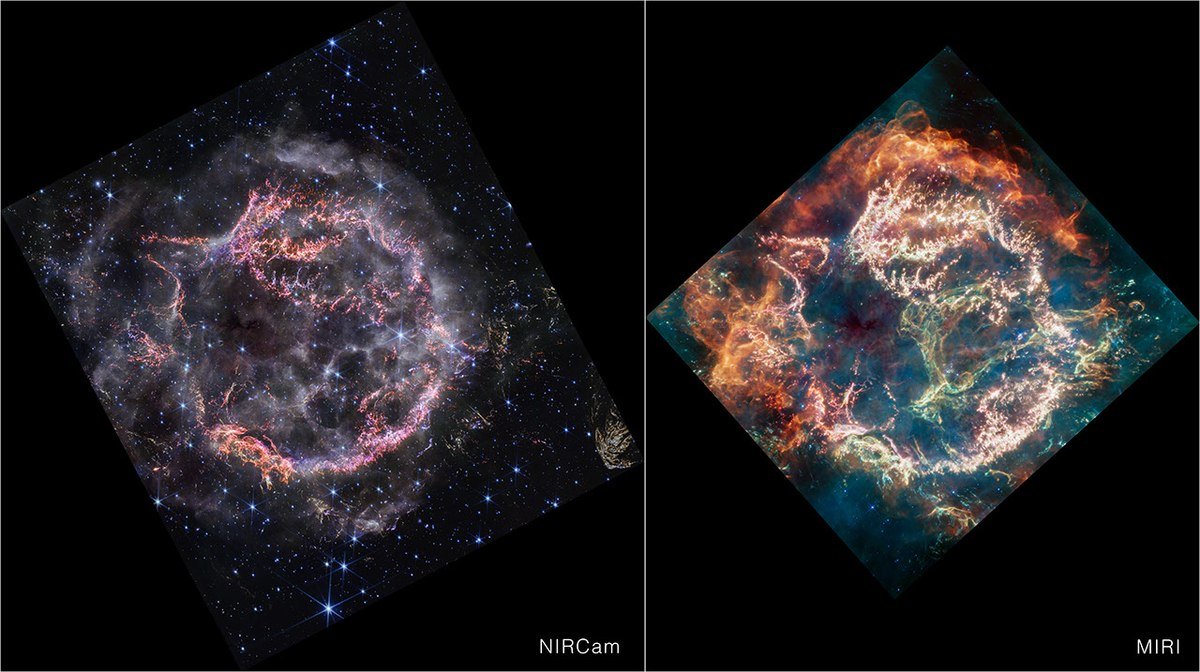
A Webb image converts different infrared bands into visible colours so that the data can be displayed and compared. Human eyes do not directly see those infrared wavelengths. Differences between a near-infrared and a mid-infrared image can reveal different material or processes, rather than a sudden change in the object between two ordinary photographs. The comparison figure on this page is useful for learning that distinction. Read its caption and follow the source for the instrument details. For another example of wavelength-dependent structure, compare the Andromeda Galaxy guide, where a galaxy's dust and stars can take on a different emphasis in an infrared observation.
Selecting a useful local time
Because Cassiopeia is a northern region, its evening height can vary substantially as it circles the celestial pole. A low passage may be blocked by your local horizon even if a high passage is excellent. Tonight selects the next local nine o'clock using the browser clock. The custom date field uses UTC, and Now restores the current instant. The planning estimate samples the next twenty-four hours and chooses a qualifying hour with the representative centre at least twenty degrees high and the Sun below minus twelve degrees. Treat this as a convenient comparison between possible observing times. It does not calculate a precise rise time for the entire constellation or measure the obstacles at your site.
Keep your first equipment choice simple
Cassiopeia's larger pattern is an unaided-eye target in suitable conditions. Binoculars add context by showing fainter stars over a wide field. A telescope is useful after you have chosen a specific object, but it can make the whole pattern harder to recognise because the field is much narrower. Support binoculars against a stable surface if hand movement makes the stars difficult to inspect. Avoid looking at a bright phone display repeatedly while trying to examine faint fields. The Night Sky Tonight page can help you build a short observing list before you go outside, reducing the need for constant chart changes during the session.
Using Cassiopeia as an orientation exercise
Choose one guide star and observe how its position changes over an hour. Compare the new view with the earlier map timestamp. This helps you understand the daily apparent rotation of the sky without relying on a memorised drawing that always faces one direction. The pattern stays recognisable even while its orientation changes. If you share the exercise with a friend in another country, share the timestamp and coordinates too; their horizon view may be very different. A northern landmark is especially useful for learning why sky maps are location-dependent and why one site's astronomical directions should not be copied into another site's observing advice.
From a northern landmark to a galaxy
Once you recognise Cassiopeia, compare its placement with the surrounding Andromeda and Perseus regions in the broader map. The exact route depends on your chosen time and orientation, so use a chart rather than a fixed left-or-right instruction. The M31 observing page provides a target-specific crosshair, catalogue coordinate and guide. Distinguish identifying a constellation from detecting a faint galaxy: the latter requires more attention to darkness and contrast. The Deep Sky Objects Tonight list can suggest a brighter cluster if the galaxy is too low or the sky is washed out.
A useful record for returning observations
Record the local time, which side of the northern horizon you faced and whether the W or M orientation was easiest to recognise. Include any obstruction that limited the view. When you revisit the region at another season, these notes will make the changing placement less confusing. Do not assign a single distance to the whole constellation, since its stars lie at different distances and its apparent shape is a line-of-sight pattern. The tool's centre is equally a navigational summary rather than a physical point in space. Refer back to NASA's constellation-name reference when introducing the region to a new observer, then use the live map for the actual night.