
What this sky directory helps you do
A clear night can feel surprisingly difficult to navigate when you know only a few bright stars. This directory gives you two useful starting points: a named region of the sky and an object inside it. Begin with a constellation you can recognise, or choose a galaxy, nebula or cluster that you would like to find. The catalogue at the top is searchable even before you set a location. Once your existing sitewide location is available, the cards add local direction and altitude. Open Constellations Visible Tonight for an evening overview, or use the directory to inspect a specific region without changing your saved location.
Constellations are regions, not physical star groups
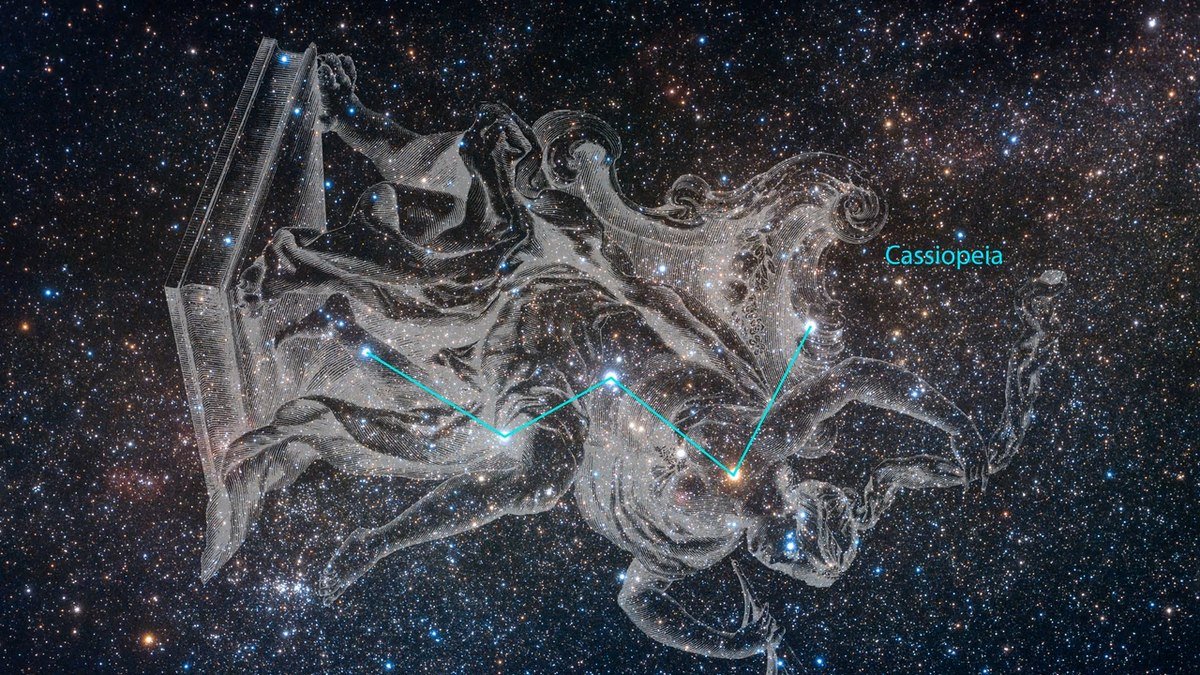
The International Astronomical Union constellation reference describes the official division of the sky into 88 regions. Those regions cover the whole celestial sphere, including parts that may never rise from your latitude. Familiar stick figures are only a convenient way to recognise bright stars within some of the regions. Their connecting lines are not physical strings, and their stars can be at very different distances. A star that seems close to another on a chart can actually lie far in front of it. Keep that distinction in mind when moving from a recognisable drawing to a scientific catalogue entry.
How the 88-constellation list works
Search by name or three-letter abbreviation to narrow the directory. Each constellation has a representative centre calculated from the Astronomy Engine constellation classification, rather than an invented star position. This centre is useful for sorting broad regions by altitude, but it is not a guarantee that every star or every corner of the region is above the horizon. Large constellations can straddle the horizon. Serpens also occupies two separate areas of sky, so its representative centre is especially limited as an observing guide. The Deep Sky Object Explorer is the better choice when you need the coordinates of an individual object rather than a regional overview.
Using the Observer Sky View
Choose Find in sky on a catalogue card to mark that target in the same style of Observer Sky View used elsewhere on SpaceTracker.live. The map shows the location and time supplied by the tool; use its own zoom buttons or a pinch inside the canvas to inspect the surrounding stars. Whole sky returns to a broad horizon view. Constellation lines make familiar patterns easier to identify, while the target label identifies the selected coordinate. The map is a chart of astronomical positions, not a camera feed or a photograph of your actual sky. It can show positions during daylight even when those objects cannot be seen by eye.
Direction, altitude and a practical horizon
The direction label tells you which part of the horizon to face. Altitude measures the angle above the astronomical horizon: zero degrees is the horizon and ninety degrees is directly overhead. These figures do not know about the building beside you, hills beyond your village, or a tree in the observing field. Choose a reasonably clear horizon and favour targets higher than about twenty degrees when possible. The near-horizon view passes through more atmosphere and often suffers greater haze. Use Night Sky Tonight to compare the wider sky before choosing a small region for a longer observing session.
Moving from patterns to deep-sky targets
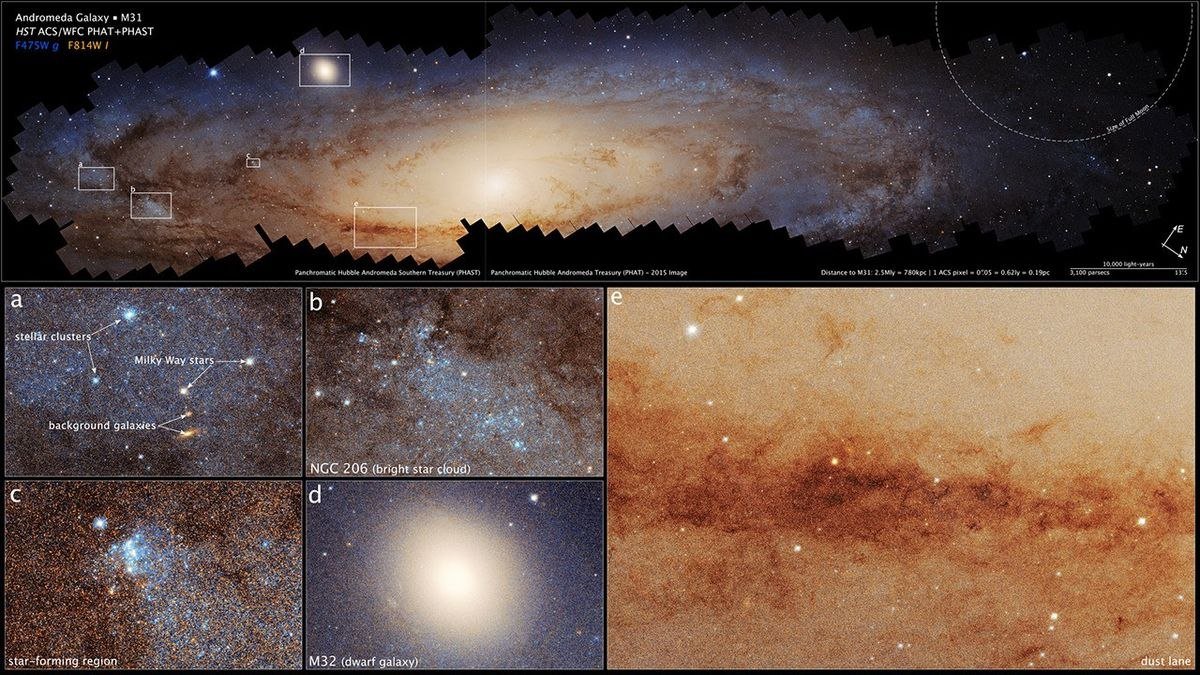
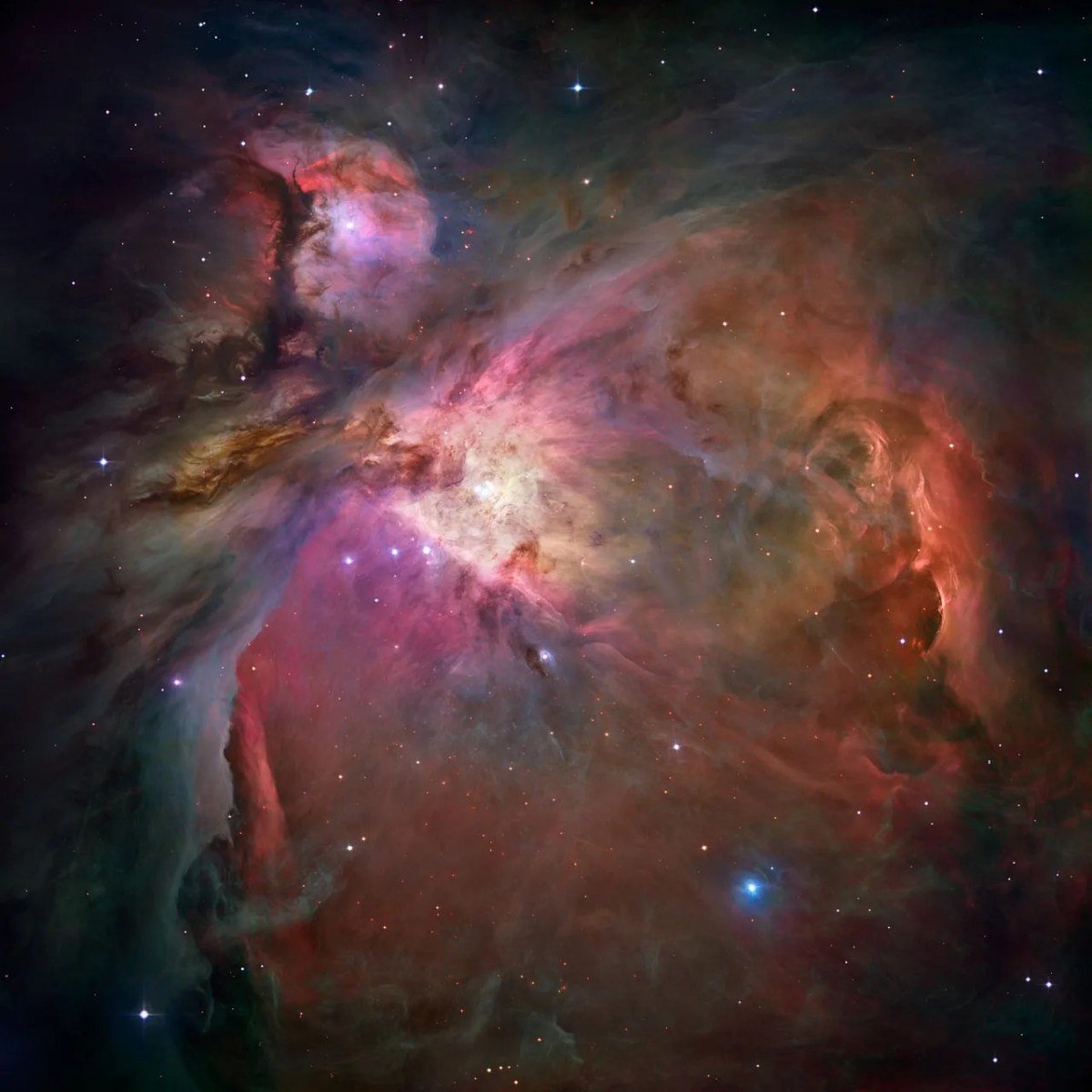
A constellation is an address on the sky, while a deep-sky object is a particular destination. The Orion observing guide helps you recognise the Belt and Sword; the Orion Nebula guide then focuses on the cloud in the Sword. In the northern sky, Cassiopeia provides a memorable W-shaped landmark. Farther toward Andromeda, a separate galaxy becomes a binocular target. This sequence is useful for beginners because it starts with a large pattern and gradually narrows the field. It also avoids trying to match a tiny telescope view to an unfamiliar whole-sky chart.
Galaxies, nebulae and clusters
Galaxies contain stars, gas and dust on a scale much larger than a single star cluster. Nebulae are clouds whose appearance can result from glowing gas, reflected starlight, or dust blocking the light behind it. Open clusters are relatively loose groupings of stars, while globular clusters are more densely concentrated. These categories matter at the eyepiece. A large galaxy can have a bright catalogue magnitude but still appear faint because its light is spread across a wide area. A compact cluster may stand out more clearly. Consult the NASA Hubble Messier catalogue for illustrated introductions to these different objects.
Choosing an observing time
The Now button shows the current sky, while Tonight selects the next local nine o'clock in the evening using your device clock. A custom date field is explicitly in UTC, so it need not have the same calendar date as your local evening. For a selected target, the opportunity estimate samples the next twenty-four hours and looks for a position at least twenty degrees high with the Sun below minus twelve degrees. This is a planning aid, not a minute-accurate culmination prediction. In particular, a sample selected near twilight may still be less favourable than one in fully dark conditions. Use the timestamp and local direction together rather than treating one label as a promise of visibility.
Equipment and realistic expectations
Start with the unaided eye to learn patterns, then use binoculars to explore wider fields before increasing telescope magnification. A stable support often improves a binocular view more than buying a more powerful instrument. For a telescope, begin with the lowest useful magnification and confirm the surrounding stars before changing eyepieces. Photographs on these pages combine light collected by scientific instruments and may show wavelengths outside human vision. You should not expect the same bright colours or small-scale detail through a modest telescope. The captions explain whether an image is a locator chart, an optical photograph or an infrared observation, so that the illustration supports the observing task rather than setting an unrealistic expectation.
Build a short route through the sky
Plan two or three targets close to one another rather than an exhausting tour of dozens of names. Choose a recognisable constellation, inspect one brighter object, and finish with a more demanding target if the sky remains clear. The Deep Sky Objects Tonight list can help rank candidates by altitude; the existing explorer can supply more catalogue choices. Record the time, equipment and what you actually saw. If a target remains invisible, a note about Moon brightness, haze or nearby lighting is more useful than simply declaring the chart wrong. Over several evenings these observations become a personal guide to what works from your own location.
Sources, precision and responsible use
The constellation names follow the IAU system and the classification code comes from Astronomy Engine. Regional centres are derived approximations. Deep-sky entries are supplied separately from OpenNGC, with catalogue credits and licence information included. The existing Gaia and named-star files support the sky background. No list here measures current transparency, cloud, local light pollution or the limiting magnitude of your equipment. If you need a specific object, inspect its coordinate instead of assuming that a whole constellation shares one rise time. For wider seasonal planning, connect these tools with the Astronomy Calendar and return to the live map on the night you observe.