
Cassiopeia A: locate a young supernova remnant
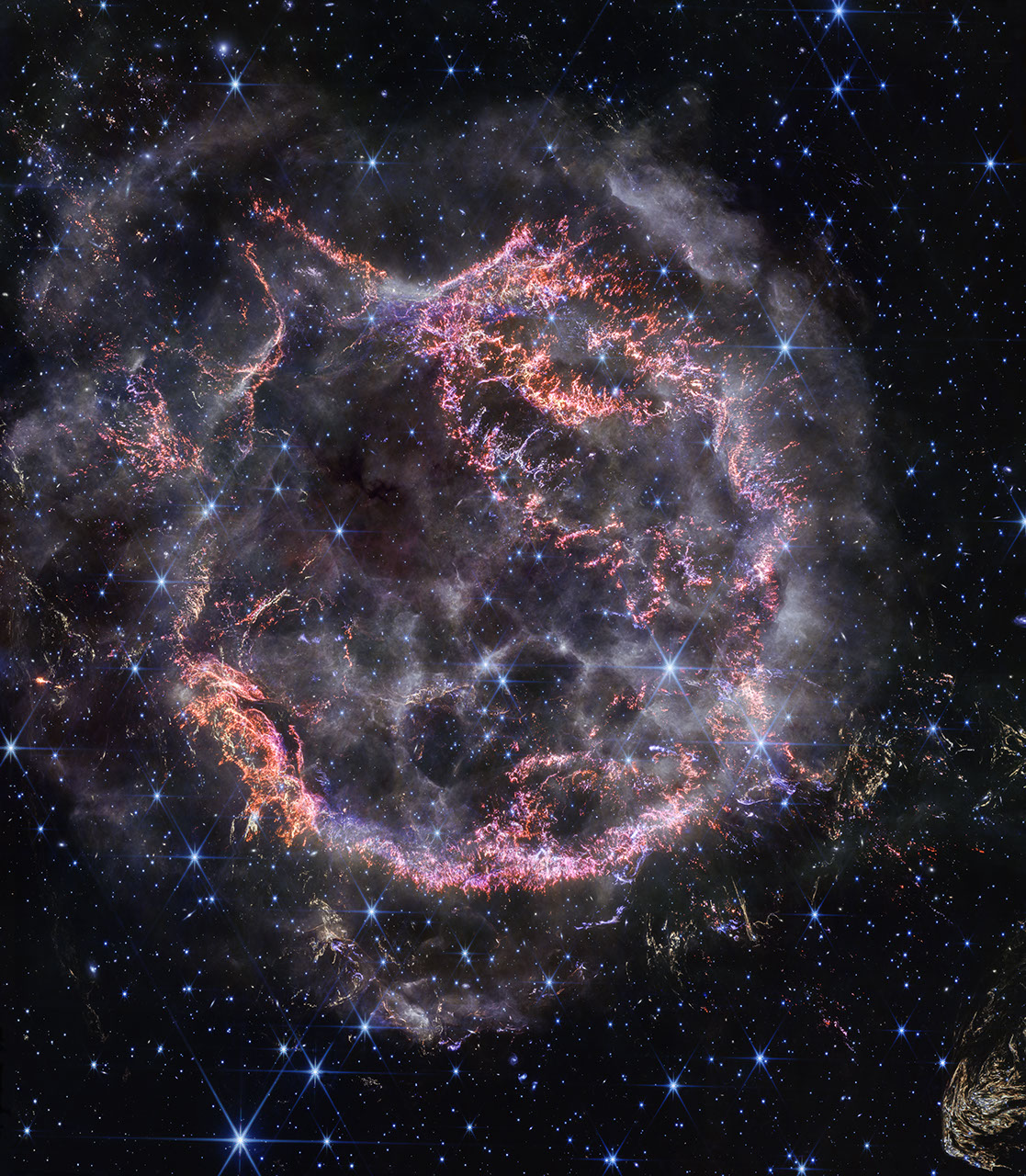
Cassiopeia A, often shortened to Cas A, is a young supernova remnant whose structure has been studied across many wavelength bands. Its scientific importance should not be confused with easy visual visibility. This page provides the reference direction, the shared Observer Sky View and three related telescope images, while explaining what each kind of information can tell you. The NASA NIRCam image record gives a reference centre in Cassiopeia and a detailed infrared observation. The circle on the chart contains a remnant symbol from the start; it does not imply that every colourful filament in the photograph is detectable through an ordinary telescope. Compare Cas A with other documented remnants before selecting an observing goal.
The name identifies a source, not the whole constellation
Cassiopeia A is one particular remnant in the sky region called Cassiopeia. It is not another name for the constellation's familiar star pattern. The Cassiopeia constellation guide helps establish the broader region, but the remnant still needs its own coordinates and finder information. This tool uses an approximate reference centre appropriate for the whole-sky chart. A small marker at that centre does not outline the extent of the debris or point to an individual knot. For a narrow scientific field, use the precise astrometry and orientation of the original observation. Keeping the constellation, the remnant and the detailed structures separate prevents a common mistake: recognising the large star pattern and assuming the difficult remnant must therefore be an obvious visual object beside it.
The shell records an uneven explosion and environment
Cas A's images show a structured debris system rather than a perfectly smooth sphere. Ejected material and surrounding matter interact, and the resulting emission depends on local conditions and the wavelength being observed. Bright knots, filaments and diffuse features should be read with the source caption rather than assigned one generic meaning. A detailed image can reveal relationships that disappear in a broad chart. The marker here therefore remains simple and stable while the gallery supplies the resolved view. If you notice a bright feature in one image but not another, check the instrument and filters first. Differences may reflect sensitivity to different material, processing choices or field coverage, not proof that the feature appeared or vanished between observations.
Infrared observations reveal a different window
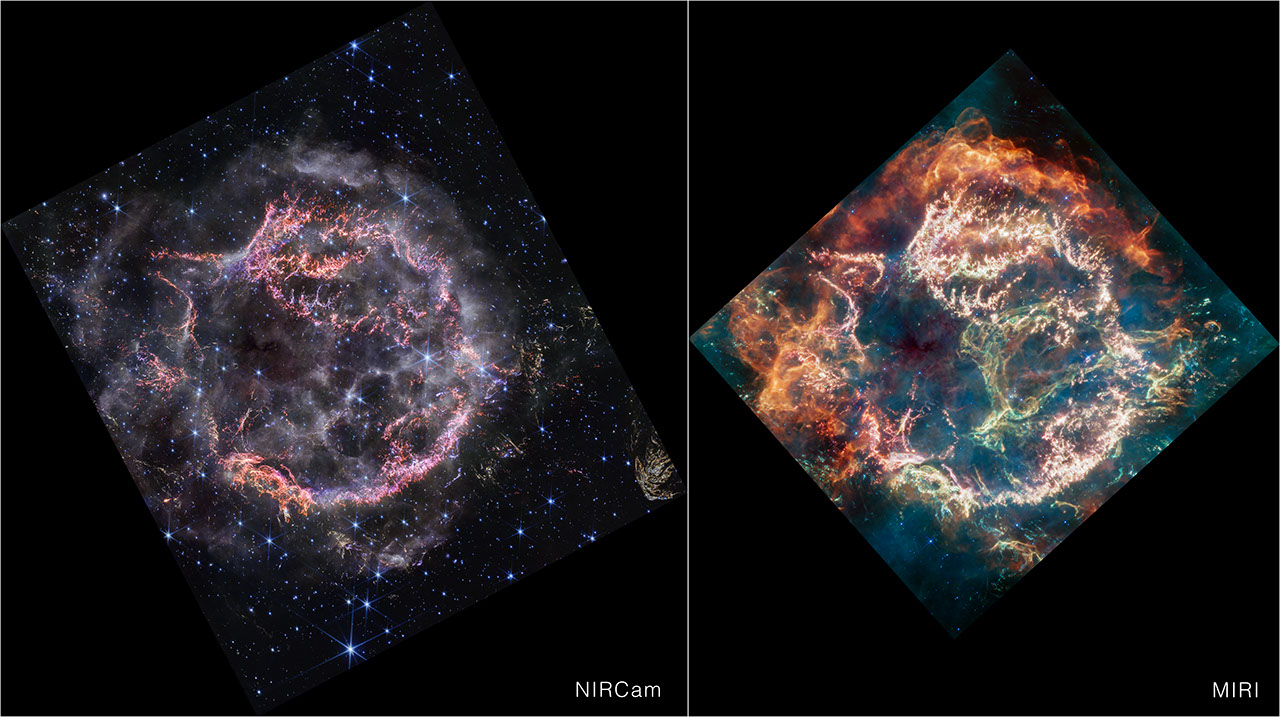
Webb's near-infrared and mid-infrared instruments provide complementary views of the remnant. They need not emphasize the same knots or diffuse structures, because their observing bands sample different kinds of emission. The NIRCam and MIRI comparison makes that distinction explicit. Read the wavelength information and colour assignments before interpreting the display as natural visible colour. An image's sharp detail is a result of the observing system and processing, not a promise that increasing the website's zoom reproduces the same view in your eye. Use the whole-sky map for direction and the instrument images for structure, with each kept on its own stated scale.
Light echoes require a geometric explanation
An old flash can illuminate or heat dust away from the original explosion site, producing a light echo. Apparent changes in illuminated structure should not automatically be interpreted as the travel of the same parcel of gas at the speed suggested by a screen animation. The flash, surrounding geometry and observing dates all matter. Source material linked from the Webb release about Cas A provides context for discussing features around the remnant. This tool does not animate an echo or calculate the expansion of the ejecta. Its time controls change the remnant centre's local altitude and azimuth, while the photographs remain identified as archival observations. That separation is useful when explaining why a dynamic physical object can still use a stable catalogue locator.
Do not confuse research significance with visual brightness
Cas A is a major radio, infrared and X-ray reference target, but those observational windows are not the same as ordinary visible-light observing. A colourful space-telescope image may be easier to appreciate than the object is to detect with a backyard setup. Begin with the goal of locating the field and understanding the published data, rather than assuming the image's displayed brightness corresponds to a convenient eyepiece target. The catalogue does not fill a current visual magnitude with an invented value. Its remnant label and position note preserve the distinction. For more familiar visual reference work, explore the Crab Nebula guide; for recently reported unresolved supernovae, use the discovery directory and inspect actual photometry.
Check local direction and seasonal access
The shared location setting determines how the northern reference direction appears from your observing site. Different latitudes can produce very different daily paths, including long periods near the horizon or a direction that remains above it. Use the displayed altitude and bearing instead of assuming that a northern constellation is equally accessible everywhere. Buildings, hills and trees can still block a mathematically positive altitude. The tool's highest sampled dark-sky opportunity is an estimate based on ten-minute checks, not an inspection of your actual horizon or weather. Compare the chosen evening with Night Sky Tonight and keep the UTC input distinct from local clock time. A careful location and time check is more useful than repeatedly trying to select the marker during a drag.
Compare optical knots with the infrared shell
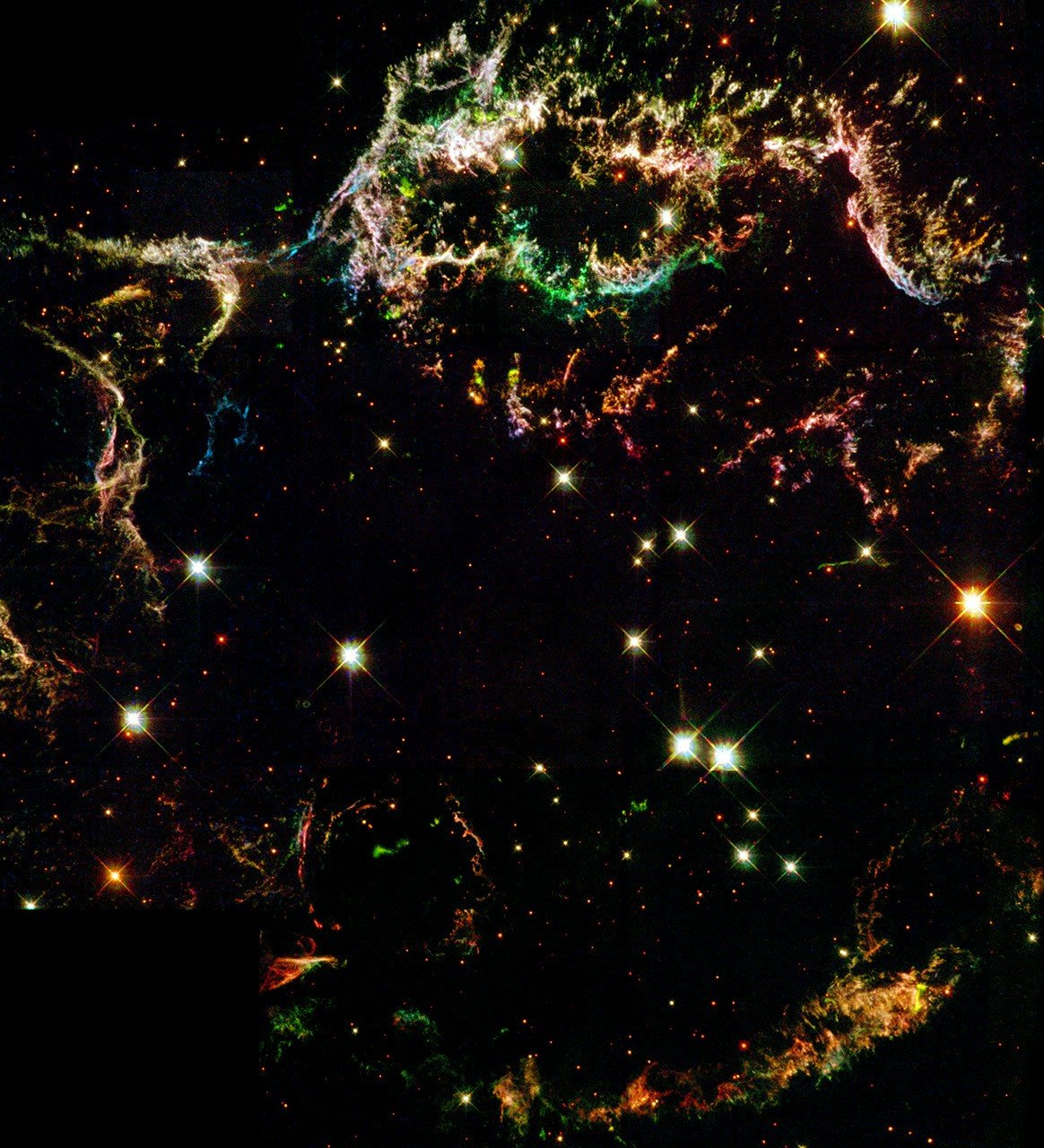
An optical observation and an infrared observation can show different parts of the same remnant with strikingly different emphasis. The Hubble reference image offers an additional window for the gallery. First align the approximate orientation and coverage, then read each caption to understand which features are being emphasized. Do not infer a physical absence merely because a component is weak in one band. If you make a presentation or observing note, retain the instrument, source and observing date with each photograph. A comparison with those details is reproducible; a collage with no wavelength information can make several genuine observations appear contradictory even when they are describing complementary physical processes.
Keep the guide connected to verifiable evidence
Use this page as an introduction and locator, then follow the credited source when you need an exact scientific interpretation. The reference coordinate does not replace the astrometry of a research image, and the small symbol does not encode distance, energy or current brightness. Save the selected location and time with any direction-based note so another observer can reproduce the geometry. To place Cas A within a wider story of stellar aftermath, compare SN 1987A and the remnant directory. Their differences in environment, observational history and wavelength coverage are more informative than a simple ranking by apparent colour. Clear labels let the map remain useful while the articles and images provide the depth that a tiny crosshair cannot carry.