
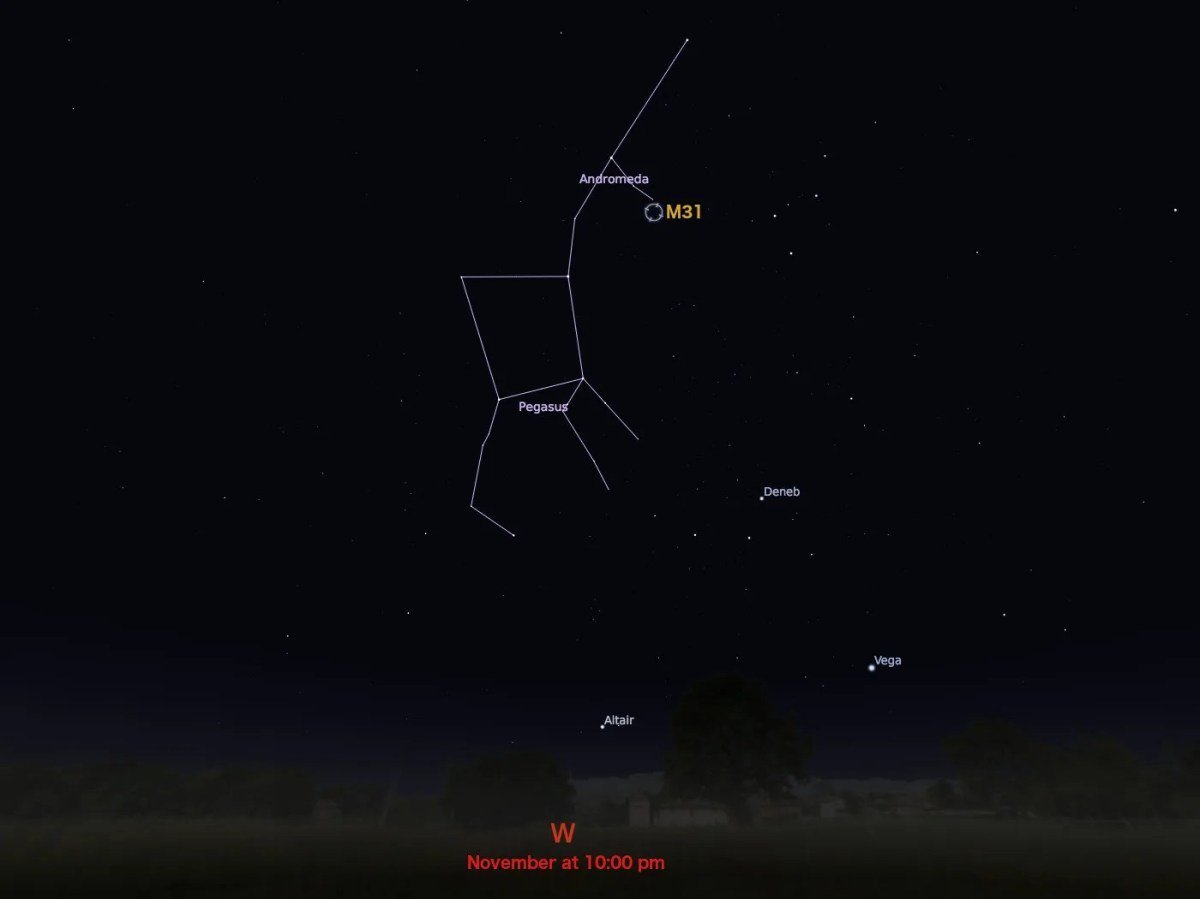
A nearby galaxy that rewards a dark sky
The Andromeda Galaxy is one of the most rewarding deep-sky targets because finding it connects a small visual glow with an enormous external stellar system. It is also called Messier 31 or M31, and its principal NGC catalogue entry is NGC 224. The selected target on this page uses that catalogue coordinate. Set your observing location through the existing site header, then compare the direction and altitude before heading outside. The Deep Sky Objects Tonight list provides alternative targets if M31 is poorly placed, while the constellation directory supplies the broader regional context.
Galaxy versus constellation
Andromeda is both the name of a constellation and the usual name of this galaxy, but the two refer to different things. The constellation is a defined region on the celestial sphere containing many objects at different distances. M31 is a particular galaxy seen in that direction. It lies roughly two and a half million light-years from Earth, according to NASA's Messier 31 reference. That distance gives its faint visual glow a different meaning from a nearby cluster. A light-year measures distance, not the age of the object or the time until something happens to it.
What you can reasonably expect to see
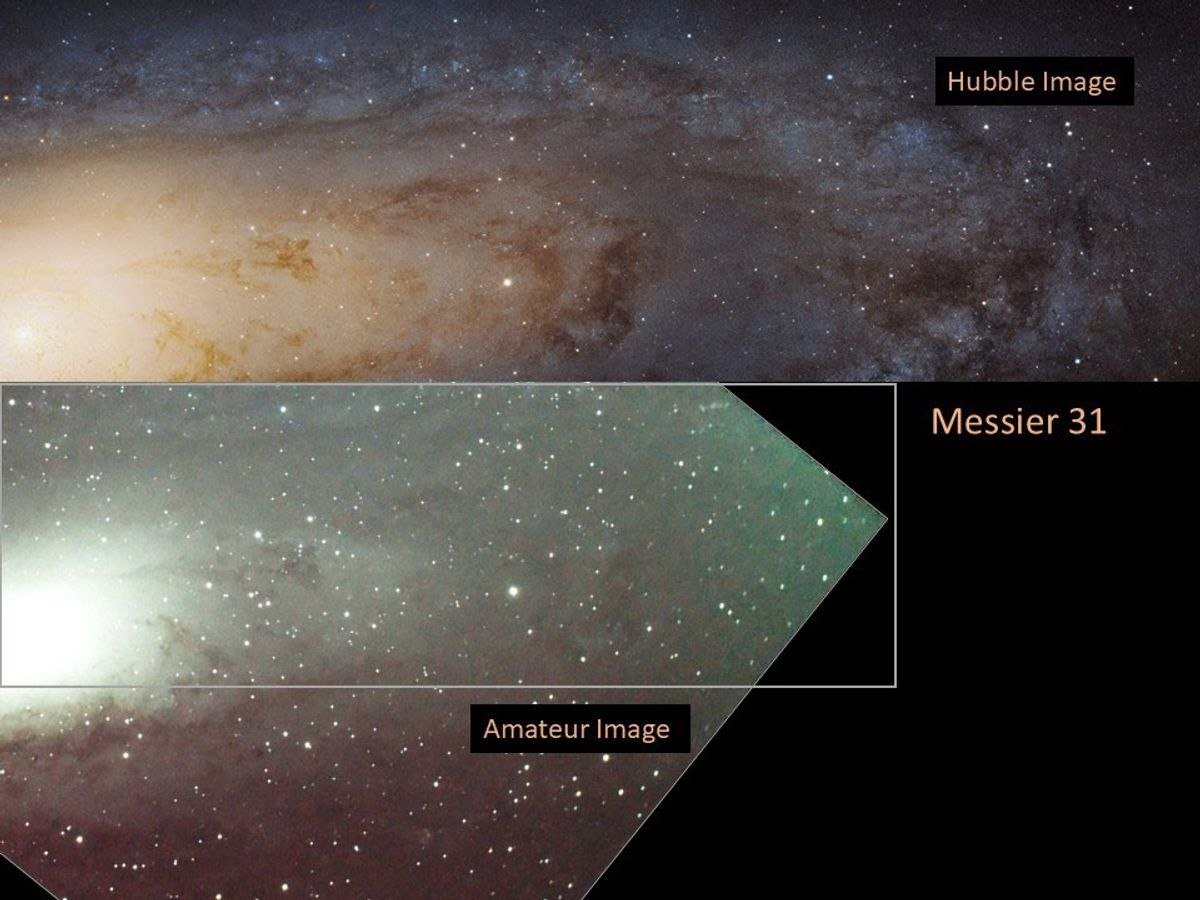
Under a sufficiently dark sky, experienced observers can detect M31 without optical aid. Many observers begin more successfully with binoculars because their wider field helps reveal the central glow and surrounding star field. Urban sky brightness, haze and moonlight can make the observation much harder. Do not expect to see the colourful panoramic structure of a processed telescope photograph. The brighter central region is usually the easier visual feature; the much fainter outer disk is more demanding. A modest but convincing grey patch in the correct field is a successful identification. Describe what you actually see rather than borrowing the appearance of a space-telescope image.
Find the correct field first
Begin with recognisable stars and use the Observer Sky View to follow the selected coordinate. If you already know Cassiopeia, compare its position with the broader northern sky instead of relying on an instruction such as always move left from the W. The pattern's orientation changes with the hour and your latitude. A separate archival finder chart appears in the article as a reference, but the live chart is the better guide to the present local horizon. Telescope finders can invert or mirror the field. Match a few nearby stars before increasing power, and check the target's altitude if the supposed field sits behind a building or tree.
Catalogue brightness is not surface brightness
The local catalogue lists an integrated visual magnitude near 3.4 for M31. That number combines light from an extended source and does not mean the galaxy will resemble a magnitude-three star. The light is spread across a large area of the sky, with the nucleus and inner region much easier to detect than the faint outer portions. A bright background can hide those outer areas even when many stars remain visible. This explains why a smaller telescope at a dark site can give a more satisfying wide-field galaxy view than a larger instrument under strong light pollution. The catalogue explorer can compare magnitude and angular-size fields, but neither field alone guarantees detectability.
Choosing magnification and field of view
Start at low magnification. M31's extended apparent size makes a wider field useful for seeing how the central glow relates to the surrounding stars and brighter parts of the disk. Increasing power can help inspect a small central region, but it also removes much of the wider context. Binoculars provide a particularly accessible introduction when supported steadily. If using a telescope, check the eyepiece field before expecting the whole galaxy to fit. The catalogue's major and minor angular dimensions are reference measurements rather than a boundary that every observer can see. The visually detectable size changes with sky darkness, equipment and experience.
When to look from your location
Use the current altitude to decide whether M31 is high enough for your local horizon. Low targets often suffer more extinction and haze. Tonight picks the next local nine o'clock; the UTC date field allows a different session time. The selected-target planner samples the next twenty-four hours for a height of at least twenty degrees and a Sun altitude below minus twelve degrees. It then reports the highest qualifying sample. This gives a useful approximate opportunity but not an exact transit prediction or a weather forecast. Compare the result with Night Sky Tonight, and favour genuinely dark conditions when you want to inspect the faint outer disk.
Why different images look different
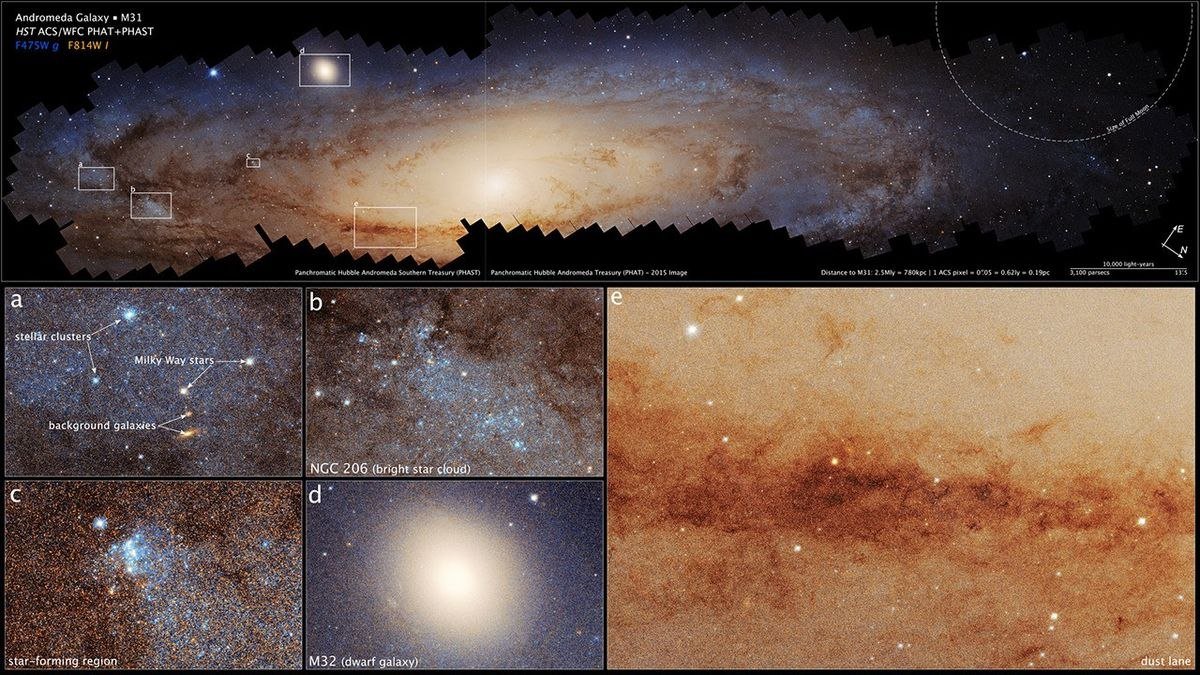
The images accompanying this guide illustrate different observing scales and methods. A locator chart teaches position, a panoramic scientific image reveals resolved regions, and an infrared view highlights structures differently from ordinary visible light. None is a current camera view from your location. NASA's WISE image of Andromeda is useful for understanding that wavelength changes the appearance of stars and dust. Infrared colours are assigned for display. Read the caption before treating an image's colours as an explanation of what a human eye would see through a telescope.
A large galaxy contains many observing scales
A distant galaxy can appear as one small glow to the eye while containing a wide range of structures that scientific telescopes resolve. Broad images can show a disk and dust lanes; more detailed images can separate crowded star fields and stellar groupings. These are different scales of the same target, rather than competing descriptions. The catalogue coordinate on this page marks a central reference position. It does not supply a labelled live map of every internal cluster or dust lane. Use the guide as an introduction and follow the linked scientific source for detailed research imagery and its instrument information.
Compare M31 with a nebula
The Orion Nebula offers a useful comparison on an appropriate night. Both may begin as hazy patches in a visual observing session, yet M31 is an external galaxy and M42 is a star-forming cloud within our own galaxy. Their photographs can look similarly spectacular while their distances, scales and physical meanings differ greatly. Learning to identify them by catalogue coordinate and surrounding field avoids relying only on the visual impression of a fuzzy patch. Record the instrument, magnification and sky conditions for both. The comparison can reveal how strongly contrast, angular size and central concentration shape an actual observation.
Avoid confusing positional precision with visibility
The page transforms the catalogue's J2000 direction to the chosen date and then computes local horizon coordinates with Astronomy Engine. Those steps improve the consistency of the map, but they cannot measure whether your eye detects the galaxy. The position can be valid during daytime while the target is effectively invisible visually. A below-horizon bearing is an orientation aid, not evidence that the galaxy shines through the ground. Nearby terrain and buildings are not included. Treat the coordinate calculation as one part of planning and your actual sky assessment as another. If needed, change the session time and choose a brighter or higher object from the list.
Keep a repeatable observing note
A good first record needs only a few details: the local time, equipment, approximate magnification, nearby field stars and the shape of the glow you identified. Add whether the central region was obvious and whether any wider extension was convincing. On another night, compare the notes under a darker sky instead of judging success by a photograph. Returning observations teach you what your own location and equipment can reveal. Connect the session with the Astronomy Calendar for future planning, and retain the live map's timestamp when sharing your result. The original source and credit links remain available beside the images for readers who want to explore the scientific view more deeply.