
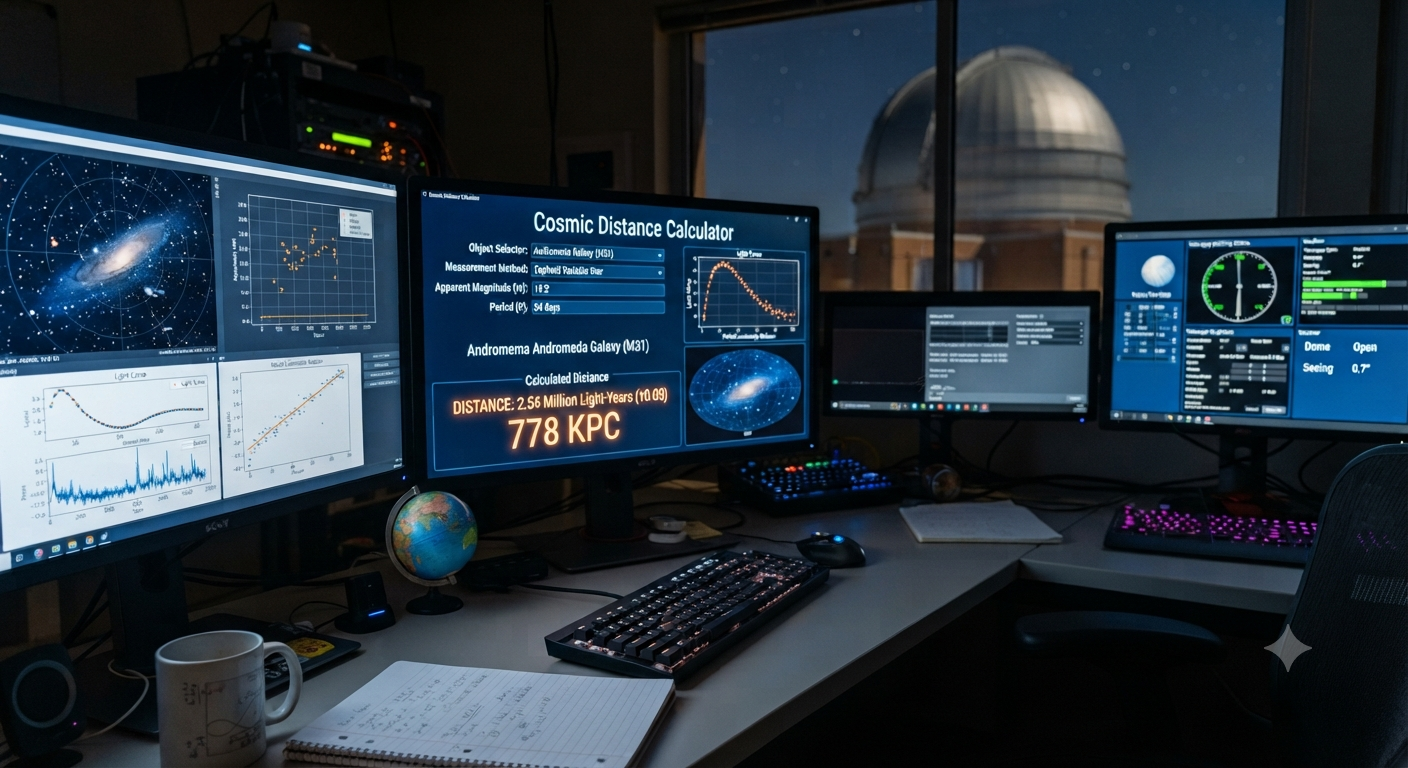
How the Astronomy Distance Converter works
Astronomy changes units as the scale changes. Kilometres are useful near planets, AU across planetary systems, light-years for intuitive stellar distances and parsecs for much professional astronomy. The converter expresses one physical distance in kilometres, miles, AU, light-years and parsecs using fixed unit definitions. The calculator runs locally in your browser, so the numerical inputs do not need to be sent to a remote calculation service. If you are building a complete observing or imaging setup, use the Light Travel Time Calculator alongside this page rather than treating one number in isolation.
Worked example and interpretation
One astronomical unit is about 149.6 million kilometres; one parsec is about 3.26 light-years.
For broader physical context, the NASA/JPL Solar System Dynamics is a useful external reference.
When this calculator is useful
Use the converter when reading mission data, comparing star catalog values, translating education material or moving between Solar System and interstellar scales.
When the result involves angular size, field, observing conditions or a current target, continue with Angular Size Calculator. For a different but related perspective, Deep Space Trackers can connect the formula to an actual observing, telescope or Solar System context.
What the visual diagrams are showing
The diagrams are intentionally schematic rather than decorative photographs. They show the variables that drive the calculation and the direction of the relationship between them. That makes them useful while reading the formula: you can identify what is fixed, what is changing, and which output should respond.
Assumptions, accuracy and practical limits
A unit conversion does not make a distance current. Orbital distances change with time, and cosmological distances use definitions that a simple converter cannot replace. Inputs should therefore be treated as measurements with finite precision, not exact mathematical truths. Rounding in the result cards is chosen for readability. If you are comparing two setups, keep the unit definitions and reference conditions the same on both sides.
A second external cross-check is available from NASA Universe. For professional observatory work, spacecraft operations, calibrated photometry or published scientific analysis, use the instrument documentation and specialist software appropriate to that task.
Read a distance in several units
Enter 1 astronomical unit and compare kilometres with light-years and parsecs. Changing the display unit changes the numerical scale, not the physical distance. Pin a result before trying a much larger distance.
Related SpaceTracker.live tools
Continue with Light Travel Time Calculator, Angular Size Calculator and Deep Space Trackers.
Worked scenarios: putting familiar distances on one scale
Each scenario uses the converter's constants (1 AU = 149,597,870.7 km, 1 ly = 9.4607 × 10¹² km, 1 pc = 3.0857 × 10¹³ km).
- Earth to Moon (mean): 384,400 km is 0.00257 AU, or 1.28 light-seconds. Kilometres are the natural unit here.
- Earth to Sun: 1 AU is 149,597,871 km, about 0.0000158 ly and 8.32 light-minutes (499 s), which is why the Sun's light is about eight minutes old.
- Sun to Neptune: about 30.07 AU is 4.50 billion km, or 4.17 light-hours. AU is the right unit for planetary systems.
- Proxima Centauri: about 4.2465 ly is 1.30 pc, 268,553 AU and 40.2 trillion km.
Choose the unit that gives a number between roughly 0.1 and 10,000. Use the Light Travel Time Calculator to see the same distances as delays.
Quick unit relationships
| Unit | In kilometres | Convenient for |
|---|---|---|
| 1 AU | 149,597,871 | Planets, asteroids, comets |
| 1 light-year | 9.4607 × 10¹² | Nearby stars |
| 1 parsec | 3.0857 × 10¹³ | Stellar catalogues |
| 1 parsec in light-years | 3.2616 ly | Converting catalogues |
| 1 light-year in AU | 63,241 AU | Scale of the Oort Cloud |
Common mistakes
- Confusing a light-year with time. It is a distance of about 9.46 trillion km.
- Mixing parsecs and light-years. One parsec is about 3.26 light-years.
- Treating a converted distance as current. The converter changes units; it does not fetch a new position.
Frequently asked questions
Is a light-year a time unit here?
No. It is a distance: the distance light travels in a Julian year in vacuum.
Does converting a planet distance make it current?
No. The converter transforms your input; it does not fetch a new planet position.