ISS vs Tiangong: Space Stations, Orbits and Local Passes
Compare the ISS and Tiangong as orbiting laboratories, then learn why their ground tracks and viewing opportunities differ.
Use the same observer location and time window when comparing ISS and Tiangong passes. Their orbital inclinations, timing and brightness behaviour differ, so one station’s pass is not a proxy for the other. Location-specific predictions make the comparison more meaningful than a general orbit diagram alone.
They share a category, not an orbit
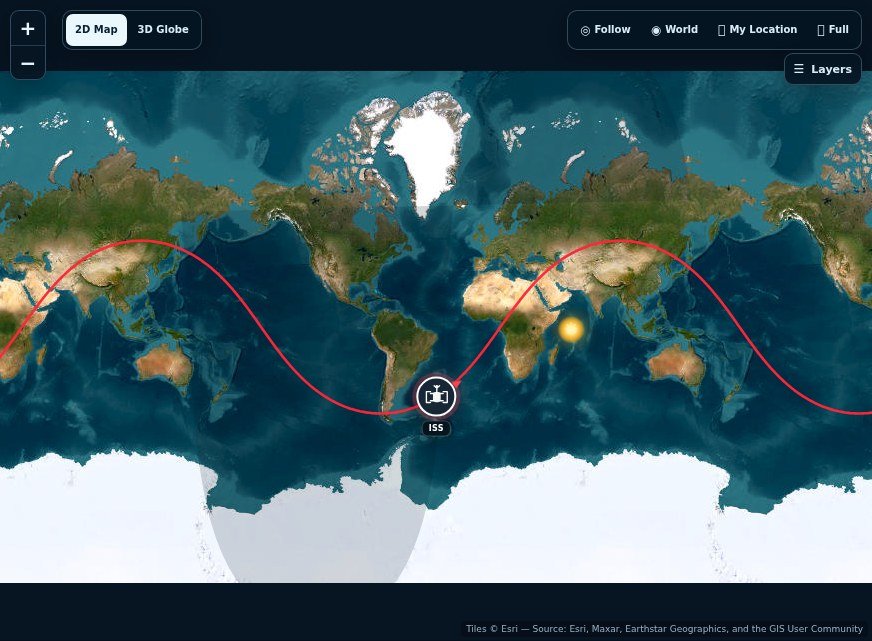
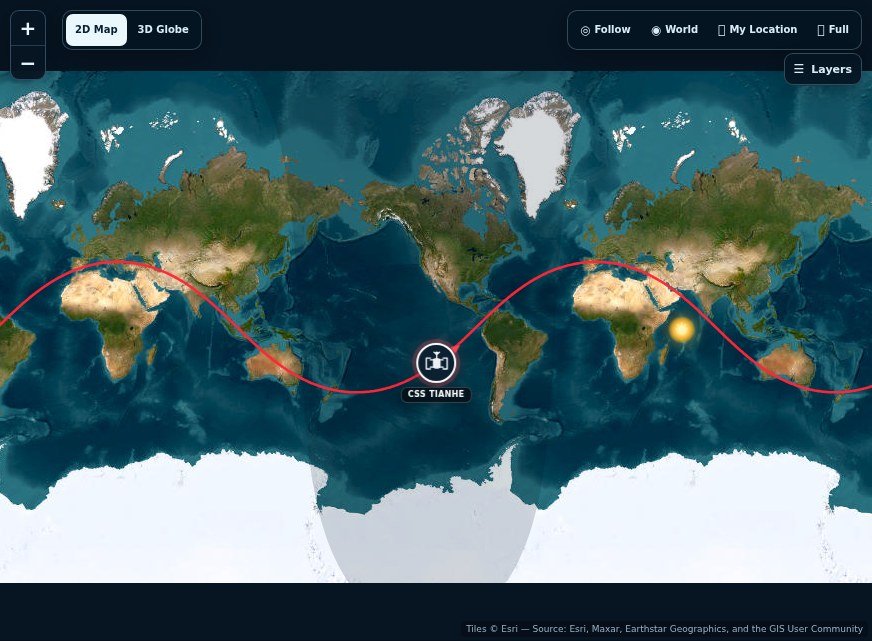
Both are crewed laboratories in low Earth orbit, but they are separate spacecraft with independent orbital planes, schedules and mission programmes. Seeing one does not tell you when the other will pass. Open the ISS and Tiangong trackers side by side and the difference becomes immediate: their ground tracks cross different latitudes at different times.
Size affects brightness, but geometry still wins
The ISS is larger and is often exceptionally bright. Tiangong can also be visible, yet its apparent brightness depends on range, illumination and orientation. Avoid using brightness alone as identification. The predicted time, travel direction and smooth motion together provide a stronger match than a single impression of how luminous the point appears.
Use the same workflow for both
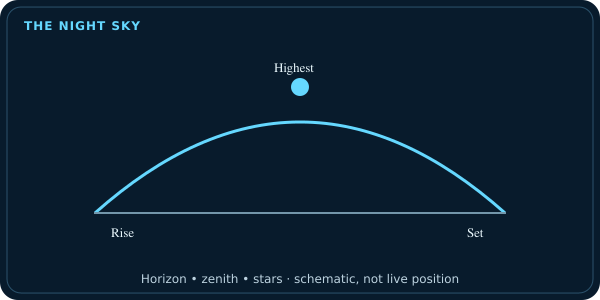
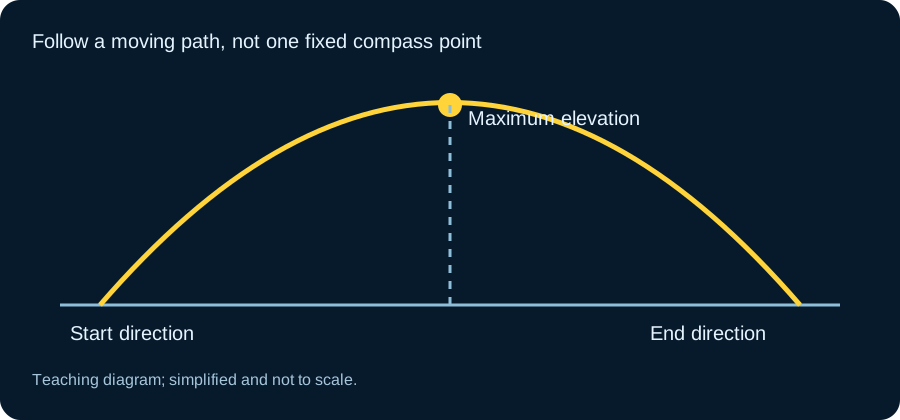
Set one accurate observer location, note each next-pass time and compare maximum elevation. Go outside early and face the predicted direction. If two passes occur on the same evening, they are an excellent practical lesson: the observer remains fixed while different orbital planes sweep different paths across the local sky.
Inclination changes the geographical pattern
The ISS and Tiangong occupy different orbital planes and have different inclinations. That affects the latitude range of their ground tracks and the elevation from a particular observing site. Neither circles directly over every inhabited place. A station can still be visible from beyond the latitude of its ground track, however, because an observer looks across a three-dimensional horizon rather than only straight upward.
For that reason, avoid deciding visibility from your latitude alone. Use the individual station's local prediction. An observer farther from the track may get a lower, more distant pass; another may see a high crossing. These differences also change apparent motion and the effect of haze. Reading elevation and direction is more useful for a real sighting than assuming the larger station must always be the better target on any given evening.
Brightness does not measure the work inside
Both stations are laboratories and living environments, but a naked-eye observation reveals reflected sunlight rather than their scientific activity. The ISS is often an especially conspicuous target, yet its appearance depends on the pass. Tiangong can also be seen under suitable conditions. The observer's distance, lighting angle and background sky all influence how either station looks.
It is tempting to turn a brighter sighting into a comparison of technological achievement. That conclusion does not follow from the observation. A science experiment, docking operation or crew task is not visible as a change in a moving point of light. Use official mission information to learn what happens aboard each station. Let the tracker answer the spatial question: where the selected station is and how its orbit relates to your sky.
Try a two-station observing notebook
For each opportunity, record the predicted peak height, the actual time you noticed the station and how much of the route you could follow. Also note cloud, trees and the part of the sky affected by streetlights. Over several evenings, you will see that geometry often explains the difference between an easy sighting and a disappointing one.
If you want to observe both in one session, allow enough time to change direction and recheck the second forecast. There is no universal order in which the stations appear. Keep the phone brightness low and memorise each starting landmark before the event. Afterward, compare the records without treating an unseen pass as a failure of the station. A consistent method makes the experience more interesting and gives you a practical understanding of two distinct orbits.
Compare a pass from one observing place
To make the comparison meaningful, keep the same observer location and time zone when you inspect both stations. Record the next geometric pass, its predicted maximum elevation and the compass direction of its highest point. Do not compare an ISS prediction for one city with a Tiangong prediction for another. The geometry of an orbit may produce an excellent pass for one region and none during the same evening for a different region.
Even if both stations are above the horizon, neither is guaranteed to be visible. Sunlight on the spacecraft, local twilight, cloud cover and nearby obstructions determine whether a person can spot it. The ISS and Tiangong are human-made orbiting laboratories; neither should be mistaken for a fixed star. An ordinary naked-eye sighting looks like a point of light moving across the sky, not a resolved image of a station module.
Why the numbers are not interchangeable
Each station has its own orbital plane, altitude variations, operating history and set of orbital records. Select the actual spacecraft by its catalog identity before reading the calculated ground track. A displayed altitude is not a measure of scientific capability, and an orbital speed alone says nothing about how many experiments are underway. Crew assignments, station visits and mission activities require separate official updates.
When sharing screenshots, label the spacecraft and capture time. A map with two similar icons can imply an encounter that is not taking place: projections compress a three-dimensional scene onto a flat world. A useful comparison uses the current orbital data for position, the official program pages for operations, and a local sky prediction when the question is about seeing a station from home.