Starlink Train Tonight in the USA: How to Find and Track It
Learn what a Starlink train looks like, why newly launched satellites spread out, and how to track Starlink passes from your U.S. location.
If you are searching for a Starlink train viewing times in the United States viewing opportunity—or you saw a line of bright lights moving across the U.S. night sky—it may have been a recently deployed group of Starlink satellites. The familiar “Starlink train” is a temporary phase, not how the constellation looks forever. Use the SpaceTracker.live Starlink tracker to inspect individual satellites and upcoming passes from your location.
A Starlink train is mainly a post-launch configuration, not the permanent appearance of the constellation. Recent launch context and pass predictions help determine whether a group of lights is still travelling together or has already dispersed into more widely separated operational orbits.
Is a Starlink train visible tonight in the USA?
There is no single nationwide yes-or-no answer. Visibility depends on your location, the timing of recent deployments, orbital geometry, sunlight and local sky conditions. A train may be well placed for one part of the United States while another location sees nothing useful at the same time. The best approach is to check recent Starlink objects and pass geometry for your location.
Open the live Starlink tracker →
What does a Starlink train look like?
A newly deployed group can appear as many points moving in roughly the same direction and following a similar path. To an observer it may resemble a string of pearls or a moving chain of lights. The spacing changes with time as the satellites separate and maneuver toward their operational orbits.
Why does the Starlink train spread out?
After launch, satellites do not remain permanently packed together. Their relative spacing increases as they progress through orbit-raising and operational deployment. That is why the spectacular close formation seen shortly after some launches becomes less obvious later. Eventually, individual satellites are distributed around their assigned orbital planes and no longer resemble one compact train.
What time will Starlink pass over me?
Use a location-specific pass prediction. “Starlink over the USA tonight” is too broad because the country spans multiple time zones and thousands of miles. Enter your location in the tracker, select a satellite, and compare the next passes. Higher elevation passes with favorable lighting are usually easier to observe.
Can you see operational Starlink satellites with the naked eye?
Sometimes. Individual operational satellites can be visible under suitable conditions, but they are often much less dramatic than a fresh post-launch train. Brightness varies with geometry, altitude, spacecraft orientation and sunlight. A geometric pass therefore does not guarantee a conspicuous visual sighting.
Starlink train versus airplane
A Starlink group normally moves smoothly and silently across the sky without the red and green flashing navigation lights associated with aircraft. Airplanes may appear to blink, change apparent speed or direction, and can sometimes be heard. If you see many evenly moving lights following the same track, a recently deployed satellite group becomes a stronger possibility.
For a deeper comparison, read how to identify Starlink without confusing it with an aircraft.
How to track Starlink from your location
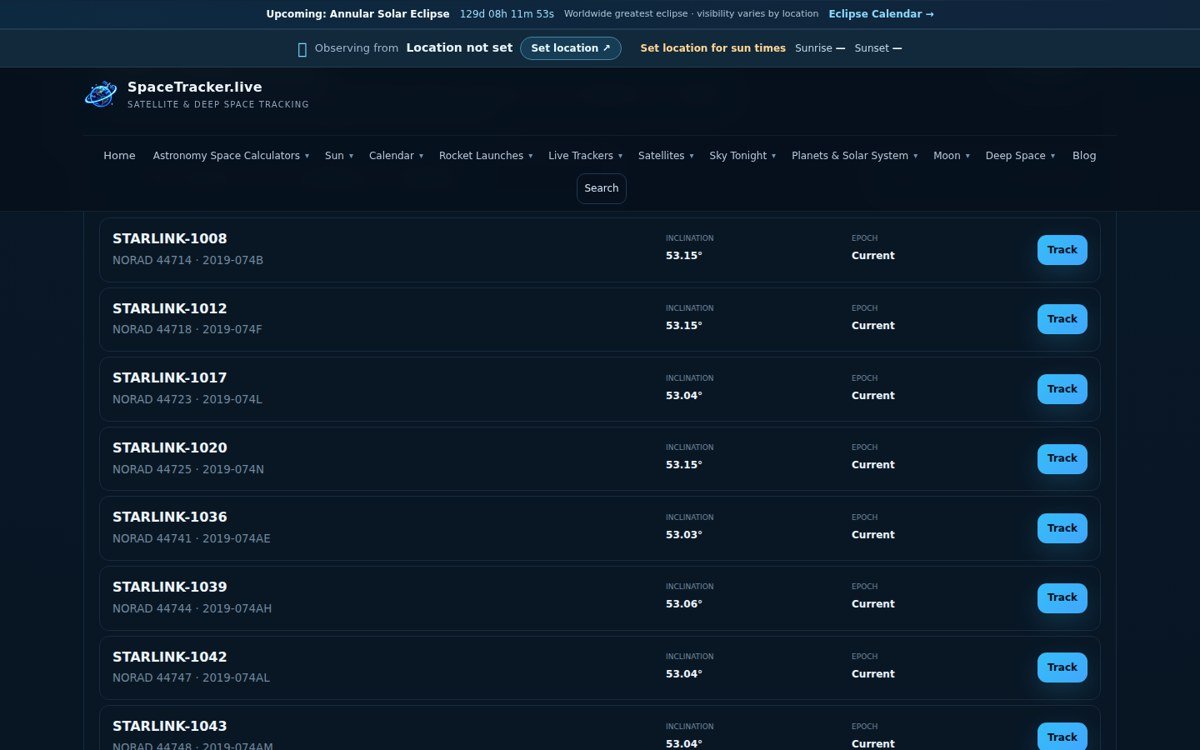
- Open the Starlink tracker.
- Choose a satellite or recent object from the directory.
- Set your observer location.
- Review upcoming pass time, direction and elevation.
- Go outside early and scan the expected path with your unaided eyes.
Why a predicted train may disappoint visually
A tracker can correctly predict that several objects will cross your sky while the actual lights remain difficult to see. Satellite brightness depends on sunlight, orientation, observer distance, atmospheric transparency and sky glow. A recently launched group seen from a dark location can be dramatic; the same geometry under haze or strong city lighting may produce little or nothing visible.
Use the pass-prediction tool for your location and read Azimuth & Elevation Explained before going outside. If only one or two lights are visible, the Starlink vs aircraft guide gives additional identification clues.
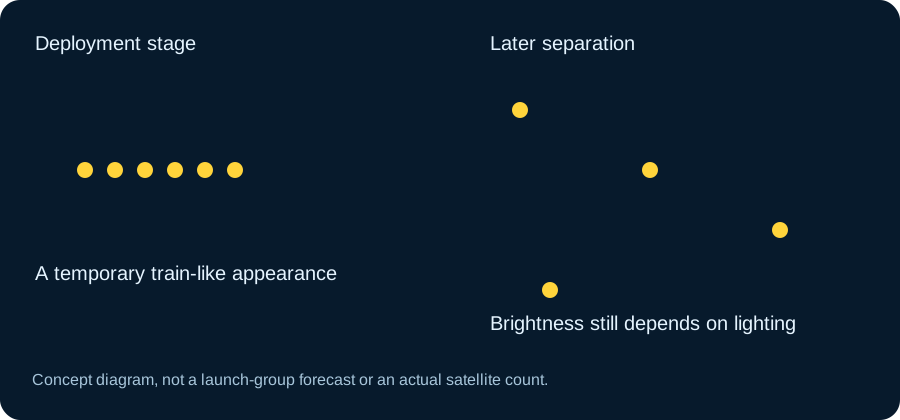
A newly launched Starlink train can appear as a conspicuous sequence, while operational satellites become more widely separated. Use recent launch context and a location-specific prediction before assuming that any line of moving lights is an active train.
Use orbital data to verify, not appearance alone
Record the exact local time and direction of motion, then compare them with the predicted Starlink path. This is more reliable than assuming every line of lights belongs to one constellation. Other satellites, aircraft and even perspective effects can create superficially similar patterns.
A train is a temporary stage of deployment
A newly deployed group can produce a memorable line of moving lights, but that appearance is not a permanent arrangement of the constellation. Spacecraft separate and move toward their operational configurations. The visible pattern evolves with time after deployment and with the geometry of your observation. A video of one launch group cannot describe every Starlink pass on a later night.
This is why the most useful search begins with a current pass list for your location. Check the selected objects and their times rather than relying on an old clip. A group can be above the horizon while lacking the lighting needed for a dramatic sighting. The phrase 'train tonight' should be treated as a local viewing question, not as a promise that a long, bright line will appear everywhere after every launch.
Apparent spacing is not a measuring tape
The distance between points in your sky view depends on range and viewing direction as well as the satellites' real separation. Objects approaching along a common route can look compressed together, then spread across more of the sky. A phone camera's field of view further changes the impression. Count and angular spacing in a clip are therefore not enough to reconstruct a deployment without additional information.
If you make a record, include the start time, observing location and broad direction of travel. Note whether the objects followed the same path or merely appeared near each other. Comparing those details with identified catalog entries is more useful than estimating orbital distances from the video. The observation can document a striking pattern while leaving the exact group identification open until it is supported.
Operational satellites can appear as separate passes
Once a group has spread out, observers may see individual objects at different times instead of a continuous parade. Some can be faint or unseen under local conditions. The constellation still exists even when its members are not obvious to the naked eye. An orbit map answers where cataloged objects are; it does not guarantee their brightness.
Choose a few clearly identified targets rather than trying to follow the entire constellation at once. Record their catalog numbers when saving predictions. Names can be similar, and a neighbouring entry can have a different pass. This gives you a manageable observing plan and avoids the confusion of switching objects while keeping a previous direction or time in mind.
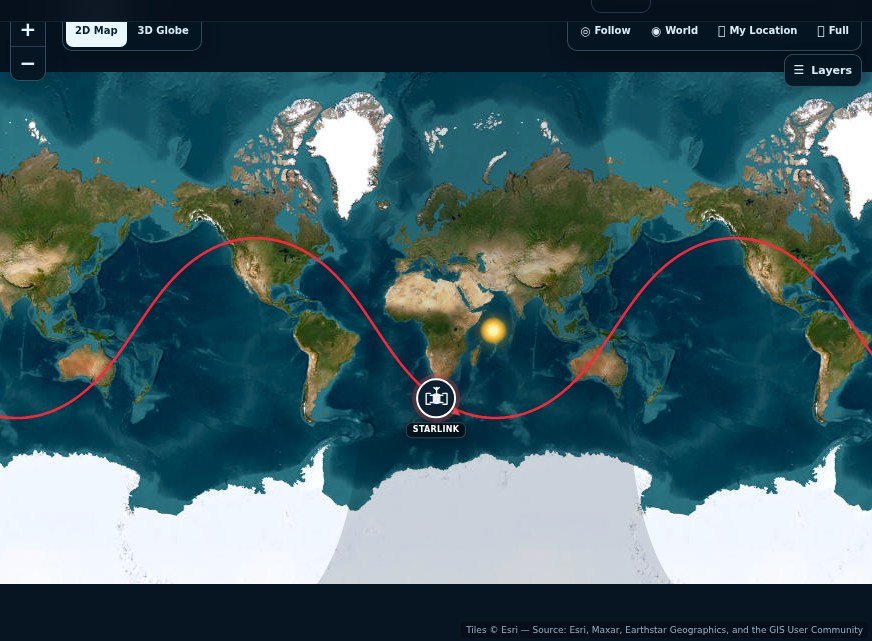
What to do after seeing a possible train
Write the details while they are fresh: time zone, direction, approximate duration and whether the lights flashed. Aircraft, camera artefacts and other objects can create confusing patterns, so check more than one clue. If the prediction agrees with both the timing and route, the identification becomes stronger. If it does not, keep the description factual instead of forcing the sighting into the Starlink label.
On a future session, compare the same local sky with a more spread-out operational set. You will see why deployment history and viewing geometry both matter. The contrast is not evidence that satellites vanished or switched off their ordinary navigation lamps; the familiar visible points are reflected sunlight. Understanding that temporary pattern makes the train interesting without presenting it as the constellation's everyday permanent appearance.
Frequently asked questions
Is every line of lights Starlink?
No. Other satellite deployments and aircraft can create confusing patterns. Use timing, motion, flashing behavior and a tracker before concluding that a sighting is Starlink.
How long does a Starlink train stay together?
There is no fixed visual lifetime. The formation changes as satellites separate and maneuver, so the compact train is most associated with the period after deployment.
Why can I see a predicted Starlink pass but no satellite?
Pass geometry alone does not guarantee visibility. Illumination, brightness, cloud, haze and local light pollution matter.
Is Starlink visible from cities in the United States?
It can be, especially during favorable bright passes, but darker skies and a clear horizon make faint satellites easier to detect.