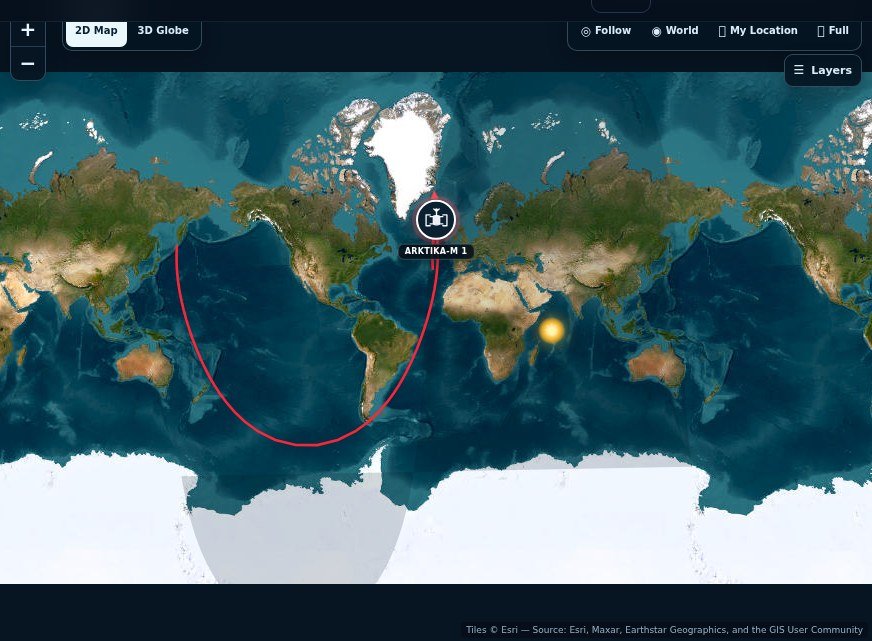
How Accurate Are Live Satellite Trackers? A Clear Guide
A tracker is a time-dependent orbital calculation, not a direct camera feed or guaranteed optical sighting.
Tracker accuracy is easiest to judge when the comparison is controlled. Use the same satellite, timestamp and coordinate reference on both services, and note the age of the orbital data before comparing positions. CelesTrak’s GP-data documentation explains the records commonly used for Earth-orbit propagation.
“Live” usually means calculated now
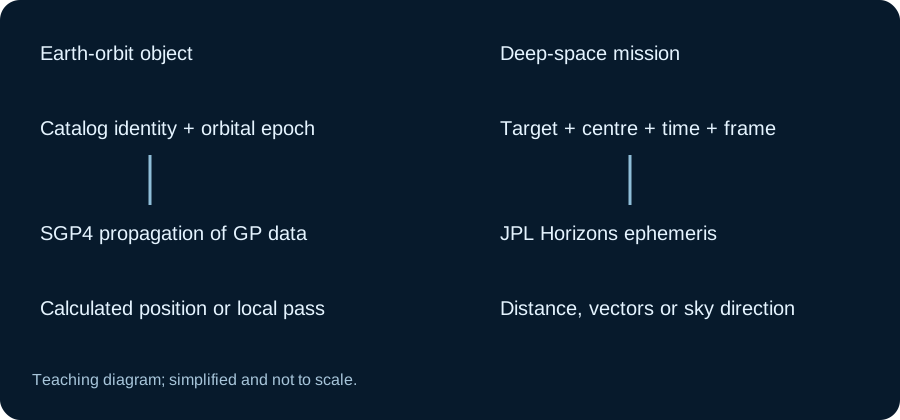
Most public satellite trackers do not receive a continuous position broadcast from every spacecraft. They obtain an orbital record and propagate it to the current time. The moving marker can update every second, but its foundation is a model tied to data with an earlier epoch. That is still useful—provided the distinction is clear.
Accuracy is not one number
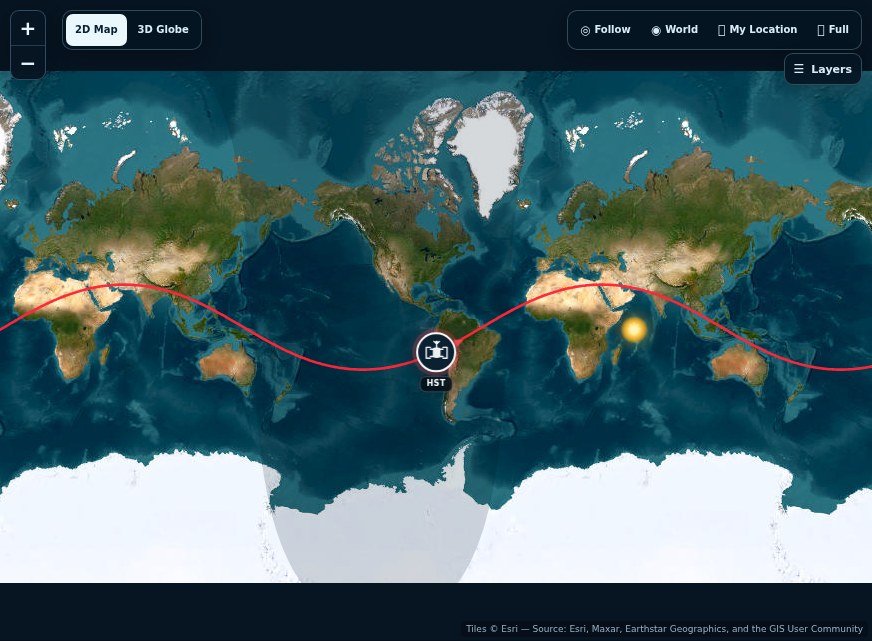
A map position, predicted pass time and naked-eye sighting have different error budgets. Orbit data age, atmospheric drag, manoeuvres, numerical implementation, observer coordinates and map projection all contribute. A tracker may show a convincing global path while local horizon timing exposes a small error more clearly.
Low orbit changes quickly
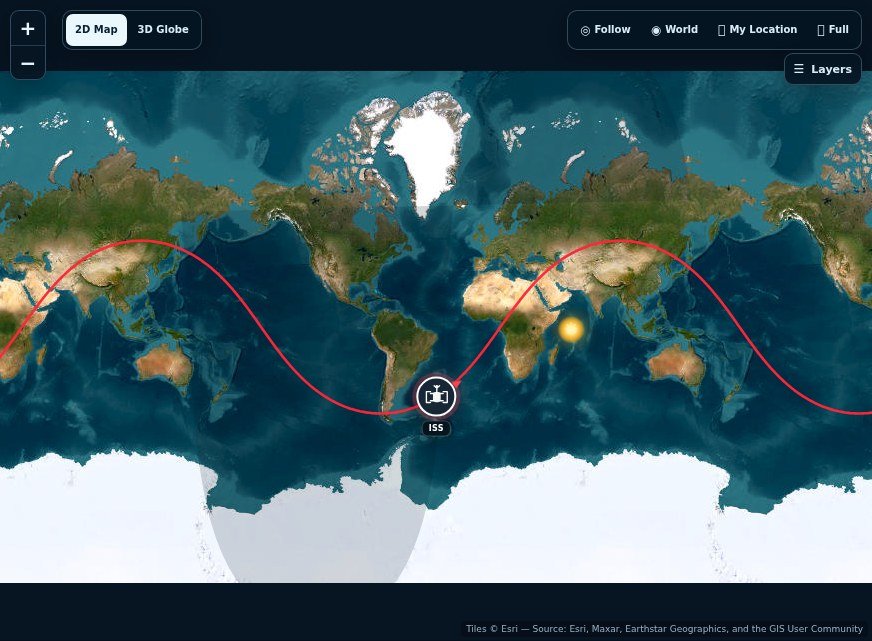
Atmospheric drag is variable and stronger for lower objects. Spacecraft may also perform planned or unannounced manoeuvres. Fresh orbital elements generally improve near-term prediction, while extrapolating far beyond the epoch increases uncertainty. Recalculate rather than relying on an old saved result.
Deep space needs another standard
Interplanetary pages use ephemerides with explicit reference centres, frames and timestamps. Their public values may be cached and the visualisation may compress scale. A screen position should therefore not be mistaken for mission-control telemetry or precise navigation suitable for operations.
A practical trust checklist
Check the displayed timestamp and object identity, confirm your observer location, distinguish geometric from visible passes and compare with an official mission source when a current event matters. Use public trackers for education and observation planning—not aviation, maritime navigation, collision avoidance or emergency decisions. Good tracking is transparent about both its data and its limits.
Decide which kind of accuracy matters to you
A classroom map, a naked-eye sighting and a precision radio experiment do not need the same error budget. For an evening observation, you usually care about a useful time window, starting direction and peak elevation. For antenna pointing or detailed orbit analysis, small angular or timing differences can be much more important. A tracker should be assessed against the question you are asking, not against an undefined promise that every marker is perfectly exact.
Separate the calculated satellite position from the displayed picture. The coordinates may update more often than the browser redraws the line. A map can also enlarge the marker so it remains readable. The visible icon therefore occupies far more space than the spacecraft. Comparing the icon's outer edge with a city boundary is not a measurement of orbital accuracy. Use numerical values and their timestamp when you want a meaningful comparison.
An orbital epoch is not the last page refresh
The epoch belongs to the orbit record. It states the reference time for the supplied elements, while the propagation time states when the software calculates the position. Reloading a page can produce a fresh-looking display while still using the same older element set. Check whether the interface exposes both times, and avoid treating a moving seconds counter as proof that the source orbit was recently updated.
Age alone is not a universal error estimate. Atmospheric drag, maneuvers and deployment activity affect how quickly a particular prediction becomes less representative. A recently launched object raising its orbit can behave differently from a stable spacecraft with similar data age. If your planned observation matters, obtain a fresh forecast and confirm the object identity. A simple rule such as 'all elements are accurate for a fixed number of days' leaves out too much of the orbital context.
Compare services at one reproducible instant
Choose the same NORAD identifier, calculation time, observer coordinates and frame before comparing two sources. If one display shows the present second and another screenshot is several minutes old, their different positions are expected. Likewise, Earth-centred coordinates cannot be compared directly with local altitude and azimuth. These values describe the same object from different viewpoints.
For a local pass, write down the appearance time, maximum elevation and ending direction from both services. Check whether either applies an elevation mask or an illumination filter. That can explain different durations without implying a faulty orbit. If a substantial disagreement remains, preserve the data epochs and settings. This is much more useful for diagnosis than a statement that two world-map markers were in different places when the pages were opened.

Use observations to test the forecast fairly
An observed pass gives you evidence, but the record needs context. Note the time you first saw the object, its direction and any obstruction. First visibility through a gap in trees is not necessarily geometric rise. A sudden fade is not necessarily set. Distinguishing those events helps you avoid judging a prediction against a different physical event.
If a station appears close to the expected route and time, the forecast has served a practical viewing purpose. It does not prove centimetre-level accuracy. If you see nothing, inspect weather, darkness and illumination before assuming the satellite was elsewhere. When the evidence genuinely conflicts, share the selected object, exact time and settings so another observer can reproduce the test. Clear reporting is a better response to uncertainty than either blind confidence or dismissing every calculation.
A pass-time comparison you can reproduce
Choose a known satellite identifier and one observing place. Record a prediction for its next horizon crossing, maximum elevation and set time. Before the event, refresh the orbital data and repeat the same calculation. A small adjustment may reflect a newer element set or a difference in numerical sampling. To judge the result fairly, observe in a clear part of the sky and record when the object becomes visible and when it disappears, allowing for trees, rooflines and twilight.
There is a distinction between a geometric horizon crossing and the instant you first notice a faint moving point. A satellite can rise above the mathematical horizon while still being obscured by the landscape or difficult to see against a bright sky. Comparing a calculated rise time directly with the first visible sighting therefore does not measure only orbit-model error. The practical uncertainty includes conditions at the observing site.
Data age is not the entire accuracy story
A freshly downloaded orbital record may still be a poor prediction after an unmodelled manoeuvre. Conversely, a stable object may remain reasonably well described over a useful interval. Drag matters more for low orbits, and prediction quality depends on the object, the record and how far into the future the result is propagated. “Updated seconds ago” can describe when a server fetched a record without revealing the record's epoch.
For a careful comparison, keep object identity, the exact timestamp, reference frame and observer coordinates fixed, then change only the data source or epoch. Note whether the pages report estimated positions or direct measurements. Public educational trackers are excellent for learning and skywatching, but they are not a suitable substitute for operational collision avoidance or safety-critical navigation.