TLE and SGP4 vs JPL Horizons: Satellite Tracking Explained
Earth satellites and interplanetary missions require different data models, reference frames and expectations.
Choose the data model according to the object being tracked. TLE with SGP4 is widely used for Earth-orbiting artificial satellites, while JPL Horizons is suited to solar-system and deep-space ephemerides. Matching the method to the target is more important than forcing two fundamentally different systems into a direct one-number comparison.
One map cannot use one method for everything
The ISS, JWST and Voyager are all spacecraft, but their motions occupy radically different regimes. A method designed to propagate catalogued Earth satellites is not automatically suitable for an interplanetary cruise. Responsible tracking begins by choosing a model that matches the object and the question.
TLE and SGP4 for Earth orbit
A general perturbations element set describes an Earth orbit at an epoch, and SGP4 propagates that description efficiently. It is well suited to public catalogues containing many artificial Earth satellites. The output can be transformed into latitude, longitude, altitude and observer-relative pass geometry.
Horizons for the solar system
JPL Horizons produces ephemerides for solar-system bodies and selected spacecraft using specified times, centres and output types. An observer table can support sky coordinates, while vector tables describe position and velocity in a chosen frame. Deep-space results therefore demand attention to centre, frame, units and light time.
Freshness and uncertainty still matter
Neither label means “perfect live telemetry.” Earth-orbit predictions depend on the age and quality of orbital records, atmospheric drag and manoeuvres. Deep-space ephemerides are modelled products that may be cached for public display. The timestamp and reference frame are part of the answer.
How SpaceTracker.live separates them
Earth-orbit tracker pages use current public orbital records with propagation, while deep-space pages use JPL Horizons-derived values. That separation prevents a visually convenient but scientifically misleading blend. When the two pages look different, the design is signalling a real physical and mathematical distinction.
Match the model to the physical problem
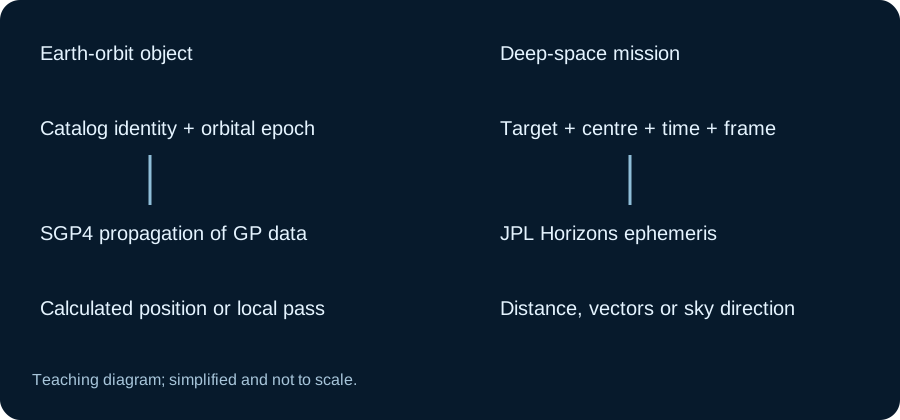
An Earth satellite and a spacecraft travelling between planets do not share the same useful orbit representation. The Earth-satellite workflow starts from a catalog object and an element record, then propagates that record with the model designed for it. A deep-space ephemeris instead supplies a trajectory evaluated in a specified frame and relative to a chosen centre or observer. Choosing between them is about the object and question, not about which service has the more impressive animation.
Before looking at precision, ask what the reported vector means. Is the centre Earth, the Sun or the observing site? Does the output describe geometric position or an apparent direction that includes light-time effects? A distance from Earth and a distance from the Sun can both be correct while having very different values. The label beside a number is part of the result, rather than decoration around it.
TLE elements belong with their intended propagator
The values in a two-line element record are model-specific mean elements. Treating them as ordinary instantaneous Keplerian elements and feeding them into any convenient orbit formula does not reproduce the intended SGP4 solution. This is why an apparently reasonable home-made calculation can disagree with a proper satellite propagator even when both start from the same text record.
The familiar two-line format is not the only way to distribute general perturbations data. Machine-readable formats can carry the same kind of catalog information with more explicit fields. What matters is preserving the object identity, epoch, conventions and intended propagation method. A change in file format alone does not turn Earth-satellite data into an interplanetary trajectory. Use the provider's documentation when interpreting fields rather than guessing from their names.
Horizons settings change the answer's meaning
An ephemeris request includes choices about the target, centre, time range and output. Observer tables and vector tables answer different questions. Local altitude and azimuth are directions in an observer's sky; a position vector describes coordinates in a specified frame. Both can help build a deep-space page, but they should not be mixed without tracking their conventions.
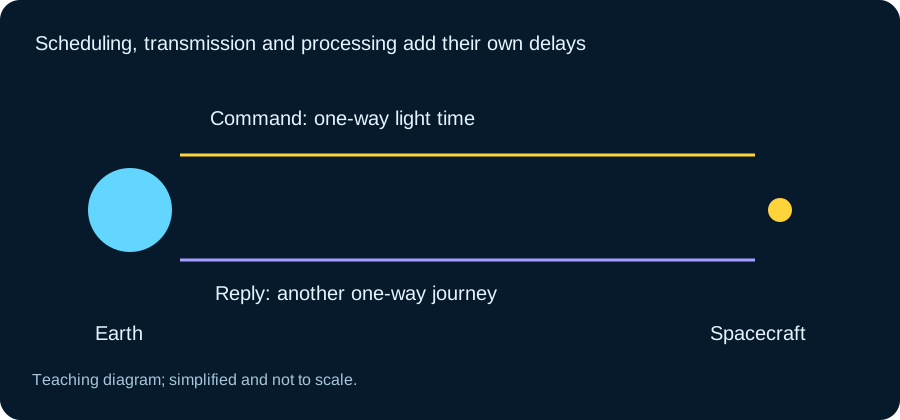
For a reproducible comparison, save the target identifier and request settings with the result. Specify the time scale rather than assuming every timestamp is ordinary local clock time. Also distinguish one-way light time from an approximate command-and-reply delay. The purpose is not to make a casual tracker difficult to use. It is to prevent a precise-looking value from acquiring a meaning that the underlying calculation never supplied.
A useful way to read both kinds of tracker
Open an Earth-orbit page and note the selected catalog number, element epoch if shown, and calculated position time. Then open a deep-space mission and note its distance labels and reference bodies. You will see that the two pages use different information because they follow different kinds of journeys. The difference is a strength when it is explained clearly.
If two sources disagree, compare definitions before comparing digits. A heliocentric speed is not an Earth-relative speed, and a geometric location is not automatically an apparent sky position. Only after matching those settings should you investigate the remaining difference. This habit makes the tools more useful for learning: instead of searching for one universal 'live number', you learn what each number describes and which calculation is appropriate for the spacecraft you are following.
A worked example: asking two services a different question
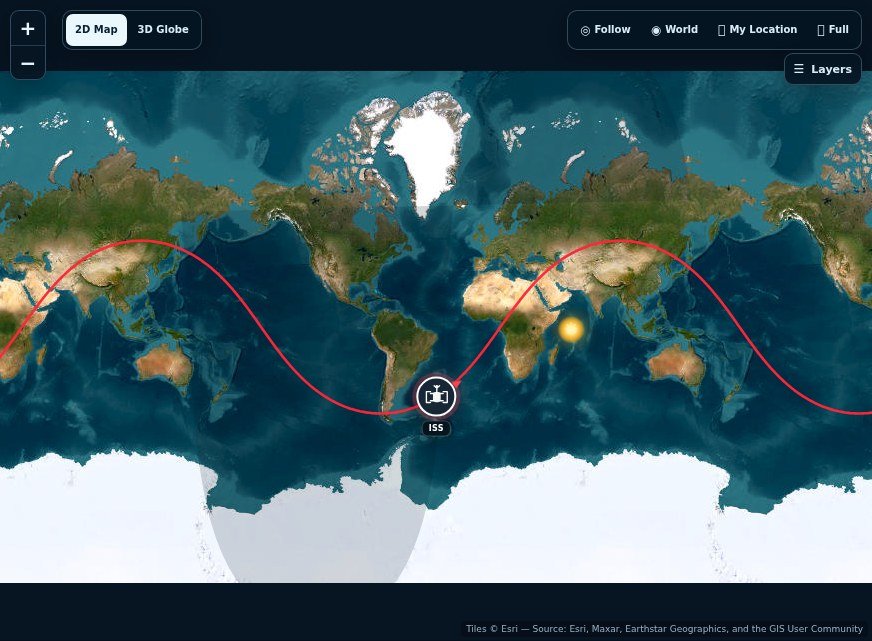
Imagine querying the ISS at a selected UTC instant. A public catalog supplies an Earth-orbit element set and its epoch, while an SGP4 implementation calculates the station's approximate position for the requested time. The result depends on the catalog entry, its age and the propagation model. If you switch to a completely different NORAD number without noticing, you will get a different orbit even though the page title still resembles the original spacecraft.
Now imagine querying Voyager 1. A JPL Horizons ephemeris request can specify a target, time and reference centre, and the result can be presented as a vector or observer quantity. There is no meaningful reason to force the same Earth-orbit element workflow onto that deep-space trajectory. Voyager is travelling under a different dynamical regime; the numerical values must be understood with their chosen reference frame and light-time conventions.
A compact checklist before comparing results
Object: verify that the catalog number or target designation really matches. Time: use a timestamp with an explicit time zone, ideally UTC. Reference: decide whether you want an Earth-fixed sub-satellite point, a geocentric vector, an observer's sky angle or a Sun-centred position. Freshness: note when the underlying orbit or trajectory record is valid rather than relying on the time printed at the top of a web page.
To see the distinction in practice, follow the ISS and then Voyager 1. Read the unit labels before writing down a distance or speed. For model references, use CelesTrak's SGP4 paper and JPL Horizons documentation. A clean scientific comparison starts with the question being asked, not with the fact that both pages happen to have a moving map.