Tracking Hubble vs Seeing Its Images: What a Map Shows
A live Hubble position shows the observatory’s orbit—not its current science target or a live camera feed.
For Hubble, separate spacecraft location from telescope pointing. A tracker can show where Hubble is in its Earth orbit, while an observation record describes where its instruments were aimed. The two are related operationally, but they answer different questions and should not be read as the same kind of data.
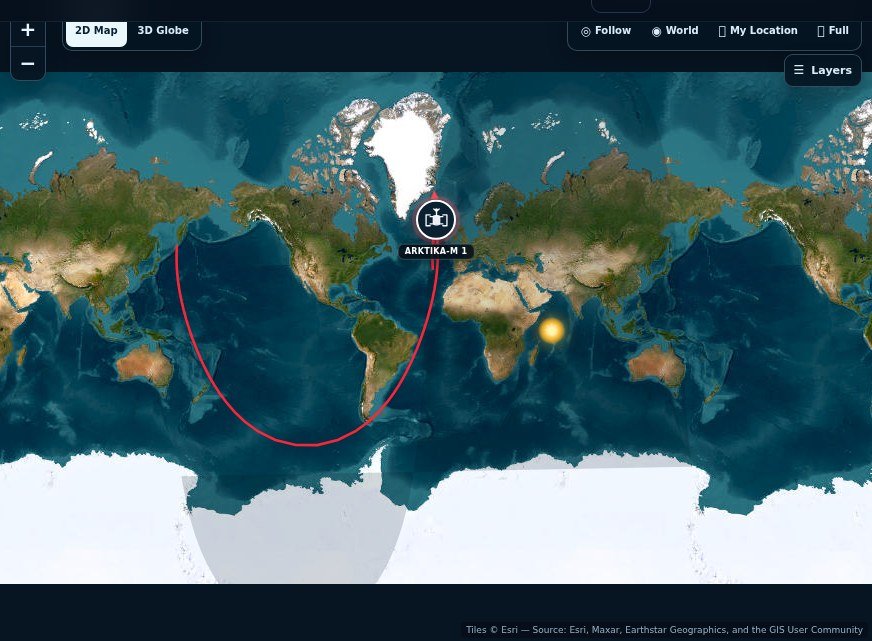
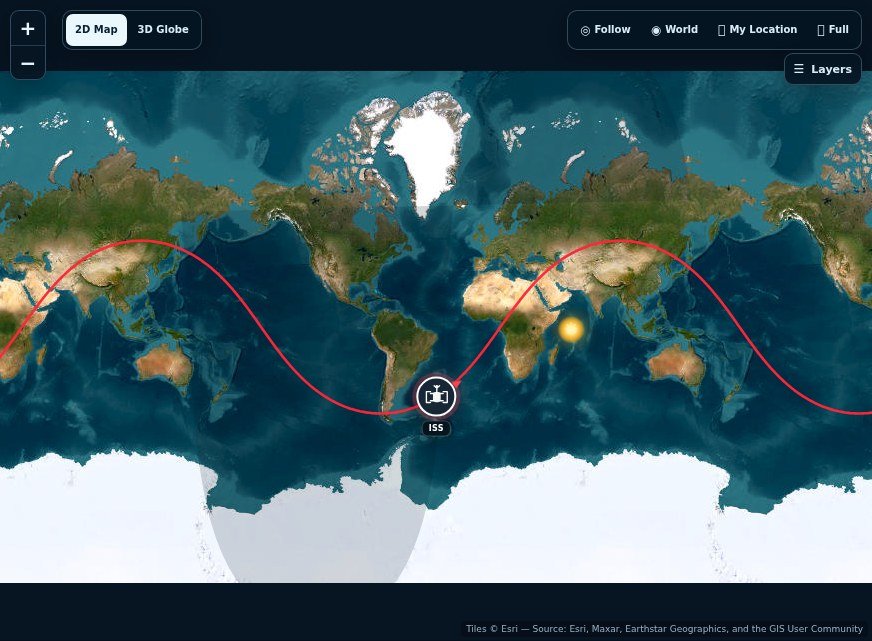
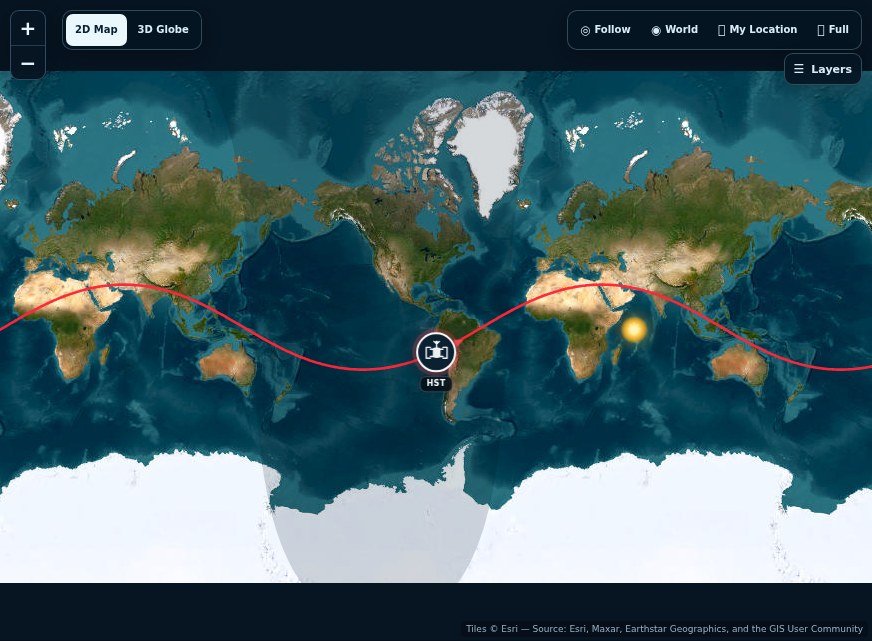
The map shows the sub-satellite point
A marker on Earth usually represents the point directly below the spacecraft, not the patch of sky its telescope is studying. Hubble can point away from that ground point within operational constraints. Reading the map as a camera footprint would therefore create a false impression of its scientific target.
Why there is no public live eyepiece
Hubble observations are planned, transmitted, calibrated and processed. The famous images are scientific data products assembled with careful choices of filters and colour representation. A live orbit display is immediate mathematics; a released Hubble image belongs to a very different workflow.
Can Hubble be seen from Earth?
Under favourable conditions Hubble can appear as a moving point, but it is generally less spectacular than the ISS. Use the local pass direction and elevation, then consider darkness and illumination. A geometric pass alone does not guarantee a naked-eye observation.
Use the tracker as context
Following Hubble’s orbit can make mission operations more tangible: Earth blockage, day-night cycles and rapid motion are no longer abstract. Pair that context with NASA’s image archive and mission updates. The tracker tells the story of where the observatory travels; the science archive tells the story of what its instruments reveal.
There are three different pictures to keep separate
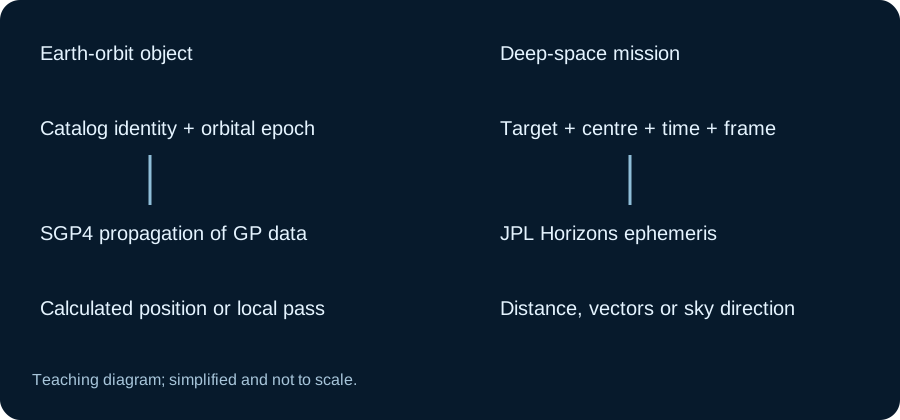
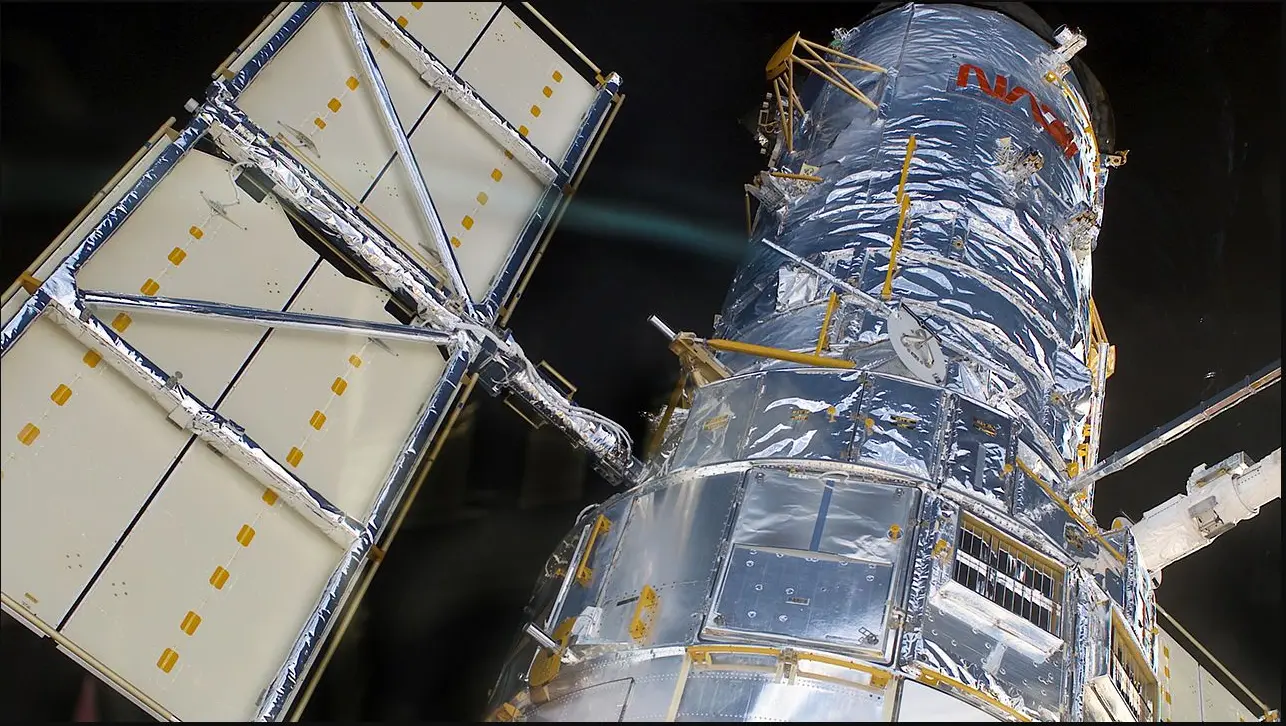
A Hubble tracker displays the telescope's position around Earth. A mission photograph shows the observatory as a physical spacecraft. A published science image shows an astronomical target observed by its instruments and processed into a usable product. All three are valuable, but they answer different questions. A beautiful nebula beside a map does not mean that nebula is Hubble's current target.
Read image captions carefully when you switch between those views. A science image may combine filters, exposures and processing choices, and it has its own observation context. The world map below a satellite marker is a geographical background. It is not a video from the telescope or an image of Earth captured at that instant. This distinction makes the page more interesting because it connects the spacecraft, its orbit and its scientific work without pretending they are one synchronized feed.
Earth's position affects observing opportunities
An observatory in Earth orbit must work within constraints involving Earth, the Sun and the Moon, as well as the instrument and target. A telescope does not simply point at any desired object continuously because its marker is visible on a public map. Science scheduling includes conditions that a basic orbit visualization does not reproduce.
For a general reader, the useful question is what Earth orbit makes possible and what it limits. Hubble benefits from observing above much of the atmosphere, but it still has a moving Earth nearby. Compare that with an observatory operating far from Earth to understand why mission locations differ. Avoid inferring an exposure start or pointing direction from latitude and longitude alone. Those coordinates describe the platform's location, not the direction of its optical axis.
Seeing the telescope is a separate observing project
A favorable Hubble pass can be an interesting target from the ground, but spotting the spacecraft does not let you see through its mirrors. It appears as reflected sunlight from a moving object. The opportunity depends on local geometry, illumination, darkness and weather. Use the Hubble pass prediction rather than trying to locate its current science target in the sky.
Choose a clear horizon and note the starting direction before the event. If the pass is low, obstacles may dominate the experience. A telescope or binoculars can make a fast-moving target harder to acquire because of the narrow field of view. Start with the simplest suitable observing method and identify the path first. An unsuccessful sighting does not tell you whether Hubble is collecting useful science data at the same time.
A comparison you can make at home
Choose a Hubble pass in the tracker and note the predicted direction, time and height above your horizon. Then choose an officially published Hubble image of a galaxy or nebula. The first set of information concerns where the spacecraft moves relative to an observer on Earth; the second concerns the scientific target and the light collected by an instrument. The two displays answer different questions even though the word “Hubble” appears on both.
For a ground sighting, allow for twilight and local obstruction. You might see the orbiting observatory as a faint moving point under favourable conditions, but the pass says nothing about which target Hubble's instruments are pointing at during that instant. A map icon often gives the spacecraft a large symbol for visibility; it is not a representation of the telescope's apparent angular size.
How to read a finished Hubble picture
Find the object name and observation description first. A colour image may combine separate exposures through different filters rather than reproduce what the unaided eye would see. The scientific caption usually identifies the instruments and the reason certain wavelengths were selected. If you are comparing a Hubble and a Webb image, matching the object is only the first step; wavelengths, spatial detail and processing also affect the appearance.
For Hubble's orbit, the live tracker provides changing position and observer geometry. For its observations, use NASA and ESA's published mission resources and the NASA Hubble mission archive. Keeping those sources apart prevents a tracker visitor from expecting an uninterrupted camera feed or interpreting a new web animation frame as a new scientific exposure.