
Planet Parade November 2026: See Mercury, Venus, Mars and Jupiter Before Sunrise
Four planets line up in the dawn sky from 13 to 22 November 2026, with Mars and Jupiter just 1° apart on 15–16 November. Here is when and where to look, and how to spot elusive Mercury.

If you are up before dawn this month, look east. From about 13 to 22 November 2026, four planets will be visible together in the morning sky: Mercury, Venus, Mars and Jupiter. Two of them will put on a close show, with Mars and Jupiter just about one degree apart on 15–16 November, and Mercury will reach its best morning position of the year on 20 November.
This planet parade November 2026 needs nothing more than your eyes, a clear view of the eastern horizon and an alarm set for about an hour before sunrise. Here is how to see it.
What is a planet parade?
A “planet parade” or “planetary alignment” is simply a time when several planets are visible in the same part of the sky at once. The planets do not form a perfectly straight line in space. They all orbit the Sun in roughly the same flat plane, so from Earth they always appear along the same path across the sky, called the ecliptic. When several of them happen to be on the same side of the Sun as seen from Earth, they line up along that path like beads on a string.
The four planets and how to find them
Face east to southeast about 45 to 60 minutes before sunrise. From the Northern Hemisphere, the planets stretch up from the horizon in this order:
- Mercury (magnitude about −0.5, in Libra): the lowest and hardest to see. Look just above the horizon, below Venus. It reaches greatest western elongation on 20 November, about 19.6° from the Sun, so the nights of 20–22 November give the best chance.
- Venus (about −4.9, in Virgo): by far the brightest point in the dawn sky, and impossible to miss once it clears the horizon. Spica, the brightest star in Virgo, sits nearby.
- Jupiter (about −2.1, in Leo): a brilliant, steady cream-coloured light higher up.
- Mars (about +0.6, in Leo): much fainter than Jupiter, but its orange-red colour gives it away. It is the highest of the four.
A useful trick is to start while the sky is still dark: find Jupiter and Mars first, follow the line down to Venus, then look for Mercury last, about 20 to 30 minutes before sunrise, when it has risen high enough. Our planets visible tonight tool shows the exact rise times and directions for your location.
Key dates for the November 2026 planet parade
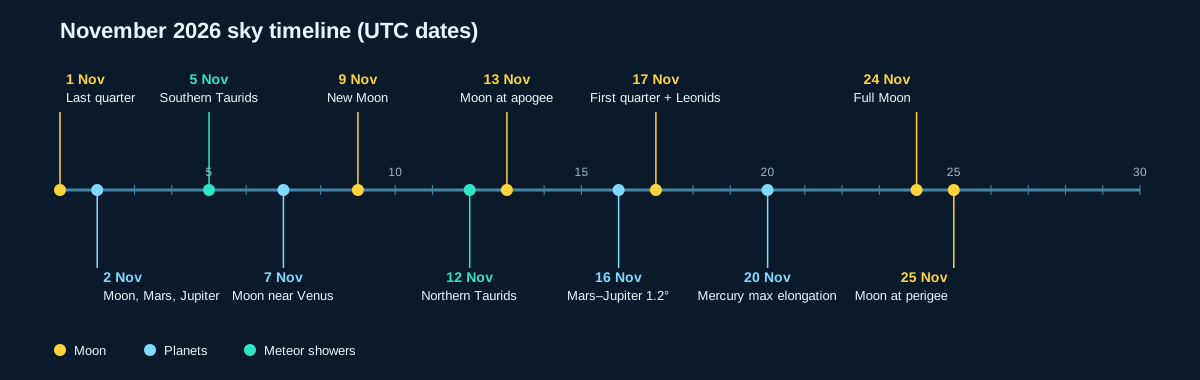
- 13–14 November: all four planets become visible together, with a slightly narrower spread across the sky.
- 15–16 November: Mars and Jupiter pass about 1° apart, roughly two finger-widths at arm’s length. With Regulus, the brightest star in Leo, nearby, the trio looks like a bright triple star.
- 17–18 November: the Leonid meteor shower peaks, so you may catch a few fast meteors while you watch the planets. Slow Taurid fireballs are active this month too; see our Taurid meteor shower 2026 guide.
- 20–22 November: Mercury is at its best, making these the easiest mornings to see all four.
- 24 November: the Beaver Supermoon is full; its bright light washes out the sky after this date.
What time should I look?
The window is short: the planets must rise high enough to clear trees and buildings, but you need to see them before the sky gets too bright. Approximate best times on 20 November:
- New York: about 6:10 a.m.
- London: about 6:35 a.m.
- Los Angeles: about 5:55 a.m.
- Tokyo: about 5:45 a.m.
Elsewhere, aim for 30 to 45 minutes before your local sunrise; check it with our sunrise and sunset times and twilight calculator. Stop observing well before the Sun comes up, and never point binoculars near the rising Sun.
Can I see it from the Southern Hemisphere or India?
From India and other tropical and northern locations, all four planets are visible, with Mercury low but reachable around 20 November. In the Southern Hemisphere, including Australia, South Africa and South America, Mercury stays very close to the horizon this month and is hard to see. Venus, Jupiter and Mars are still easy, so you can enjoy a three-planet parade.
Binoculars and telescopes
The parade is a naked-eye sight, but binoculars help in two ways: they make it easier to find Mercury low in the twilight, and they reveal Jupiter’s four large moons as tiny points of light beside the planet. A small telescope at 50× to 100× shows the phase of Venus, a crescent this month because it has only just moved out from between Earth and the Sun, and the cloud belts of Jupiter. Use our magnification calculator to see what your eyepieces will show, and compare the planets’ sizes with the planet apparent size tool.
How to photograph the planet parade
The planets spread across a wide stretch of sky, so a phone’s standard or wide lens works well. Put it on a tripod or rest it on a wall, frame the eastern horizon with a building or tree for scale, and use night mode or an exposure of 1 to 2 seconds while the sky is still deep blue. Take shots every few minutes as the twilight brightens: early frames show Mars and Jupiter best, later ones catch Mercury once it rises. For the Mars–Jupiter pairing on 15–16 November, a zoom or telephoto lens on a tripod gives a lovely close-up of the two planets, with Regulus nearby.
And in the evening?
The evening sky has its own planets. Saturn is up after dusk in the southern sky, and Uranus reaches opposition on 25 November, when it is closest and brightest for the year. It is faintly visible to the naked eye from a dark site, between the Pleiades and the Hyades in Taurus, and easy in binoculars. Neptune lies near Saturn but needs a telescope. To see how all these worlds are arranged around the Sun right now, open our live Solar System map.
The Moon joins the line-up
Later in the season, the Moon visits the morning planets. Around 30 November and 1 December, a half-lit Moon passes close to Mars and Jupiter after midnight, and it returns near them again around 26–28 December. Check what planet is near the Moon tonight for the exact pairing from your location.
Sources: Star Walk: Planet parade in November 2026; BBC Sky at Night Magazine: planet alignment November–December 2026. Planet positions on SpaceTracker.live are calculated with the Astronomy Engine library.
Source: Star Walk ↗

More to read
All astronomy news →


 From our guidesNovember 2026 Night Sky: Mars and Jupiter, Leonids and a Near-Perigee Full MoonSkywatching Guides · Oct 30, 2026