
Voyager 1 Is About to Become the First Spacecraft One Light-Day From Earth
On 18 November 2026, NASA's Voyager 1 will be so far away that its radio signals need a full day to reach Earth. Here is how far one light-day is, why the milestone matters and how to watch it.

In two weeks, a spacecraft launched in 1977 will cross a line no human-made object has ever crossed. On 18 November 2026 at about 06:16 UTC, NASA's Voyager 1 will be one light-day from Earth. A radio signal sent from the probe at that moment will need a full 24 hours to reach us, even though it travels at the speed of light.
It has taken Voyager 1 a little over 49 years to get there. Here is what the Voyager 1 one light-day milestone means, how far that really is, and how you can watch the distance tick past the mark yourself.
How far is one light-day?
Light moves at 299,792 kilometres per second. In one day it covers about 25.9 billion kilometres (16.1 billion miles). That is roughly 173 times the distance between Earth and the Sun, or 173 astronomical units (AU).
To put that in perspective:
- Sunlight reaches Earth in about 8 minutes and 20 seconds.
- It reaches Neptune, the outermost planet, in about 4 hours.
- It would need a full day to catch up with Voyager 1.
You can compare these numbers for any distance with our light travel time calculator. As of 3 November, our live Voyager 1 tracker shows the probe about 172.9 AU from Earth, with its signal taking just under 24 hours to arrive. The last few minutes of that gap close over the next two weeks.
Exactly when does Voyager 1 reach one light-day?
NASA has given the date as 18 November 2026, and EarthSky, citing NASA, puts the moment at 12:16:07 a.m. Central time, which is 06:16 UTC (11:46 a.m. in India). That is 49 years, 2 months and 11 days after the probe left Cape Canaveral on 5 September 1977.
There is a small twist. Voyager 1 is moving away from the Sun at about 17 kilometres per second, but Earth is moving too, circling the Sun at about 30 kilometres per second. Depending on the time of year, Earth is travelling partly towards or partly away from the probe, so the Earth-to-Voyager distance grows faster in some months than in others. The milestone is about the distance from Earth, because that is where the radio signals are received.
Why this milestone matters
One light-day is a round number, but it is also a real working problem for the Voyager team. Every command NASA sends now takes about a day to arrive, and the confirmation takes another day to come back. A simple "did that work?" check needs two full days.
That delay shaped one of the mission's tensest episodes. In late 2023 Voyager 1 started sending back unreadable data. Engineers traced the problem to a failed memory chip in the flight data system, then rewrote and moved the affected code to other parts of the memory, a fix that worked in 2024. Each attempt meant waiting about two days to see the result. We explain how these long-distance conversations work in how NASA communicates with Voyager.
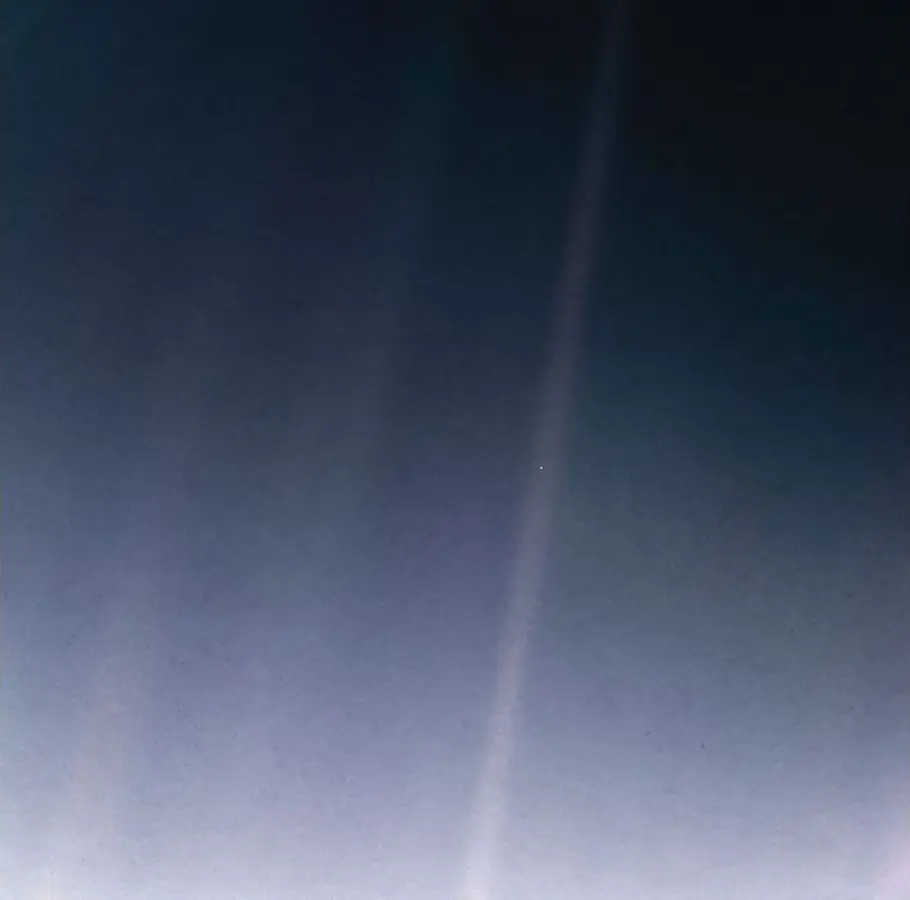
The milestone is also a reminder of how far the probe has already come. Voyager 1 flew past Jupiter in 1979 and Saturn in 1980. In 1990 it turned its camera back to take the famous "Pale Blue Dot" image of Earth. In August 2012 it crossed the heliopause, the edge of the bubble of solar wind around our Sun, and became the first spacecraft to enter interstellar space.
Is Voyager 1 still working?
Yes, but it is running on very little. Voyager 1 gets its electricity from radioisotope generators that turn the heat of decaying plutonium into power. That output drops by about 4 watts every year, so NASA has been switching instruments and heaters off one by one to keep the spacecraft alive. In April 2026, the team turned off the Low-Energy Charged Particle instrument, which measured cosmic rays and ions in interstellar space. EarthSky reports that it could be switched back on later.
The remaining instruments still send back measurements of magnetic fields, plasma waves and particles beyond the Sun's influence. These are the only direct readings humanity has from interstellar space. The probe's radio transmitter puts out about the power of a refrigerator light bulb. By the time its signal reaches Earth it is unimaginably faint, and only NASA's largest Deep Space Network dishes can pick it up.
Where is Voyager 1 heading?
Voyager 1 is travelling "up" out of the plane of the planets, towards the constellation Ophiuchus. It is far too faint to see with any telescope, but you can follow its calculated position and its distance from both the Sun and Earth on our Where Is Voyager 1 Now? page, which uses NASA/JPL Horizons data.
Its twin, Voyager 2, launched a few weeks earlier, on 20 August 1977, but took a longer route past all four giant planets. It is now about 145 AU from Earth and moving more slowly. NASA expects it to reach one light-day only around 2035. You can track it on our live Voyager 2 page or compare the two missions in Voyager 1 vs Voyager 2.
How to watch the moment
- Follow the countdown: open the Voyager 1 tracker on 17 and 18 November and watch the "signal time" pass 24 hours.
- Check your local time: 06:16 UTC on 18 November is 1:16 a.m. in New York (EST), 6:16 a.m. in London, 11:46 a.m. in New Delhi and 5:16 p.m. in Sydney.
- Look the right way: Ophiuchus sits close to the Sun in late November, so Voyager 1's direction is above the horizon mainly during the day. Nothing is visible, but it is a nice thought for an evening walk.
- Explore the neighbourhood: see where other distant probes are, including New Horizons, on our deep space tracker.
What comes next for Voyager 1?
NASA expects Voyager 1 to keep returning some science into the late 2020s, as long as there is enough power to run at least one instrument and the radio. When the power finally runs out, the probe will fall silent but keep coasting at 17 km/s. It will not come anywhere near another star for tens of thousands of years.
It carries the Golden Record, a gold-plated disc with greetings in 55 languages, music and 116 images of life on Earth. It was made in case anyone ever finds it.
On 18 November, the clock reaches one light-day. It is a fitting milestone for a spacecraft built with 1970s technology that is still, every day, sending news home from interstellar space.
Sources: NASA Night Sky Notes: "Light-Day Away" (30 October 2026); EarthSky: Voyager 1 to reach 1 light-day from Earth on November 18; NASA Voyager mission. Distances on SpaceTracker.live are calculated from NASA/JPL Horizons ephemerides.

More to read
All astronomy news →


 From our guidesVoyager 1 vs Voyager 2: Journeys, Distances and Light TimeDeep Space · Aug 21, 2026