Voyager 1 vs Voyager 2: Journeys, Distances and Light Time
The twin Voyager probes launched weeks apart, followed different planetary routes and now travel through interstellar space.
A useful Voyager comparison keeps the two spacecraft independent. Their launch history is shared, but their trajectories, directions from Earth, distances and communication delays are now different. Read each mission tracker separately before comparing any current value.
Twins with separate flight plans
Voyager 2 launched first in August 1977, followed by Voyager 1 in September. The numbering reflects mission planning rather than launch order. Their trajectories diverged: Voyager 1 made close encounters with Jupiter and Saturn, while Voyager 2 continued to Uranus and Neptune, becoming the only spacecraft to visit those ice giants.
Why Voyager 1 is farther
Voyager 1 was placed on a faster, more direct path after Saturn. Voyager 2 took the longer planetary tour. As a result, the probes occupy different directions and distances even though they share much of the same hardware heritage. A single “Voyager location” would erase the central fact that these are independent travellers.
Reading two deep-space trackers
Open both tracker pages and compare distance from Earth, distance from the Sun and light time. The visual scale is compressed, so use the numbers for comparison. Their apparent positions also depend on the reference centre and coordinate frame; a deep-space vector is richer than a familiar latitude-longitude marker.
A mission measured in patience
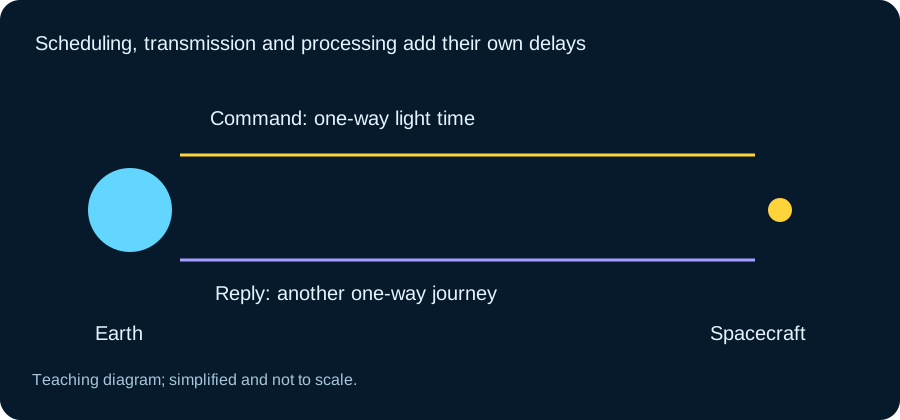
Signals take many hours to cross the gulf between Earth and each probe. Commands and engineering decisions therefore unfold slowly. The Voyagers make distance feel real: two similar machines launched in the same season have spent decades separating not only from Earth, but also from each other.
Their histories explain their different directions
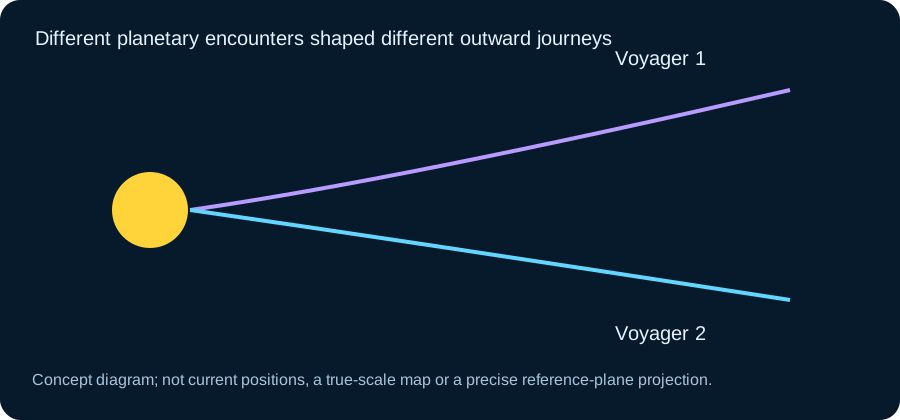
The Voyager spacecraft share a mission heritage, but their planetary encounters created distinct paths. Voyager 1's trajectory carried it away from the plane of the main planetary orbits after its Saturn-system encounter. Voyager 2 continued to Uranus and Neptune before heading outward on its own route. Their present separation is therefore not simply one spacecraft travelling a little farther along the same line.
A top-down solar-system picture can hide this distinction. The probes also have motion above or below the reference plane used in the view. Change the scene angle if the interface allows it, but rely on the labelled values for scale. A line that looks close to a planet in a compressed visualization does not establish that an encounter is happening now. The encounter history and current position are different kinds of information.
Interstellar space does not mean another star system
Both probes have crossed the heliopause, the boundary associated with the Sun's solar-wind influence. This is the basis for describing their measurements as interstellar. It does not mean they have arrived at another star, or that every definition of the solar system places its edge at the same boundary. The Sun's gravitational influence and the distant distribution of small bodies involve much larger scales.
When reading mission articles, check which boundary the author means. A headline that says a probe 'left the solar system' can compress several different ideas into one phrase. The more useful description identifies the region being measured and the boundary crossed. This makes the probes' scientific achievement clearer without overstating their distance from the broader environment around the Sun.
Distance from Earth changes differently from distance from the Sun
Earth continues around its own orbit while each probe travels outward. Consequently, Earth-relative distance can show a seasonal component in addition to the long-term outward journey. A small change in the Earth-distance trend does not mean a probe reversed course. Compare the Earth and Sun distance fields and their timestamps before interpreting the direction of travel.
Light time follows the relevant path to Earth, so it should be read with the Earth-distance value. It is not a countdown to a new image or a guarantee of continuous contact. The public tracker provides calculated spatial context; the mission team determines which observations and operational updates are available. This distinction matters especially for spacecraft whose communication and power conditions change over their long lives.
Avoid turning a comparison into a race
Voyager 1's greater distance does not make Voyager 2's achievements less important. Voyager 2 explored planetary systems that Voyager 1 did not visit, and the two outward paths sample different environments. Their value comes from the measurements and encounter histories, not from which marker reaches the edge of the screen first.
Choose one question for each reading session. You might compare the two paths, examine their communication delays, or learn what an instrument measures in interstellar space. Follow the latest official mission information for health and instrument status rather than inferring those details from a moving marker. A clear comparison lets the twin spacecraft remain distinct: similar machines, different journeys, and complementary records of environments no ordinary Earth-orbit tracker can describe.
A comparison that does not depend on the map's scale
Open the two spacecraft pages at the same time setting. Note distance from the Sun, distance from Earth and the stated light-time convention for each. Sun-relative distance is useful for comparing how far outward the probes have travelled. Earth-relative distance changes partly because Earth is moving around the Sun. The values therefore answer different questions and need not increase at an identical rate throughout the year.
Check the coordinate context before comparing the apparent directions of their tracks. A schematic solar-system view can flatten a three-dimensional trajectory, and icons are usually enlarged enormously so visitors can select them. Voyager 1 and Voyager 2 followed different paths after their planetary encounters. Seeing their paths diverge on a drawing is educational, but measuring a separation in pixels is not a substitute for a numerical ephemeris.
Keep mission history separate from today's spacecraft health
Voyager 2 visited Uranus and Neptune; Voyager 1 did not. Voyager 1's historic imaging of Jupiter and Saturn supported a different planetary tour. These distinctions explain why the spacecraft took separate outward routes. Both later crossed the heliopause, but that does not mean they left the Sun's gravitational system or reached another star. The limits of the heliosphere and the vast scale of the Oort Cloud are not identical boundaries.
For an actual science or engineering update, check the date and spacecraft named in NASA's Voyager reporting. A tracker can continue to compute a trajectory even when a particular instrument is off or when a radio link is not currently scheduled. Comparing the probes responsibly means pairing the calculated position with an independent, dated operational report.