Europa Clipper vs Juice: Jupiter Ocean-World Missions
NASA and ESA are approaching Jupiter’s icy moons with complementary targets, instruments and tours.
The most useful comparison starts with mission purpose rather than spacecraft appearance. Europa Clipper and Juice follow different trajectories and investigate different parts of the Jupiter system, so their live trackers should be read alongside NASA and ESA mission information rather than treated as equivalent views of one mission.
Shared destination, different emphasis
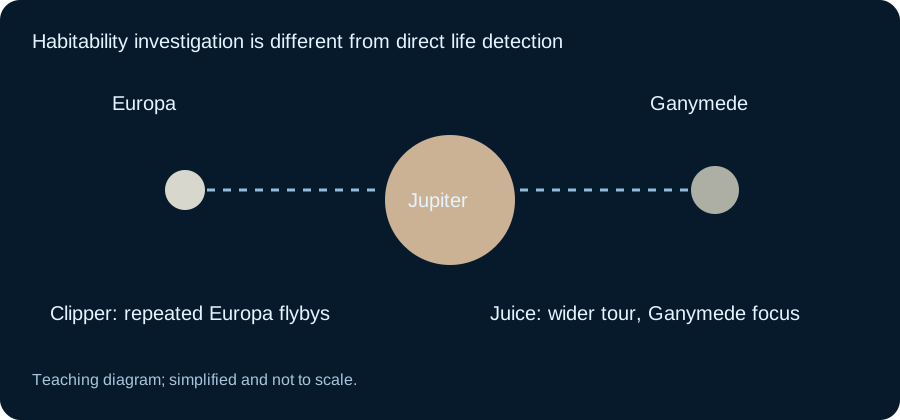
Both missions investigate the Jupiter system and its ocean-bearing moons, but they are not duplicates. Europa Clipper concentrates on whether Europa has environments that could support life. JUICE studies Jupiter, Europa, Callisto and especially Ganymede as planetary worlds and possible habitats.
Europa Clipper uses repeated flybys
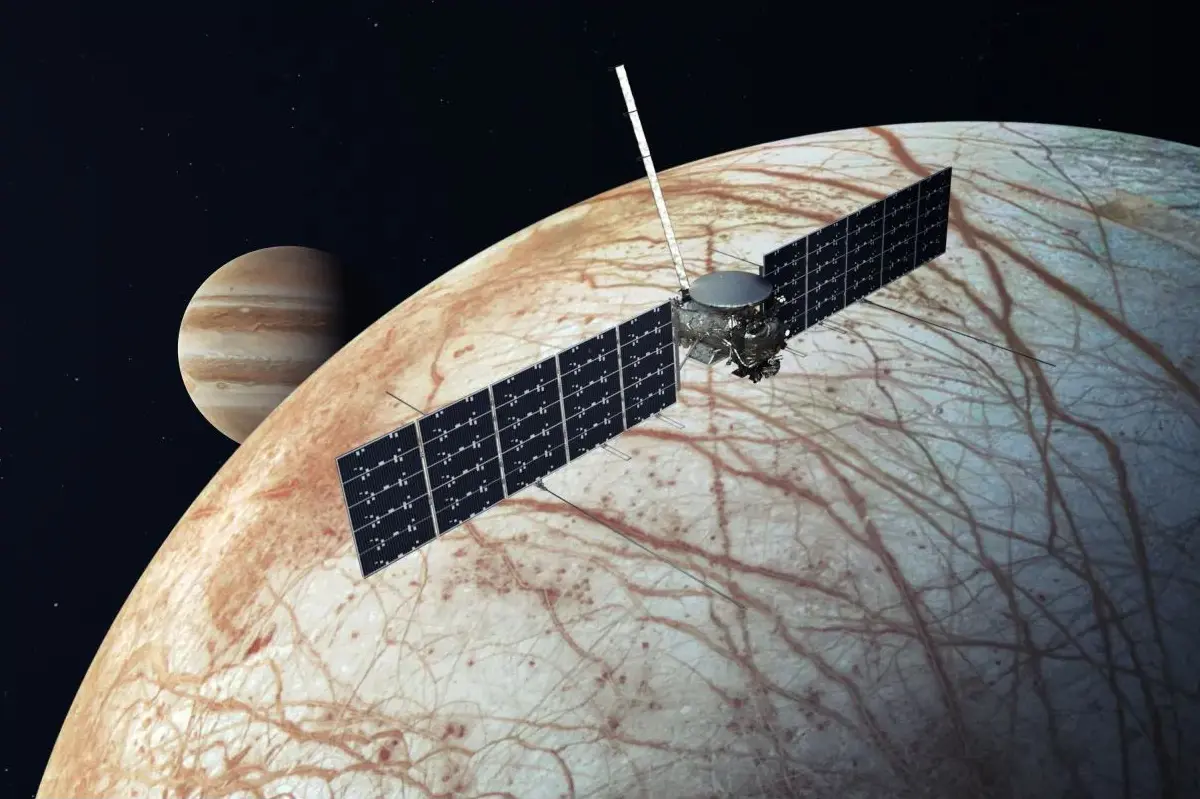
Europa sits deep inside Jupiter’s intense radiation environment. Rather than remaining in orbit around the moon, Clipper will orbit Jupiter and make dozens of close Europa flybys. This strategy gathers global and regional measurements while limiting continuous exposure near the moon.
JUICE builds toward Ganymede orbit
ESA’s mission will tour the Jovian system with flybys of several moons before entering orbit around Ganymede. That final phase makes JUICE the first spacecraft planned to orbit a moon beyond Earth’s Moon. Its broad system study complements Clipper’s focused Europa investigation.
Neither mission is a simple life detector
Habitability asks whether conditions suitable for life may exist; it is not the same as finding an organism. Instruments examine ice, oceans, chemistry, magnetic environments, geology and energy. Careful language matters because an exciting target does not guarantee a biological discovery.
Follow two long journeys
Use the two deep-space pages to compare changing distances and trajectories during cruise. Gravity assists can make the routes look indirect because missions trade time and planetary geometry for launch energy. The trackers provide context; NASA and ESA mission sites remain the authoritative sources for milestones and science results.
A flyby is a planned measurement window
A close encounter is not simply a spacecraft passing an interesting place on the way elsewhere. The geometry, closest approach, illumination and instrument sequence can be chosen to serve particular observations. Repeated flybys allow a mission to sample different regions and conditions. Between them, the spacecraft travels on the broader orbit that makes the next encounter possible.
This helps explain why a tracker may show a long loop away from a moon after an encounter. That path can be part of the mission design rather than wasted motion. The scene usually compresses sizes and distances for visibility, so it cannot show the true scale of every close approach. Use official encounter information for altitude and observing plans, and use the animation to follow the general sequence of the tour.
Radiation is an engineering constraint
Jupiter's environment makes spacecraft design and tour planning demanding. Instruments and electronics need protection, and mission teams account for accumulated exposure. Europa Clipper's architecture uses repeated encounters rather than a permanent Europa orbit. Juice's broader tour and eventual Ganymede phase support a different set of requirements. These choices should be understood within each mission's design rather than ranked as simple degrees of ambition.
An illustration of a spacecraft beside a moon often places the two close together for storytelling. It does not indicate a continuously maintained position or current exposure level. Likewise, a tracker distance alone cannot tell you how much radiation an instrument has received. Keeping engineering conclusions with the official mission sources avoids reading too much into a visually attractive page.
Compare cruise and science phases separately
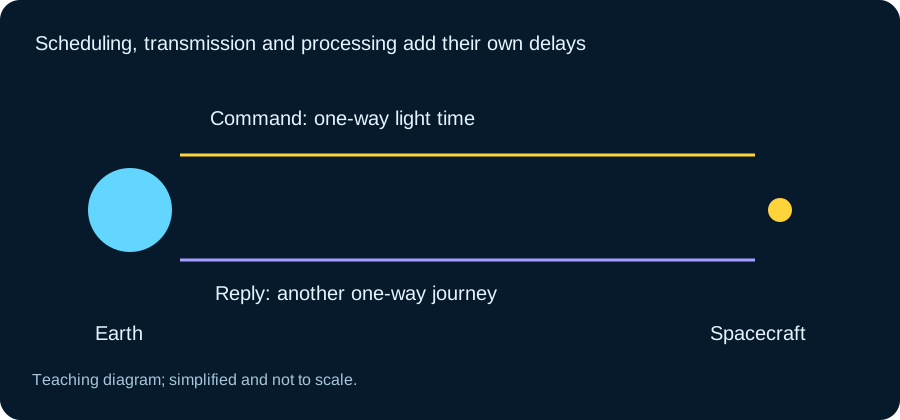
During interplanetary cruise, distance and light time are useful ways to follow progress. During a Jupiter-system tour, encounter geometry and instrument goals become more important to understanding the science. A single progress bar cannot express all those phases accurately. The routes are also shaped by gravity assists and planetary timing, which can make an outward journey appear indirect.
Use the individual trackers to follow where each mission is at the displayed time, then consult NASA and ESA for the latest confirmed milestones. If a future event is described as planned, keep that qualifier. Do not convert a target date into an accomplished encounter or suggest that the two missions are racing toward the same finish. Their real comparison is more interesting: different routes and observing strategies designed to investigate related, but distinct, ocean-world questions.
What a useful side-by-side observation looks like
Suppose you are following the missions in the same week. For each spacecraft, write down its reported distance from Earth, the time of the ephemeris and whether you are looking at an actual or predicted position. These values describe where the missions are, not whether a particular instrument is collecting science. A shorter Earth distance does not by itself mean that a spacecraft is closer to its next planned encounter; planetary geometry and the route taken matter.
When a new mission announcement appears, identify its phase before comparing it with the other mission. A cruise correction changes the course during travel. A moon flyby is a short, carefully timed opportunity for measurements. A later orbital phase allows a different observing cadence. Europa Clipper and JUICE will encounter Jupiter's environment with different schedules, trajectories and instrument priorities, so a single shared progress percentage would misrepresent both stories.
Three questions worth asking of a mission update
What is confirmed? A completed manoeuvre or received dataset is different from an event that is still on the schedule. Which body is being observed? Images and measurements of Europa, Ganymede and Callisto address related but not identical questions about ice and possible internal oceans. What measurement was made? A camera image, magnetic-field observation and radar sounding reveal different properties and come with different limits.
That distinction helps when reading a spectacular image. A visible crack or ridge tells us about surface geology but cannot alone confirm liquid water beneath the ice. Inferences about internal structure draw on multiple forms of evidence and physical models. For official mission plans and results, use NASA's Europa Clipper mission and ESA's JUICE mission. The trackers complement those sources by making the journey easier to picture.