Why Parker Solar Probe Is So Fast: Its Orbit Explained
Gravity assists and repeated close approaches to the Sun explain Parker Solar Probe’s extraordinary speed.
Parker’s speed makes sense only in the context of its orbit around the Sun. Its velocity rises dramatically near perihelion, so compare speed with solar distance and orbital position instead of treating the highest figure as a constant cruising speed. NASA’s mission material provides the authoritative context for record-setting close approaches.
Speed depends on where you measure it
A spacecraft’s velocity is always described relative to a chosen reference body or frame. Parker’s record figures are usually discussed relative to the Sun near perihelion, the closest part of its orbit. The value is not a constant cruising speed carried unchanged throughout the mission.
Falling toward the Sun
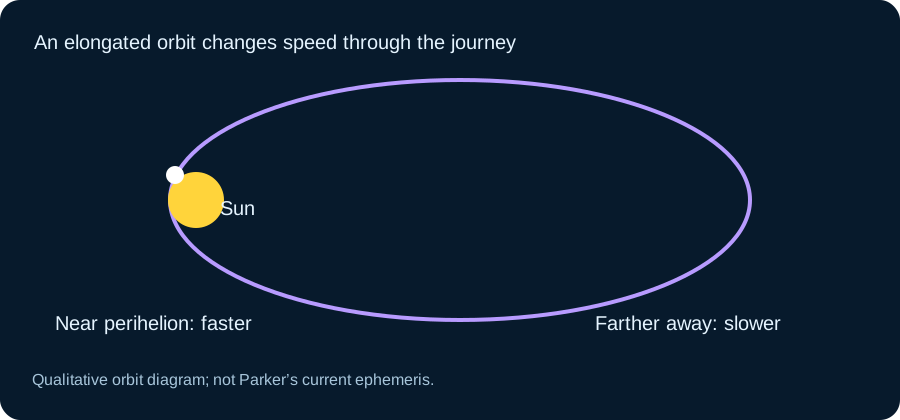
The Sun’s gravity accelerates Parker as it descends inward. Near perihelion it moves extremely fast; climbing outward, it slows. This exchange between gravitational potential and kinetic energy is orbital motion, not continuous thrust from a giant engine. The elongated orbit repeats the acceleration and deceleration cycle.
Venus reshapes the orbit
Repeated Venus gravity assists reduce the spacecraft’s orbital energy relative to the Sun and lower perihelion. It sounds paradoxical that a gravity assist can help a probe approach the Sun, but reaching the inner solar system requires shedding sideways orbital energy inherited from Earth. Venus provides that trajectory-changing leverage.
How the spacecraft survives
A carbon-composite heat shield protects the observatory while the thermal protection system faces the Sun. The probe must keep that shield correctly oriented; sensitive components operate in its shadow. Extreme speed attracts attention, but controlled attitude and heat management are what make useful measurements possible.
Going toward the Sun is not simply aiming at it
Earth already moves sideways around the Sun, and a spacecraft launched from Earth begins with that orbital motion as part of its starting conditions. Reaching much closer to the Sun requires changing the trajectory substantially. The difficulty is not that the Sun is too weak to pull a spacecraft inward; it is arranging a path that sheds enough of the inherited sideways motion to reach the desired close approach.
This makes Parker's Venus encounters easier to understand. The mission uses planetary geometry to reshape successive orbits, lowering the closest approach. Once that trajectory carries the spacecraft deep into the Sun's gravity, its speed rises strongly near perihelion. A simple arrow pointing directly at the Sun hides the orbital problem. Looking at the whole elliptical path explains why record speed is part of a repeating journey rather than a permanent straight-line sprint.
The fastest section is also a short section
A highly elongated orbit spends different amounts of time in different regions. Near the Sun, Parker covers its path quickly; farther out, it travels more slowly. The dramatic peak speed therefore describes a particular portion of the orbit. A public tracker opened on another day should not be expected to display that same value.
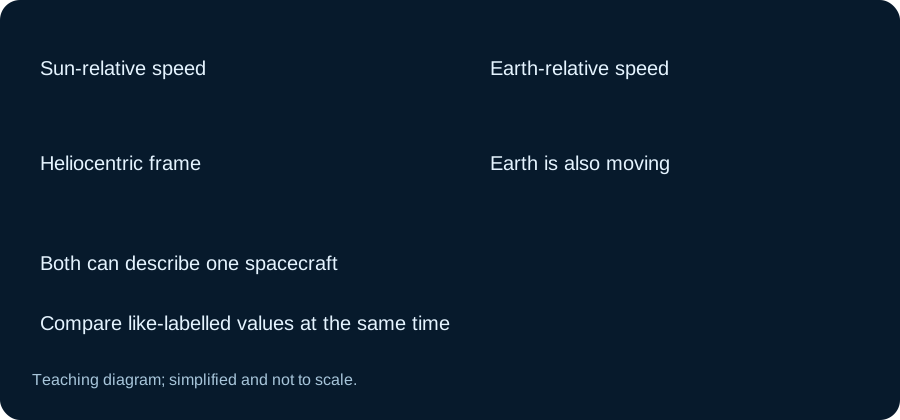
Compare speed together with the labelled Sun distance and time. If the page's speed is measured relative to Earth, it is not directly comparable with a headline quoting a heliocentric record. Both numbers can be valid, but their reference frames differ. A careful article states the frame and the circumstances rather than using one record number as a general specification of how fast the spacecraft always moves.
The heat shield and the measurements do different jobs
The thermal protection system allows sensitive components to remain protected while the spacecraft encounters an extreme environment. The instruments then collect measurements addressing questions about the corona and solar wind. A heat-shield illustration helps explain survival, but it is not the same as an instrument image or a temperature measurement.
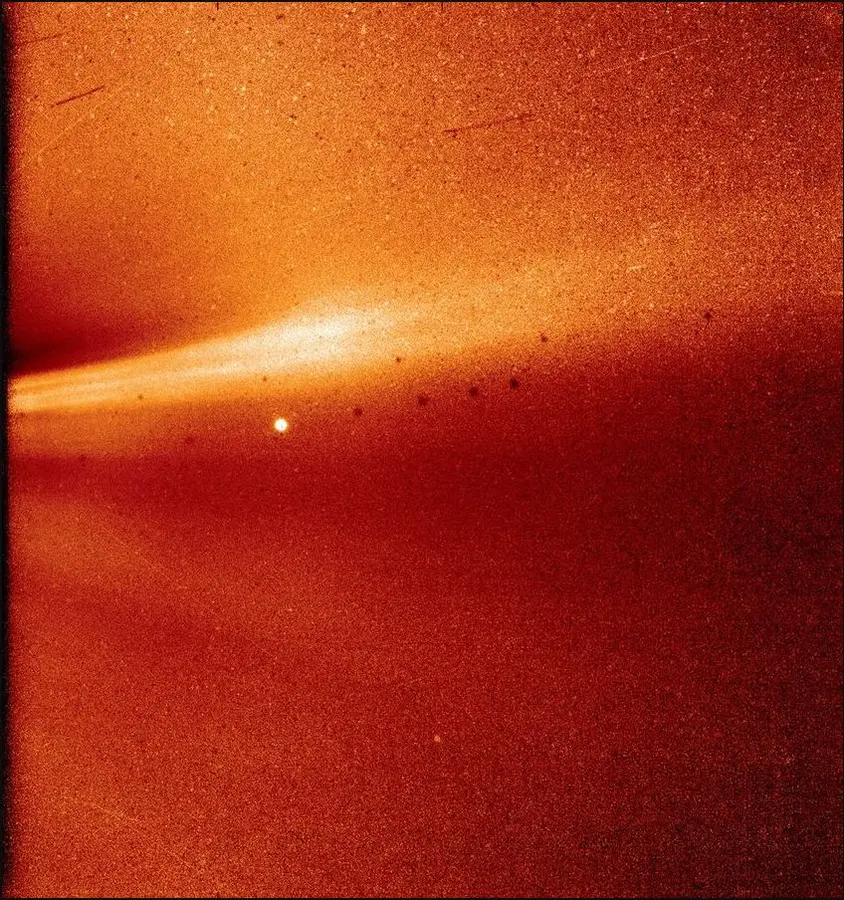
Parker's WISPR images, for example, come with their own observation context. Read the official caption to understand what is shown. A coronal structure in a science image does not locate the spacecraft on your map, and a map marker does not predict the structure's appearance. Linking the two through the mission explanation is useful; treating them as a single live camera view would erase the difference between position, engineering and science.
Read the orbit as a cycle
When following Parker over time, look for the alternating inward and outward portions. Note how Sun distance and speed evolve together, using comparable timestamps and the same frame. The visible line may be compressed to fit the scene, so use the numeric fields for actual scale. This exercise makes the changing values expected rather than surprising.
For the newest record, maneuver or science announcement, use NASA's mission information. A public tracker cannot establish a milestone from a rounded speed alone. It is most effective as a companion that shows why the trajectory produces such extreme conditions. Parker's achievement is not only travelling quickly: it is obtaining useful observations through a carefully designed sequence of close solar encounters, supported by thermal control, attitude management and planned communications.
Why a close solar pass produces a speed peak
Picture the probe on a long, eccentric orbit. As it falls deeper into the Sun's gravitational field it gains speed; as it moves outward again, the speed decreases. That is a relationship between distance and motion within the orbit, not a permanent acceleration in one direction. The exact speed quoted for a record needs a reference frame: a Sun-relative value cannot be compared unqualified with the ground speed of a satellite over Earth.
Venus flybys adjust Parker's heliocentric path. The gravitational encounter exchanges orbital energy and angular momentum in a way that allows the next solar approach to be closer. The spacecraft does not have to cancel its original sideways motion in a single engine burn. This is why the trajectory looks like a carefully planned sequence rather than a straight line from Earth toward the Sun.
A sensible way to explore the tracker timeline
Choose two points in the same orbit: one near the closest approach to the Sun and another farther away. Write down Sun distance and Sun-relative speed at each timestamp. You should expect the faster part of the orbit to be closer to the Sun, though details depend on how the displayed quantities are defined. Avoid mixing Earth-relative and Sun-relative speeds, and do not infer a specific heat-shield temperature solely from distance.
The mission's scientific measurements concern the solar wind, magnetic fields and energetic particles in a challenging environment. The shield protects sensitive systems; it does not mean every exterior surface remains cool. Follow NASA's Parker Solar Probe mission updates for confirmed flybys and instrument results, and use the trajectory page for the evolving geometry.