How NASA Communicates with Voyager Across Deep Space
Huge antennas, precise pointing, weak signals and long light times keep the Voyager conversation alive.
The Voyager tracker is useful for understanding distance and geometry, but communication is handled through NASA’s Deep Space Network. Read the current distance and light-time as context for the radio link, then use NASA mission information for confirmed communication and spacecraft-status updates.

Navigation is not a live tracker dot
A public tracker displays an ephemeris-derived estimate at the requested time. Mission navigation uses radio measurements, spacecraft models and specialised orbit determination. The web visualisation is valuable for scale and education, but it is not the operational console and should not be interpreted as direct telemetry.
Why the power budget shapes the conversation
Voyager depends on a limited electrical supply, so its operational plan cannot be treated as unlimited continuous broadcasting. Teams must balance spacecraft health, essential functions and scientific measurements. The radio infrastructure on Earth provides the other half of the link, using planned antenna time to receive faint signals. This engineering context makes each dated mission-status update more useful than a generic claim that the spacecraft is either “online” or “offline.”
A radio link is a carefully planned conversation
The spacecraft and ground antennas must be pointed appropriately, and the receiving system must distinguish a very weak signal from noise. Communication is scheduled and managed rather than being a continuous public video connection. The fact that a tracker can display Voyager's calculated position does not prove that a ground antenna is talking to it at that moment.
Think of the public tracker and the communication network as separate layers. The tracker provides spatial context, including distance and a calculated delay. The network carries commands, engineering telemetry and science data during operations. A mission update may then describe what was received. Keeping those steps separate prevents a live-looking animation from being mistaken for an operational dashboard or direct confirmation that every instrument is currently active.
One-way light time is only part of the wait
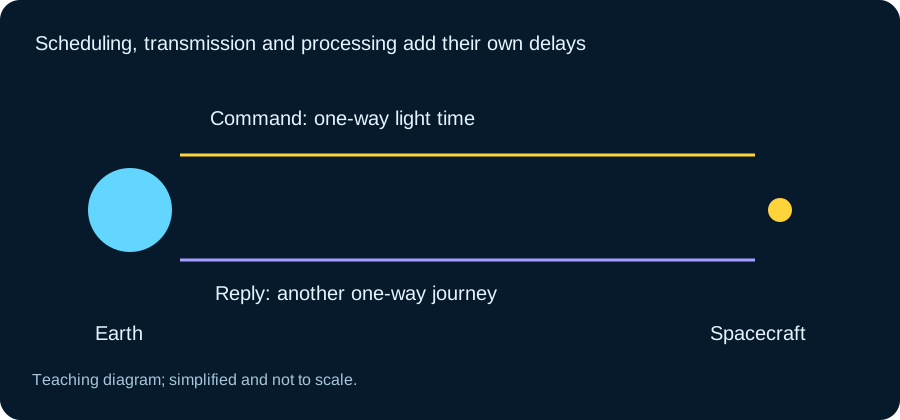
Radio waves travel at the speed of light, but the spacecraft is so distant that propagation takes a substantial time. A command must first travel outward. If the response can be generated immediately, it then has another journey back. Twice the one-way light time is therefore a useful lower-level estimate of the propagation portion of a command-and-response exchange, not a promise about the complete operational turnaround.
Ground scheduling, spacecraft processing and the time required to transmit data can add to the wait. A large dataset is not delivered merely because the first radio wave reaches Earth. The link also has a finite data rate. When reading a distance field, connect it with the physical delay while leaving room for those operational factors. This makes long-distance communication understandable without inventing a precise response timetable from a single number.
Earth's rotation creates a worldwide network problem
A distant target moves relative to a ground site's horizon as Earth rotates. A single antenna complex cannot provide the same view all day. NASA's Deep Space Network uses sites in widely separated longitudes so different locations can support missions as the planet turns. The geographical arrangement is as important to the story as the size of the dishes.
Each scheduled contact also competes with the needs of other deep-space missions. The network does not exist solely for Voyager. For an educational exercise, compare the network's locations with a world map and imagine which horizon faces the spacecraft at different times. Do not assume that every geometrically available antenna is receiving at once. Actual network operations depend on schedules, equipment availability and mission requirements beyond a simple visibility calculation.
Weak signals require patient engineering
A signal spreading across an enormous distance becomes difficult to receive. Large antennas, sensitive receivers, appropriate coding and careful operations help recover useful information. Increasing the size of a spacecraft icon on a map has no relation to that signal strength. Nor does a smoothly updating distance value show the rate at which Voyager's measurements reach Earth.
Read an official operational update when you want to know what the team has heard from the spacecraft. Then use the tracker to appreciate the distance behind the account. This combination is more informative than calling every page refresh a new message from Voyager. The remarkable feature of the mission is not an instant feed. It is the continuing ability to conduct a slow, technically demanding exchange with a small spacecraft far beyond the outer planets.
Follow the stages of a command without assuming an instant reply
Imagine that mission control needs Voyager to adjust a setting. Engineers first prepare and verify a command sequence. An available Deep Space Network antenna can then transmit it when the geometry and schedule permit. The command propagates through space, is received and processed by the spacecraft, and may prompt an action or a later telemetry message. A receiver on Earth must acquire and decode the returning signal. These are distinct events, not a single click in a browser.
The light-travel-time calculator helps with just the propagation part. If a tracker reports a one-way light time of 23 hours at a particular instant, a signal exchange with an immediate response would require at least 46 hours of travel time. That is only an illustration of the arithmetic, not a claim about today's Voyager distance or the duration of a real mission operation. Equipment checks, antenna availability and spacecraft processing can make the actual cycle longer.
What a DSN status display can and cannot tell you
A network activity page may show an antenna, a spacecraft designation or a scheduled contact. It describes ground-network operations at that moment; it does not necessarily identify the instrument whose science data will eventually be published. Equally, an ephemeris point on SpaceTracker.live can keep updating between contacts because the position is calculated from stored trajectory data. The point does not require a fresh radio message for every animation frame.
For mission health or instrument status, rely on a dated statement from NASA's Voyager team. For the communication infrastructure, read the Deep Space Network overview. Looking at both explains why navigation, receiving a faint signal and publishing a science result operate on different timetables.