
James Webb finds the most distant ring galaxy ever seen, possibly born from a head-on crash
Webb has identified GS18660, a galaxy wrapped in a ring of young stars, seen just 2.1 billion years after the Big Bang. It is the most distant ring galaxy found so far, and the evidence points to a smaller galaxy punching straight through its centre.

Ring galaxies are among the strangest shapes in the universe. Picture a bright hoop of young, blue stars circling an almost empty middle, like a cosmic smoke ring. They are rare even in our corner of space. Now the James Webb Space Telescope has found one so far away that its light left it when the universe was only about 2.1 billion years old.
The galaxy is called GS18660, and it is now the most distant ring galaxy ever identified. If the team behind the discovery is right, it was shaped by a violent head-on collision with a smaller galaxy. That would make it one of the earliest snapshots of such a crash ever caught.
What astronomers actually found
The study was led by Michele Perna, a postdoctoral researcher at the Centro de Astrobiología in Spain. It was published in Astronomy & Astrophysics on 8 September 2026 and drew wide attention in late October. The work is part of GA-NIFS, a Webb programme that studies distant galaxies in three dimensions.
Interestingly, nobody went looking for a ring. The team picked GS18660 because it looked stretched and lopsided in older Hubble Space Telescope images. Then Webb's Near-Infrared Spectrograph (NIRSpec) took a much closer look. Its integral field mode records a spectrum for every point in the image, so astronomers can map how gas moves and what it is made of. That detailed view revealed a clear ring of star formation hidden in the blur.
Using that 3D data, the researchers studied four things:
- the shape of the galaxy and its ring
- how its hot gas is moving
- the chemical makeup of that gas
- when and how quickly its stars formed
How a ring galaxy is born
The leading explanation for most ring galaxies is surprisingly simple. A small galaxy dives straight through the disk of a bigger one, close to its centre. The impact sends a wave of compressed gas rushing outward, much like ripples spreading after you drop a stone into a pond.
As that wave travels, gas piles up and collapses into new stars. The result is an expanding ring of bright, young stars. The most famous nearby example is the Cartwheel Galaxy, which Webb photographed in stunning detail in 2022.
Astronomers call these collisional ring galaxies. In today's universe, only about one galaxy in 10,000 has this shape. Finding a convincing one in the distant universe has been very hard, because they are faint and short-lived.
The clues pointing to a cosmic crash
The team did not rely on the ring's shape alone. They found several separate pieces of evidence that fit the collision story.
1. A runaway companion. A small galaxy sits next to GS18660 and is moving away from it at roughly 425 kilometres per second. That is about 1.5 million km per hour.
2. A bridge of gas. Webb detected a stream of gas linking the two galaxies. The speed of the gas changes along this bridge, which suggests the two are physically interacting.
3. The right position. The companion lies roughly along the main galaxy's short axis. That is exactly where you would expect an intruder to end up after plunging through a galaxy's disk.
4. A burst of new stars. Between 10% and 20% of the stars in the ring formed only in the last few tens of millions of years. That fits a recent, sudden trigger.
From the companion's speed and distance, the team estimates the crash happened about 17 to 42 million years before the moment Webb captured. On cosmic timescales, that is almost yesterday. The timing lines up with the star-formation burst, so both were likely caused by the same event.
Christopher Conselice, an extragalactic astronomer at the University of Manchester who was not part of the study, told Live Science the merger explanation looks like the more likely one. He also pointed out how rare it is to catch a system like this mid-story.
Why this discovery matters
This is more than a pretty shape. It could change how we picture the young universe.
Until now, many astronomers assumed collisional rings were about as rare in the early universe as they are today. GS18660 hints that head-on galaxy crashes may have been more common back then. That makes sense in principle. The early universe was smaller and more crowded, so galaxies bumped into each other more often.
If GS18660 is confirmed, scientists will need to revisit their estimates of how often these rings formed. That in turn feeds into bigger questions: how galaxies grew, how they got their shapes, and how quickly they settled into the spirals and ellipticals we see now.
It also caps a busy few weeks for Webb, which recently showed that the lava world TOI-561 b is surprisingly shiny. You can follow more of these stories in our Latest Astronomy News section.
Is there another explanation?
The researchers are careful not to overclaim. They describe the collision as their preferred scenario, not a final answer.
The main alternative involves a stellar bar. GS18660 shows a bar-like structure running north to south through its centre. In some galaxies, bars funnel gas into rings at set distances from the core, with no intruder needed. The team cannot yet tell whether this feature is a true bar or a side effect of the collision.
Either answer would be exciting. Webb has already found barred galaxies in the early universe, such as CEERS-2112. But no one has yet seen a clear bar-driven ring this early in cosmic history. So whichever way it goes, GS18660 will teach us something new about how fast young galaxies became structured.
What happens next
More observations should settle the debate. Deeper imaging could confirm whether the companion's path truly crossed the main galaxy's disk. Better maps of gas motion could also show whether the ring is expanding outward, as a collision would predict.
Webb is also scanning many more distant galaxies through programmes like GA-NIFS. If more early rings turn up, it will strengthen the idea that the young universe was a far rougher neighbourhood than we thought.
Key facts at a glance
| Detail | Value |
|---|---|
| Galaxy name | GS18660 |
| Seen as it was | ~2.1 billion years after the Big Bang |
| Record | Most distant ring galaxy found so far |
| Telescope and instrument | James Webb Space Telescope, NIRSpec |
| Likely cause | Head-on collision with a smaller galaxy |
| Estimated time since impact | 17–42 million years |
| Companion speed | ~425 km/s |
| Ring galaxies today | About 1 in 10,000 galaxies |
| Study | Perna et al., Astronomy & Astrophysics, Sept 2026 |
The bottom line
GS18660 is a reminder of how much Webb is still surprising astronomers. A galaxy chosen for looking slightly odd turned out to hold a record-breaking ring, and possibly the scar of an ancient crash. Whether the culprit was an intruding galaxy or the galaxy's own bar, it shows that young galaxies were already building complex structures within the universe's first few billion years.
Follow Webb yourself
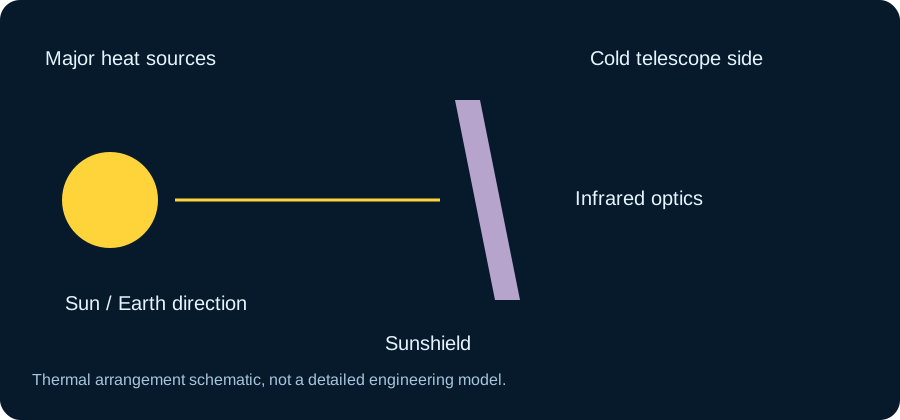
Webb does not orbit Earth. It works near the Sun–Earth L2 point, about 1.5 million kilometres away, and you can watch its position on our live JWST tracker. To understand why it sits there, read why JWST orbits L2, or see how it compares with its famous predecessor in Hubble vs James Webb.
Want something you can see with your own eyes tonight? Check the ISS tracker, or read our new guide on how to spot the ISS and Starlink from anywhere in the world.
Source: Perna et al. 2026, Astronomy & Astrophysics ↗ · Live Science report ↗

More to read
All astronomy news →


 From our guidesWhy JWST Orbits L2: Webb’s Location and Sunshield GeometryDeep Space · Aug 21, 2026