Hubble vs James Webb: Orbits, Wavelengths and Tracking
Hubble circles Earth while Webb travels around the Sun near L2, so the two observatories need different tracking methods.
Hubble and Webb are easiest to compare by separating orbit, wavelength range and scientific role. Hubble circles Earth; Webb operates around the Sun–Earth L2 region. Their tracker views therefore represent very different geometries even when both observatories are discussed on the same page.
They are partners, not replacements
Hubble and Webb overlap in some science but were designed with different strengths. Hubble observes ultraviolet, visible and near-infrared light; Webb is optimised mainly for infrared work. Astronomers can combine their observations, making the comparison more interesting than a simple contest over which telescope is “better.”
Hubble is an Earth satellite
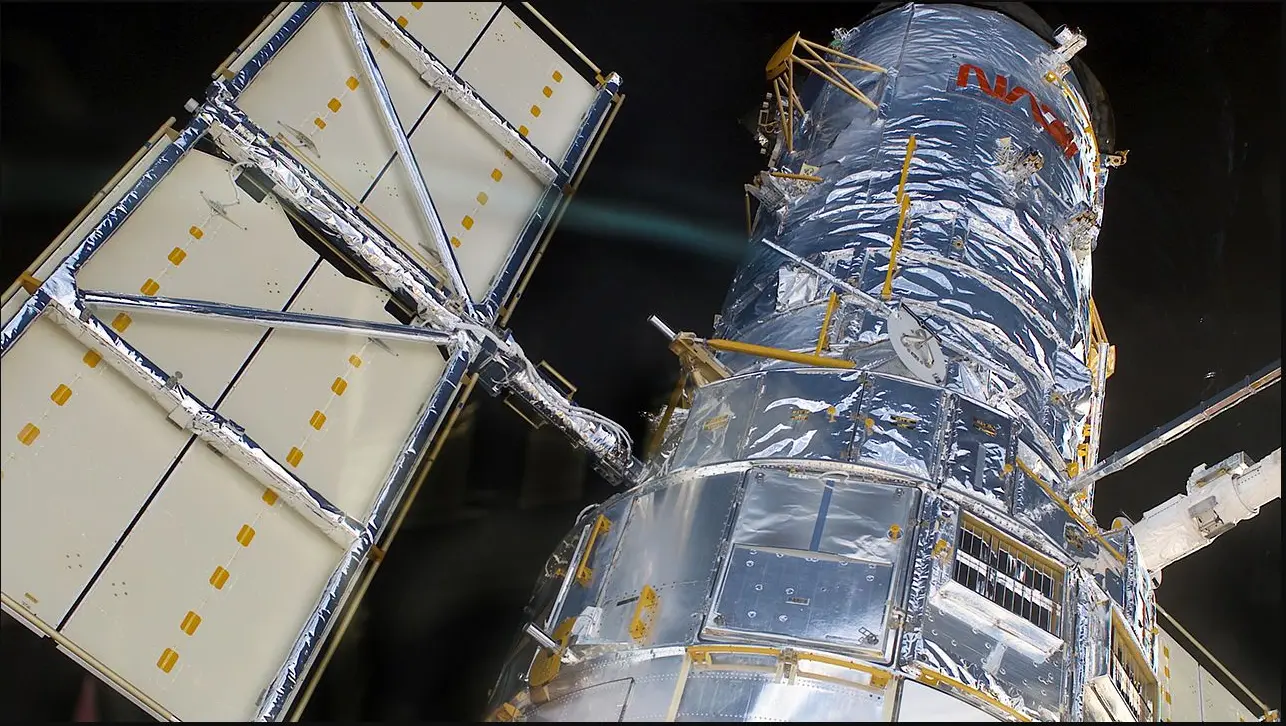
Hubble moves around Earth in low orbit, so current orbital elements and an SGP4-style propagation workflow can produce a ground track and observer-relative passes. Its position changes rapidly across the map. For a person on Earth, local azimuth and elevation are meaningful parts of the tracking experience.
Webb belongs on a deep-space page
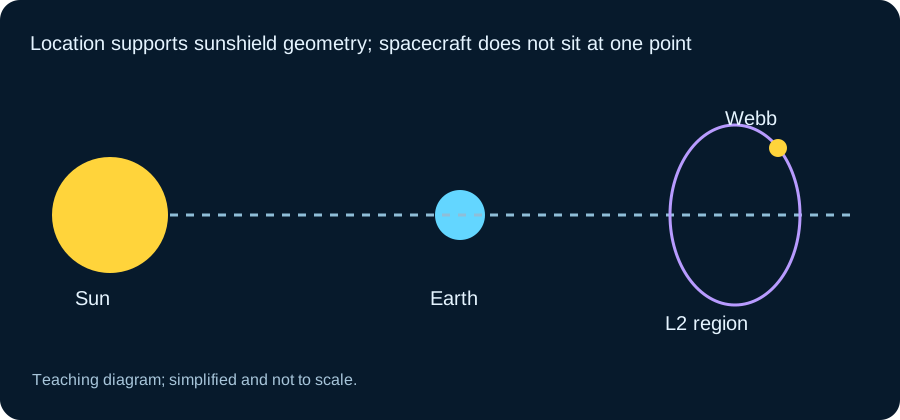
JWST operates near the Sun–Earth L2 region and follows a large orbit around the Sun rather than circling Earth like Hubble. A normal satellite TLE page is the wrong conceptual model. SpaceTracker.live therefore uses deep-space ephemeris information for Webb, displaying distances and a compressed solar-system view.
Different orbits support different science
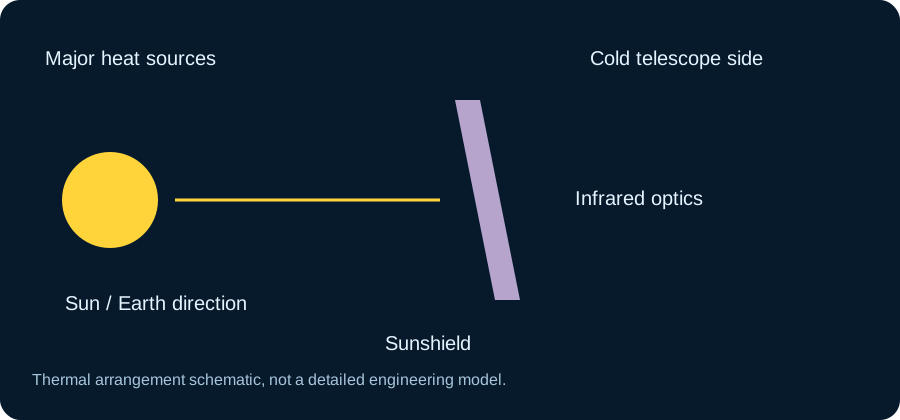
Hubble’s proximity allowed servicing missions and gives it a fast Earth orbit. Webb’s thermal design needs a stable, cold observing environment with the Sun, Earth and Moon kept on the shielded side. Its location and sunshield are connected directly to its infrared sensitivity.
Start with the question you want the observatory to answer
The two telescopes are best understood through their observing capabilities, not as contestants for a single title. Hubble has a long record of observations across ultraviolet, visible and parts of the infrared spectrum. Webb concentrates on infrared observations with a different instrument system and thermal design. A target can reveal different information in different wavelength ranges, so comparing their images requires more than choosing the one that looks more dramatic.
For a nebula, one view may emphasise glowing gas while another reveals structures associated with dust or cooler objects. For distant galaxies, infrared capability helps study light shifted toward longer wavelengths. These are scientific reasons for complementary observatories. They do not mean that a public orbit tracker can reproduce the telescopes' images. The tracker follows the observatories; the science products belong to their instruments and data-processing workflows.
Cold optics are part of Webb's observing method
Warm equipment emits infrared radiation that can interfere with sensitive measurements. Webb's design therefore includes a large sunshield and a location that supports keeping major heat sources on the shielded side. It is not enough to place a large mirror anywhere in space and expect the same observing performance. Thermal control and instrument requirements help explain the mission's distant trajectory.
Hubble has a different design and operates in Earth orbit. Its location brought advantages for the servicing missions that formed part of its history. Webb was designed for a very different environment and deployment sequence. When comparing the spacecraft, consider those engineering choices alongside mirror size. The instruments, wavelengths, thermal conditions and mission architecture together explain their capabilities much better than a simple claim that one telescope replaces the other.
Their tracker distances need different reference points
On Hubble's page, altitude is naturally understood above Earth. On Webb's page, Earth distance, Sun distance and the L2-region geometry are more useful. Comparing these numbers as if they were the same orbital radius creates confusion. A deep-space scene may compress distances so all objects fit on screen, while an Earth map shows a ground projection. Neither presentation should be read with a ruler as a true-scale drawing.
Use the labelled numerical fields to compare the environments. Hubble repeatedly circles Earth; Webb travels with Earth around the Sun while moving around the L2 region. These different paths explain why one can be represented with an Earth-satellite propagator while the other needs an interplanetary ephemeris. They also explain why Webb does not have an ordinary sequence of naked-eye overhead passes comparable to the ISS.

Make an image comparison that teaches something
Pick one astronomical object for which official Hubble and Webb images exist. Read both captions before comparing colour or sharpness. A blue or red region may represent different filter choices, not the true colour of a cloud as an astronaut would see it. The instruments sample different parts of the electromagnetic spectrum, and those differences can highlight star formation, dust or other structures in different ways.
Next ask about the observing conditions. Hubble repeatedly passes around Earth, and targets may be temporarily hidden by the planet. Webb works near the Sun–Earth L2 region with a large sunshield that maintains a more consistent thermal arrangement. Neither spacecraft sits in a permanently fixed position on a celestial map. Their orbit drawings operate at dramatically different distance scales.
Two trackers, two coordinate questions
For Hubble, the natural questions include its sub-satellite latitude and longitude, altitude and next local pass. For Webb, Earth distance, Sun distance and trajectory around the L2 region provide more meaningful context. Comparing the numerical altitude of Hubble to the distance of Webb from Earth as though they were identical measurements would be misleading. The frame, origin and timestamp must accompany any distance quoted from a tracker.
Use Hubble's Earth-orbit display and Webb's deep-space tracker for spatial context. For a telescope's actual discoveries or instrument status, look up a dated mission update from Hubble or Webb. A tracking visualisation and an observatory's science record are complementary, not interchangeable.