Why JWST Orbits L2: Webb’s Location and Sunshield Geometry
L2 helps the James Webb Space Telescope keep its optics cold and its major heat sources on one side.
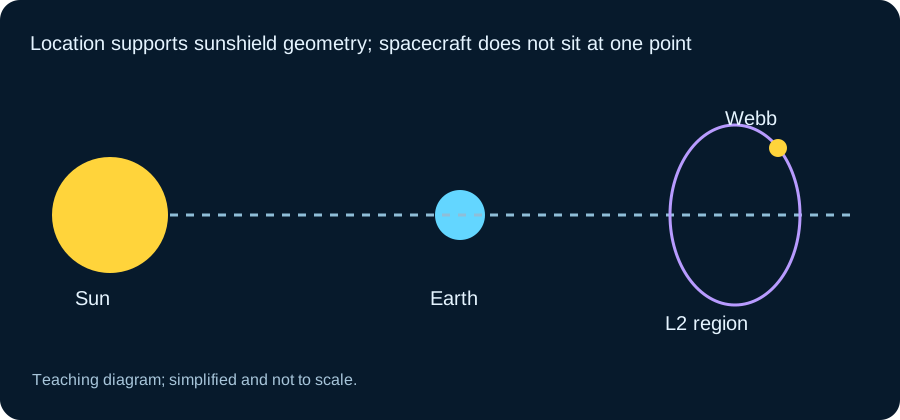
The important idea is that Webb is not parked motionless at a single point. It travels in a large orbit around the Sun–Earth L2 region while keeping the Sun, Earth and Moon on the same general side of its sunshield. NASA’s Webb orbit material explains why that geometry supports the observatory’s thermal design.
Why not a low Earth orbit
A telescope close to Earth repeatedly experiences changing illumination, Earth blockage and a warmer environment. Low orbit also creates a fast ground track that is useful for an ISS-style map but less suitable for Webb’s thermal architecture. The chosen orbit trades easy physical access for a stable observing geometry.
L2 is a region in a moving system
The Sun-Earth L2 point is defined by the relationship between the Sun and Earth in a rotating frame. It moves around the Sun with Earth; it is not a permanent pin fixed against the stars. Webb's path around the region is therefore different from the simple picture of a satellite orbiting a stationary ball. A diagram is useful only if that moving context remains clear.
Imagine following Earth around the Sun while looking outward, away from the Sun. The L2 region lies in that general direction, beyond Earth. Webb travels around the region rather than sitting exactly on the mathematical point. A changing Earth distance is consequently normal. Do not interpret a few different tracker values as evidence that the telescope has drifted out of place without considering the full trajectory and its reference frame.
Keeping the hot side and cold side separate
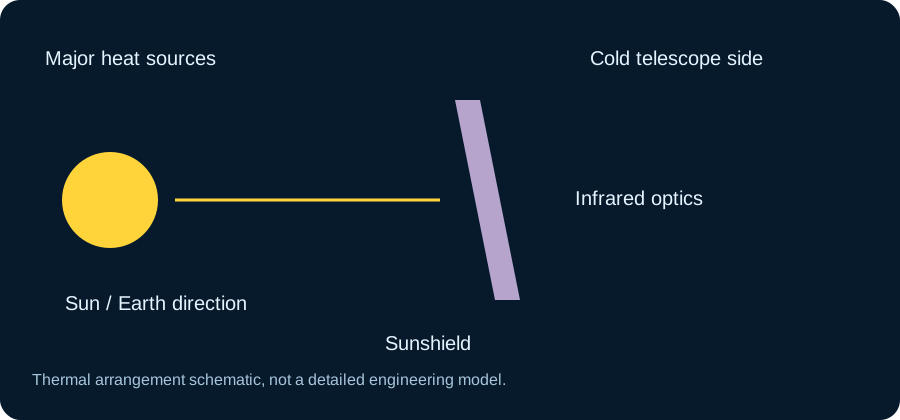
Webb's sunshield helps separate the side exposed to major heat sources from the cold telescope and instrument side. The mission location supports that geometry while the observatory travels around the Sun. Infrared sensitivity gives a practical reason for the thermal arrangement: the observatory needs to control its own heat contribution to the measurements.
The public illustration often exaggerates the shield and spacecraft so they can be seen. That is an educational choice, not a depiction of their physical size relative to Earth. Likewise, a bright Sun icon does not simulate the actual heat flow through the observatory. Read the mission's design explanation for the engineering, and use the tracker to understand the relative locations. Combining the two gives a clearer picture than expecting the animation to demonstrate every thermal detail.
An orbit around L2 needs maintenance
A Lagrange-point region does not eliminate all operational work. Webb's orbit and orientation are managed through planned operations, including trajectory maintenance. The idea that gravity makes the telescope stay forever at an exact point without any corrections is too simple. The mission's real path is designed to support observing, communication and thermal requirements together.
This also explains why the phrase 'parked at L2' should be treated as shorthand. It can help a beginner locate Webb in the broad Sun-Earth arrangement, but it hides the motion around the region. Watch the changing geometry over time rather than expecting an immobile marker. The trajectory in a public tracker describes position; it does not reveal every maneuver, scheduling decision or spacecraft-control command that supports the observatory.
What you can learn from the numbers
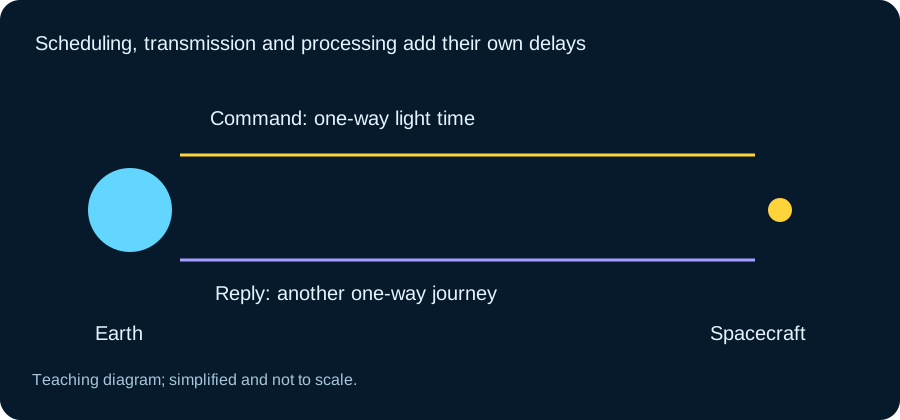
Earth distance helps explain communication delay, while Sun distance gives context for the shared journey around our star. If the page includes a speed, check which body or frame it is relative to. The same spacecraft can have different speed values in different frames without any contradiction. Timestamp and units are essential parts of all these fields.
For a practical comparison, save a few clearly dated readings for your own notes and compare their trends over a suitable interval. Do not infer an emergency from one rounded value. Follow official mission updates for operational status. The tracker becomes most useful when it teaches the geometry: Webb is near Earth in a solar-system sense, very far from an ordinary Earth satellite, and moving within a deliberately chosen region that supports its infrared science.
Sketch the geometry before opening the animation
Place a lamp at one end of a table to represent the Sun and a small object farther away to represent Earth. The Sun–Earth L2 region lies beyond Earth along roughly the same direction from the Sun. This is a conceptual sketch, not an exact geometry model. Webb does not remain at the mathematical point; its actual trajectory follows a large three-dimensional path in the L2 neighbourhood while it travels around the Sun with Earth.
Webb's location supports the thermal and observing design. The observatory's sunshield helps keep the telescope's cold side separated from incoming heat and light, while solar arrays and communications equipment serve different sides of the spacecraft. Its attitude and trajectory are controlled operationally; “at L2” should not be read as “the engine can never fire” or “the telescope is gravitationally motionless.”
Reading Earth distance and light time together
The Earth-to-Webb distance changes through its orbit, so a tracker may show different values on different dates. The round-trip radio travel time is approximately twice the one-way light time, before allowing for spacecraft or ground-system handling. A slowly changing distance value is a calculation based on an ephemeris, not proof of an active antenna contact. This is particularly important when a map is animated at an accelerated time scale.
To investigate the mission further, use Webb's tracker for the geometry and NASA's Webb mission site for confirmed operations and discoveries. When describing a Webb image, identify the instrument and wavelength as well as the target. The orbit supports the science, but an orbital distance alone cannot tell you what the telescope observed today.