Why Moon Phases Change: Sunlight, Geometry and the Cycle
Understand why the Moon waxes and wanes, how illumination changes, and how moonrise times connect with the lunar phase cycle.
The Moon can look dramatically different from one evening to the next, but the Moon itself is not switching its light on and off. Moonlight is reflected sunlight, and the Moon is normally half illuminated by the Sun, except during a lunar eclipse. What changes is the fraction of that sunlit half that we can see from Earth as the Moon moves around our planet. That changing geometry produces the familiar sequence of lunar phases.
To follow the phase cycle, compare the Moon’s position relative to Earth and the Sun over several nights rather than looking at one image in isolation. The tracker supplies the local observing geometry, while NASA’s lunar-phase material explains why the visible illuminated fraction changes.
The lunar phase cycle is about 29.5 days
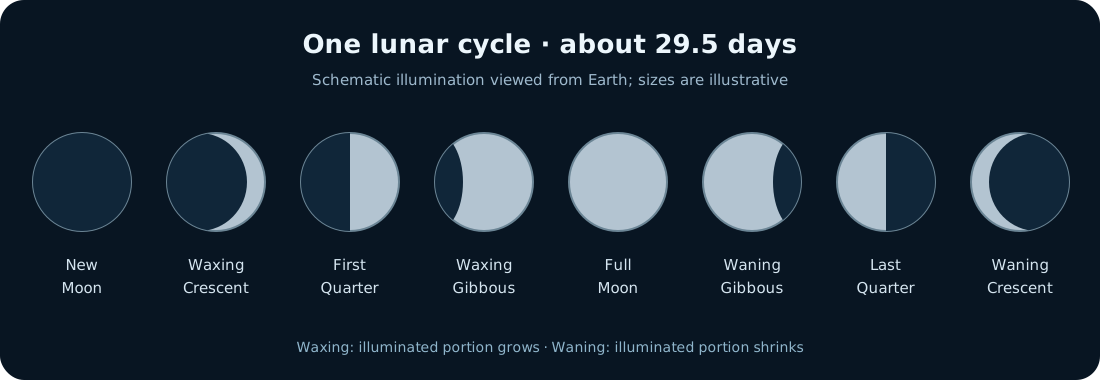
NASA describes the repeating visible phase cycle as about 29.5 days. It begins around new Moon, grows through waxing crescent and first quarter, becomes waxing gibbous, reaches full Moon, then decreases through waning gibbous, third quarter and waning crescent. The cycle is continuous, so the percentage of illumination changes a little every day rather than jumping suddenly from one named phase to the next.
“Waxing” and “waning” tell you what happens next
Waxing means the illuminated fraction is increasing toward full Moon. Waning means it is decreasing after full Moon. The terms first quarter and third quarter describe positions in the lunar cycle, even though the Moon appears approximately half illuminated from Earth at those times. If you want the current percentage and lunar age, open Moon Phase Today.
Why tonight can feel different from today
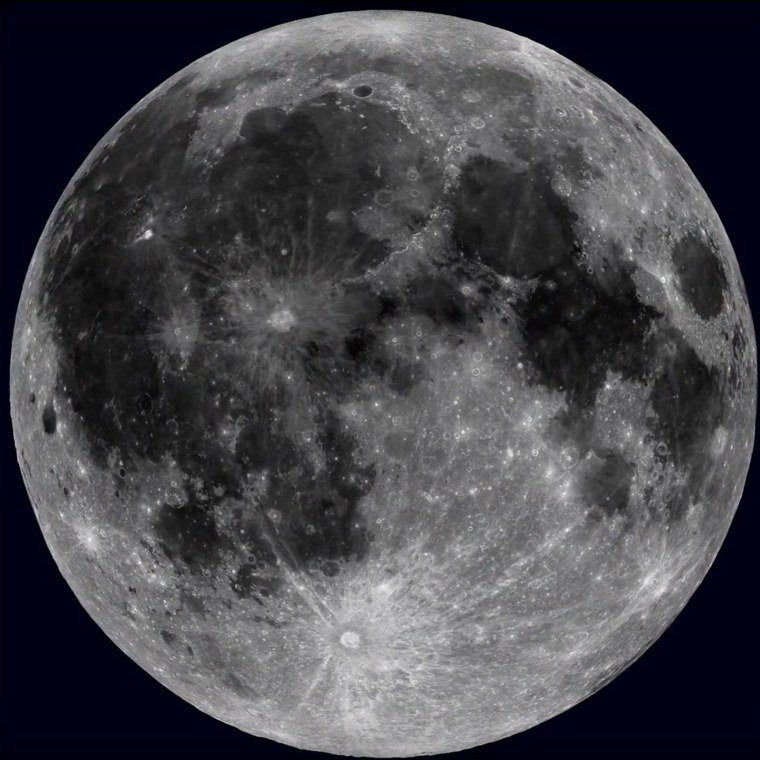
For most dates, the formal phase name will not change between daytime and evening, but the Moon’s altitude, direction and visibility certainly can. That is why SpaceTracker.live separates Moon Phase Today from Moon Phase Tonight. The first is useful for the daily phase and illumination; the second is better when you are deciding what the evening sky may look like from your location.
Moonrise shifts with the phase
Moonrise and moonset are tied to lunar geometry. NASA notes that a full Moon generally rises around sunset and sets around sunrise, while a first-quarter Moon rises around midday and sets around the middle of the night. These are useful patterns, but exact times vary by date and location. Use the Moonrise & Moonset Time calculator instead of assuming the same schedule everywhere.
Why the crescent is good for surface detail
A very bright full Moon is impressive, but it is not always the best phase for seeing craters and mountain relief. Near the boundary between lunar day and night, called the terminator, sunlight strikes the surface at a low angle and produces long shadows. Those shadows can make terrain easier to notice. A crescent, quarter or gibbous Moon can therefore be especially rewarding through binoculars or a small telescope.
Illumination percentage and lunar age add useful context
The named phase is only a convenient label. The illumination percentage tells you how much of the visible lunar disk is sunlit, while lunar age estimates how far the Moon has progressed through the current synodic cycle since new Moon. Two evenings can both be described as waxing gibbous yet still have noticeably different illumination. Checking those values helps you understand gradual change instead of treating phases as eight isolated states.
How to use the phase pages together
- Check today’s phase and illumination.
- Open tonight’s Moon page for evening context.
- Use the Moon Live Tracker for altitude, azimuth and distance.
- If a full Moon is approaching, check the next full Moon countdown.
Moon phase is a lighting geometry, not Earth’s shadow moving across the lunar disk. Reading the phase together with the Moon’s position and rise/set times makes the nightly change easier to understand from an observer’s point of view.
Earth's shadow is not the everyday phase mechanism
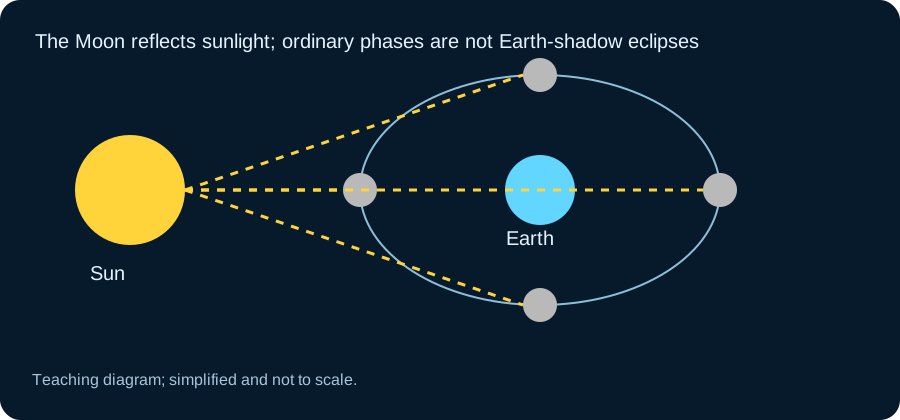
The ordinary lunar phases come from our changing view of the Moon's sunlit side. Earth's shadow produces a lunar eclipse under the appropriate alignment, which is a different event. Confusing the two makes it difficult to understand why the phase cycle continues every month while lunar eclipses are much less frequent.
Imagine moving around a lamp-lit ball and looking at it from different directions. You can see a crescent, half-lit view or nearly full illuminated face without another object casting a shadow on the ball. The Moon's real motion supplies that changing geometry for an observer on Earth. The illustration is deliberately simple, but it explains the basic cause more accurately than the idea that Earth gradually covers the Moon during every ordinary month.
A quarter phase is about progress through the cycle
The terms first quarter and third quarter refer to the Moon's progress through the phase cycle. They do not mean that only a quarter of the visible disk is illuminated. At those named phases, the disk looks approximately half lit. Separating the cycle fraction from the visible illuminated fraction removes a common source of confusion in phase tables.
Lunar age and illumination percentage describe different aspects of the same changing geometry. Age counts time since a reference new Moon, while illumination gives the sunlit fraction of the visible disk. The relationship is not a straight line that adds an equal number of percentage points every day. Use them as complementary clues rather than converting one to the other through a simple daily rule.
The orientation depends on your viewpoint
Pictures of waxing and waning phases can look rotated when compared with your own sky. Hemisphere, location, time and the Moon's position all affect how the illuminated portion is oriented relative to your horizon. A fixed 'lit on the right' instruction is therefore not reliable everywhere. The underlying waxing or waning status remains meaningful even when the apparent tilt differs.
When you compare a diagram with the sky, first identify the phase and then allow for rotation. A telescope or camera setup may also invert or mirror the image. This does not change the lunar surface or the phase sequence. Understanding the viewpoint makes the diagram a useful guide rather than a rigid template that every observer must see in exactly the same orientation.
Why full Moon is not always the best surface view
A bright full Moon can be visually impressive and convenient for landscape photographs, but much of the visible surface is illuminated from near the observer's direction. Shadows across terrain are consequently less dramatic than near the terminator at other phases. For observing crater relief, a quarter or suitably placed crescent can provide a richer view.
Try following the same region over several evenings with binoculars or a telescope if you have appropriate equipment. Note how the shadow boundary changes rather than assuming the feature itself has changed shape. Use the phase page for the cycle and the live tracker for direction and altitude. This connects the monthly pattern with an actual observing experience, while keeping cloud, horizon obstruction and camera settings separate from the Moon's changing illumination.
Frequently asked questions
Does the Moon make its own light?
No. The light we call moonlight is sunlight reflected from the lunar surface.
Why can I sometimes see the Moon during the day?
The Moon can be above the horizon during daylight for many phases. Visibility depends on its position, brightness and the surrounding sky.