
Leonid Meteor Shower 2026: When and How to See the Fastest Meteors of the Year
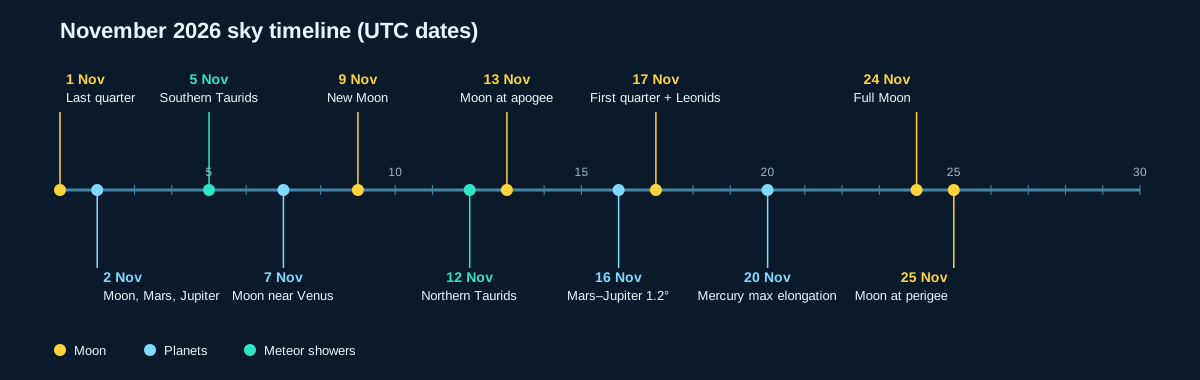
The Leonids peak on the night of 17–18 November 2026. With the Moon setting around midnight just as Leo rises, the hours before dawn offer the best chance to catch these swift, bright meteors.

Every November, Earth ploughs through a trail of dust left behind by a comet, and the sky responds with some of the fastest shooting stars of the year. The Leonid meteor shower peaks on the night of 17–18 November 2026, and this year the timing works out nicely: the Moon sets around midnight, just as the shower's source in the sky starts to climb. Here is everything you need to know to see the Leonids from wherever you are.
Leonid meteor shower 2026 at a glance
- Active: 6 – 30 November
- Peak: night of 17–18 November 2026 (the maximum is predicted around 23:45 UTC on 17 November)
- Expected rate: about 10–15 meteors per hour under a dark sky
- Speed: about 71 km/s — among the fastest of any major shower
- Radiant: the “Sickle” of Leo, the Lion
- Parent comet: 55P/Tempel–Tuttle
- Moon: first quarter on 17 November, about 55% lit at the peak, setting close to midnight
Want to know what is happening above your own location on any night this month? Our meteor shower tonight page shows which showers are active and where to look.
When is the best time to watch?
The single most useful tip for the Leonids is simple: watch after midnight.
Meteors seem to fly out of one point in the sky called the radiant. For the Leonids, that point lies in the constellation Leo, which only rises in the late evening. We worked out the timings for a few cities on the peak night:
- London: the radiant rises around 22:15, and the Moon sets around 23:30.
- New York: the radiant rises around 22:50, and the Moon sets just before midnight.
- Delhi: the radiant rises around 23:50, and the Moon sets shortly after midnight.
So in most of the Northern Hemisphere, the sky gets properly dark at roughly the same time the radiant gets above the horizon. From then until the first light of dawn, the radiant climbs higher and the meteor count goes up. The last two or three hours before dawn on 18 November are usually the best of all.
If clouds spoil the peak, don't give up. The Leonids produce a few meteors on the nights before and after, so 16–19 November are all worth a try. Our best time to stargaze tonight tool combines darkness, the Moon and the cloud forecast for your location.
Where to look
You do not need to stare at Leo. Leonid meteors can appear anywhere in the sky; if you trace their trails backwards, they all point back towards the Lion. In fact, meteors that appear 40 to 60 degrees away from the radiant tend to have longer, more impressive trails.
A good plan is to face east or south-east after midnight, lie back and take in as much of the sky as you can. If you are not sure where Leo is, open Live Sky AR on your phone, point it at the sky and search for “Leonids” — the app marks the radiant and shows the constellation lines around it. The backwards question-mark shape of the Sickle, with the bright star Regulus at its base, is easy to recognise once you have spotted it.
Why are Leonid meteors so fast?
The comet behind the Leonids, 55P/Tempel–Tuttle, orbits the Sun in the opposite direction to Earth. Its dust therefore meets our planet almost head-on, at a combined speed of around 71 kilometres per second. At that speed, a grain of dust no bigger than a grain of sand heats the air in front of it to thousands of degrees and leaves a quick, bright streak.
Fast meteors often look white or slightly green, and the brightest ones can leave a persistent train — a glowing smoky line that hangs in the sky for a few seconds, sometimes longer. Watching a train slowly twist in the upper-atmosphere winds is one of the best rewards of a night outdoors.
Tempel–Tuttle takes about 33 years to go around the Sun. It last passed through the inner Solar System in 1998 and will next return in 2031. You can see its long, tilted orbit — and where the comet is right now — in our 3D Solar System Live model under the comets layer.
The famous Leonid storms
Most years the Leonids are a modest shower. But they are famous for something few other showers can do: every few decades, when Earth crosses a dense, freshly-laid ribbon of comet dust, the Leonids turn into a meteor storm.
In November 1833, observers in North America reported meteors falling “like snowflakes” — so many that the event helped start the scientific study of meteors. In 1966, observers in the western United States saw rates estimated at thousands of meteors per minute for a short time. Strong displays returned around the comet's last visit, especially in 1999 and 2001, when many skywatchers saw hundreds or even thousands of meteors in an hour.
2026 is not expected to be a storm year — the rich dust trails are not in Earth's path this time. Some forecasters expect the shower to become more active again as the comet's 2031 return approaches, so the Leonids are one to keep watching over the next decade. Our meteor shower calendar lists all the major showers of the year so you can plan ahead.
How to see more Leonids: practical tips
- Get away from lights. Even a small town's glow can hide most faint meteors. A park or field outside the city makes a huge difference.
- Give your eyes 20–30 minutes. Your night vision builds up slowly. Avoid looking at your phone screen, or switch it to a red night mode.
- Lie back. A reclining chair or a mat lets you watch a wide area of sky without a stiff neck.
- Dress warmly. November nights are cold in much of the Northern Hemisphere. Bring layers, a hat and a hot drink.
- Be patient. Meteors come in clusters and gaps. Plan to watch for at least an hour.
- Skip the telescope. Binoculars and telescopes show too little sky. Your eyes are the best tool for meteors.
Can you see the Leonids from the Southern Hemisphere?
Yes, but with fewer meteors. Leo rises later and stays lower in the sky south of the equator, so the radiant only gets a decent height in the hour or two before dawn. Observers in Australia, South Africa or South America should focus on that pre-dawn window, face north-east, and expect lower rates than in the north.
Bonus: Taurid fireballs and bright planets
The Leonids are not alone in November. The Northern Taurids, which peak around 12 November, are slow and few, but they are known for occasional bright fireballs that can light up the whole sky. Any slow, bright meteor you see coming from the direction of Taurus is probably a Taurid rather than a Leonid.
November evenings also offer bright planets. Saturn is well placed in the evening sky, while Jupiter and Mars rise later in the night — handy targets while you wait for meteors. Check what is up on any night with our night sky tonight map, and see the Moon's phase on our Moon phase tonight page.
Photographing the Leonids
Catching a meteor on camera takes luck, but you can improve the odds. Put a camera on a tripod, use a wide-angle lens, set manual focus to infinity and take continuous exposures of 15–25 seconds at a high ISO. Point the camera about 45 degrees away from the radiant rather than straight at it. Leave it running for an hour or two, and check the frames later — you may find a streak you never saw with your eyes.
Many phones now have a night or astrophotography mode that does a similar job on a tripod. Keep expectations modest: only the brightest Leonids will show up on a phone.
Report what you see
Meteor counts from ordinary observers still help scientists. The International Meteor Organization collects visual counts from around the world, and the American Meteor Society takes reports of bright fireballs. NASA's meteors and meteorites pages explain more about where shooting stars come from.
Quick summary
Go out after midnight on the night of 17–18 November 2026, find a dark spot, let your eyes adjust and watch a wide stretch of sky until dawn. With the Moon out of the way and Leo rising, you have a good chance of catching a few of the fastest meteors of the year — and maybe one that leaves a glowing trail behind it. Clear skies!
Keep exploring
All guides → Skywatching GuidesCan You See ISS, Hubble and Starlink with the Naked Eye?Skywatching Guides · Aug 21, 2026Skywatching GuidesHow to See the ISS Tonight in the USA: Live Pass Times & Viewing GuideSkywatching Guides · Aug 21, 2026
 Skywatching GuidesAstronomy Calculators: Units, Equipment and Useful ResultsSkywatching Guides · Oct 1, 2026
