How to See the ISS Tonight in the USA: Live Pass Times & Viewing Guide
Use your location to check upcoming ISS passes, then learn exactly when and where to look in the U.S. night sky.
Searching for ISS tonight USA viewing information? The useful answer depends on your exact location, the station’s orbit, local twilight and whether the ISS is still illuminated by the Sun. Use the SpaceTracker.live ISS tracker to check upcoming passes for your location, then use this guide to interpret the time, direction and elevation.
For tonight’s ISS viewing, begin with your own location and the next predicted pass rather than a generic global time. Pay particular attention to maximum elevation and whether the station is sunlit while your sky is dark enough. NASA’s Spot the Station guidance provides the observing background for these conditions.
Is the ISS visible from my location tonight?
An ISS pass over the United States is not automatically a visible pass. The station must be above your local horizon, the sky must be dark enough, and the station must still be sunlit. Enter your location in the live tracker and check the next predicted passes rather than relying on a national schedule. A pass that works for New York may not work at the same time for Chicago, Houston, Los Angeles or another city.
What time can you see the ISS tonight?
Visible opportunities are commonly clustered around dawn and dusk because the ground can already be dark while the ISS remains illuminated by sunlight. NASA’s Spot the Station guidance explains that sighting opportunities occur within a few hours before or after sunrise or sunset. That is why a pass listed in the middle of a bright afternoon may be geometrically overhead but still difficult or impossible to see with the naked eye.
How to read an ISS pass prediction
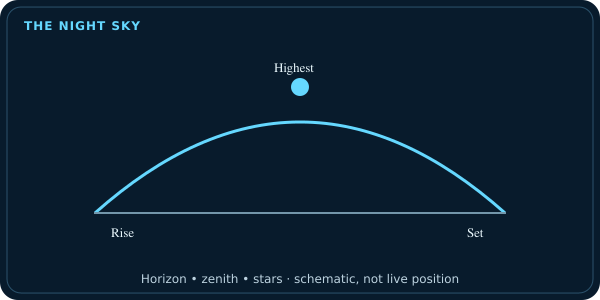
Start with four values: local time, maximum elevation, the direction where the ISS appears, and the direction where it disappears. Elevation is measured from the horizon: 0° is the horizon and 90° is directly overhead. A higher pass is generally easier to spot because the station spends more of the pass well above buildings, trees and haze.
If your tracker lists an azimuth rather than a compass word, use our azimuth and elevation guide to translate the angle into a practical direction.
What does the ISS look like?
The ISS often looks like a bright star moving steadily across the sky. It does not normally blink with the red and green navigation lights associated with aircraft, and it does not make abrupt turns. NASA similarly describes the station as resembling a bright star or airplane moving across the sky without flashing lights or changing direction.
Do you need binoculars or a telescope?
No. A good visible pass can be seen with the naked eye. In fact, binoculars can make the first acquisition harder because their narrow field of view makes it easier to lose the moving object. First identify the ISS with your unaided eyes; optical equipment is optional.
Why a predicted pass may still be hard to see
Cloud, haze, light pollution, a low maximum elevation, bright twilight or the station entering Earth’s shadow can reduce visibility. Pass predictions are therefore best treated as geometry plus viewing conditions, not a guarantee of brightness. Check the sky conditions and choose a viewing spot with a clear horizon.
A practical five-minute viewing routine
- Open the ISS live tracker and set your location.
- Choose a pass with a convenient local time and useful elevation.
- Note the appearance direction and maximum height.
- Go outside several minutes early and let your eyes adapt.
- Scan the expected direction for a steady, bright moving point.
How to choose the best pass when several are listed
If your location has multiple ISS passes, do not choose only by clock time. Compare maximum elevation, duration and the starting direction. A higher pass generally spends more of its path above buildings and haze, while a very low pass can be difficult even when the station is technically above the horizon.
Illumination matters just as much. The best naked-eye opportunities usually occur when your sky is dark enough but the ISS is still in sunlight. Read Why Sunset and Sunrise Matter for that geometry, then use Satellites Above Me shortly before the event for current local context.
City lights usually do not prevent a bright ISS pass
Light pollution washes out faint stars and satellites, but a favorable ISS pass can be bright enough to see from a major city. The more important practical problems are often cloud, haze, a blocked horizon and looking in the wrong direction. Choose an open area with a broad sky view and arrive several minutes early.
For an ISS sighting, prioritize a pass with useful elevation and a dark-enough sky while the station remains sunlit. Check the pass again shortly before going outside so the displayed times match your current location and the latest orbital data.
If you want a photo, observe the pass first
A phone can record a bright pass, but exposure and focus are challenging against a dark sky. For a first attempt, prioritize seeing the station rather than magnifying it. A wide field of view and a stable support are more forgiving than trying to track a fast-moving point at high zoom.
For interpreting the direction numbers in the pass table, use our azimuth and elevation guide.
Check what kind of pass the page is showing
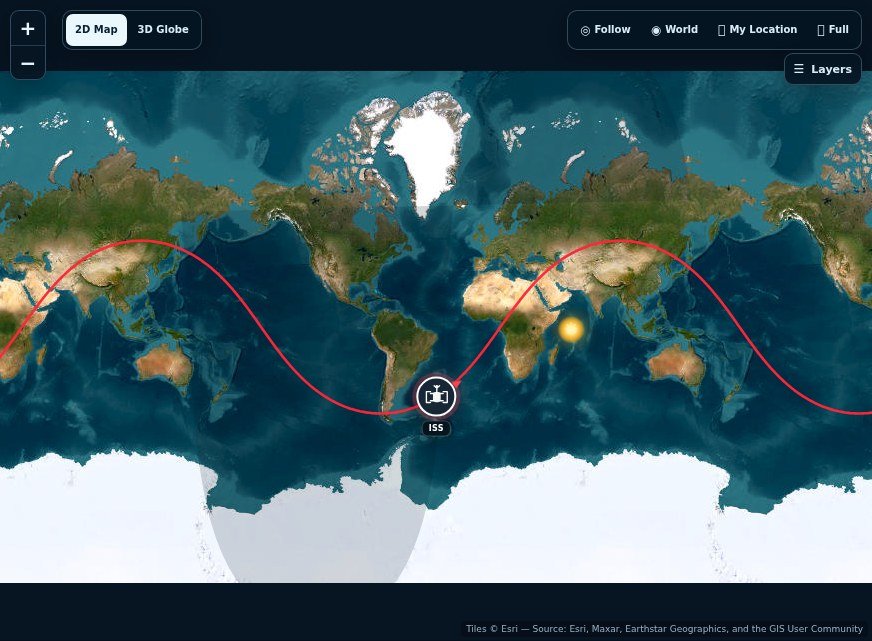
A pass table can answer two different questions: when the station is above the horizon, and when it is likely to be visible. Read the labels before treating every listed event as a sighting opportunity. A geometric pass can be calculated correctly even if the station is in shadow or your sky is still bright. If illumination is not part of the displayed forecast, compare the timing with an official viewing forecast before making a special trip.
This is particularly useful when you find several opportunities close together. One might peak higher but occur in daylight; another might be lower but take place in more useful lighting. Weather and obstructions add a final local check. Choose an event that fits all of those conditions rather than the one with the most impressive map path. There is no need to chase every predicted orbit crossing to enjoy a clear station sighting.
A practical example without inventing tonight's time
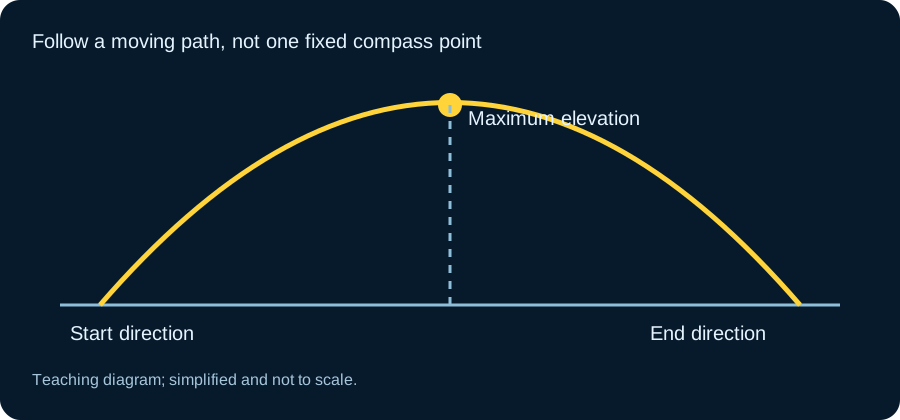
Suppose a future pass is listed as beginning in the northwest, reaching forty degrees elevation, and ending in the southeast. Those are illustrative values, not a forecast for your city. Before going outside, identify the northwest horizon and imagine a route that rises to less than halfway between the horizon and the zenith. Watch a broad region around the starting point instead of keeping your eyes fixed on the phone.
If the first section passes behind a building, look where the path should emerge into open sky. The station continues along its orbit while your view is blocked. Do not restart your search at the appearance point after the expected time has passed. The local prediction is most helpful as a moving sequence: start, highest point, finish. Following that sequence is usually easier than trying to interpret a world map while the station is already overhead.

Keep a small sighting record
Afterward, save the location, local time, direction and rough duration of your observation. A simple note is more informative than an enlarged photograph with no context. If you did not see the station, write down whether there was cloud, an obstructed horizon or strong twilight. These details explain many missed passes and help you choose a better opportunity next time.
Do not replace a missing observation with certainty that the tracker was wrong. First compare the selected location, time zone, object identity and forecast type. On the other hand, if those checks agree and a prediction appears inconsistent, preserve the exact page and values so it can be investigated. The aim is to connect a calculated pass with a real sky observation. One careful record can teach you more than repeatedly refreshing the map without knowing which value has changed.
Frequently asked questions
Is the ISS visible every night in the USA?
No. Viewing opportunities vary by location and orbital geometry. Some locations may get several useful opportunities in a short period and then fewer for a while.
How long is the ISS visible?
A useful visible pass may last several minutes, but the exact duration depends on the geometry and when the station enters or leaves sunlight.
Can I see the ISS from a major U.S. city?
Often yes, when the timing and geometry are favorable. Brightness can make the ISS visible even from light-polluted urban areas, although a clear view of the sky helps.
Why did the ISS disappear suddenly?
It may have entered Earth’s shadow. The station can stop reflecting sunlight even while it remains above your horizon.