
Geminid Meteor Shower 2026: The Best Meteor Show of the Year, With a Dark Sky
The Geminid meteor shower 2026 peaks on the night of 13 to 14 December with only a thin crescent Moon in the evening sky. Here is when to watch, the best dark-sky hours for six cities, where to look, how to photograph the meteors and why this is the best Geminid year in a while.

If you only go out for one meteor shower this year, make it the Geminids. The Geminid meteor shower 2026 peaks on the night of 13 to 14 December, and this year it comes with a rare gift: a nearly moonless sky. The Moon is new on 9 December, so on peak night it is only a thin crescent, about 20 percent lit, that sets in the mid-evening. From then until dawn, nothing in the sky competes with the meteors.
Under a truly dark sky, the Geminids can produce more than 100 meteors an hour at their best, which makes them the strongest and most reliable shower of the year. This guide covers when to watch, where to look, what to expect from your location and how to get the most from a cold December night. If you want to know what else is happening in the sky, our meteor shower tonight page always shows which showers are active right now.
Geminid meteor shower 2026 at a glance
- Active: roughly 4 to 17 December
- Best night: 13 to 14 December 2026, with good rates on the nights either side
- Predicted peak: 14 December, between about 06:00 and 14:00 UTC depending on the forecast (see below)
- Rate under ideal skies: up to about 120 to 150 meteors per hour at the radiant overhead
- Moon: waxing crescent, about 20 percent lit, sets mid-evening
- Radiant: near the bright star Castor in the constellation Gemini
- Parent body: asteroid 3200 Phaethon
When exactly is the peak?
Forecasters do not quite agree. Some predictions, including the one used by EarthSky and In-The-Sky.org, put the peak at about 05:44 UTC on 14 December. Others, based on the International Meteor Organization's solar-longitude forecast, place it closer to 14:00 UTC on 14 December. The good news is that the Geminid peak is broad, with high rates lasting around 12 hours or more, so both predictions point to the same practical answer.
For North and South America and Europe, the best night is 13 to 14 December. For Asia and Australia, 13 to 14 December is also excellent, and if the later forecast is right, the evening of 14 December could still deliver strong rates. If the weather gives you the choice, watching both nights is the safest plan. The official calendar from the International Meteor Organization lists the latest predictions.
The best hours from your location
Unlike most meteor showers, the Geminids get going early. The radiant in Gemini rises in the north-east soon after sunset, so meteors start appearing by mid-evening, and rates climb as the radiant gets higher. The radiant is highest at around 2 a.m. local time, which is when you will see the most meteors.
We calculated the moonset and dawn times for the night of 13 to 14 December for six cities. The blue bars show the dark, moon-free window, and the yellow dot shows when the radiant is highest.
In New York, the Moon sets at about 20:36 and dawn twilight begins around 05:32, which leaves almost nine hours of dark sky. London's window runs from about 19:56 to 05:54, and New Delhi's from about 21:02 to 05:40. In each case, the radiant climbs very high, 70 to 88 degrees above the horizon, around 2 a.m. That is close to perfect.
The Southern Hemisphere has a harder time. From Sydney, the Moon sets at about 23:04, dawn starts before 04:00, and the radiant only reaches about 24 degrees above the northern horizon. You will still see Geminids, especially the long, bright ones, but expect noticeably fewer than viewers in the north. Check your own local times with our twilight times page and the Moon phase tonight tool.
Where to look
You do not need to stare at Gemini. Meteors appear all over the sky, and the ones far from the radiant have longer, more impressive trails. The best approach is to lie back, face roughly east or south (north in the Southern Hemisphere), and take in as much sky as you can, ideally with the radiant about 40 to 60 degrees off to one side of your view.
To find the radiant itself, look for the two bright stars Castor and Pollux, the "twins" of Gemini, rising in the north-east in the evening and passing high overhead after midnight. Above them and to the right you will see Orion and the reddish star Betelgeuse. Our night sky tonight guide shows what is above your horizon, and the planets visible tonight page will help you avoid mistaking a bright planet for a slow meteor.
Why the Geminids come from an asteroid
Most meteor showers are made of dust from comets. The Geminids are different. Their source is 3200 Phaethon, a rocky object about 5 kilometres across that swings closer to the Sun than Mercury does. Every 1.4 years or so Phaethon is baked at more than 700 °C, which cracks its surface and releases dust. Over centuries that dust has spread along Phaethon's orbit, and every December Earth ploughs through it.
Because Geminid particles are denser than fluffy comet dust, they burn more slowly and tend to produce bright, often yellowish meteors that move at a moderate 35 km per second. That makes them easier to see and photograph than the faster Leonids. Asteroids are in the news this week too: a new study of samples from asteroid Bennu found surprising chemistry inside single molecules, as we reported in our Bennu sample story. NASA's Geminids page has more on Phaethon.
How to watch: a simple checklist
- Get away from lights. Even a short drive out of town can double the number of meteors you see.
- Give your eyes time. It takes 20 to 30 minutes for your eyes to adapt to the dark. Avoid your phone screen, or use a red-light mode.
- No telescope needed. Binoculars and telescopes narrow your view. Your eyes are the best tool.
- Dress for December. You will be still for a long time. Layers, a hat, gloves and a blanket or reclining chair make a big difference.
- Stay at least an hour. Meteors come in bursts and lulls. Patience is rewarded.
- Check the weather. Clouds are the biggest enemy. Have a backup night ready.
For a full planning routine, our night sky planning guide covers weather, darkness and location step by step.
Photographing the Geminids
The Geminids are one of the best showers for photography because so many of their meteors are bright. Use a camera on a tripod with a wide-angle lens, set focus to infinity on a bright star, open the aperture wide, and take continuous exposures of about 15 to 25 seconds at ISO 1600 to 3200. Point the camera about 40 degrees away from the radiant and leave it running for an hour or two. Most modern phones can do a version of this in night mode on a tripod. Many of the best Geminid images are stacks of dozens of frames, each catching one or two meteors.
How 2026 compares
The Moon makes or breaks a meteor shower, and 2026 is a good year. In 2025 a waning crescent Moon rose in the early morning hours. In 2027 the Geminids will fall close to a full Moon, which will wash out all but the brightest meteors. That makes this December one of the best chances in several years to see the Geminids at their full strength. If you enjoyed November's Leonids, our Leonid 2026 viewing guide covers how the two showers differ.
Geminid meteor shower 2026: quick FAQ
What night should I watch? The night of Sunday 13 December into Monday 14 December 2026 is the best. The nights of 12 to 13 and 14 to 15 December are also worth trying.
What time is best? From moonset, usually around 20:00 to 21:00 in the Northern Hemisphere, until dawn. Rates are highest around 2 a.m. local time.
Can I see the Geminids from India? Yes. From New Delhi the Moon sets around 21:00 and the radiant climbs almost overhead around 2:20 a.m., so conditions are excellent if skies are clear and you can get away from city lights.
Will the Moon interfere? Hardly at all. The thin crescent Moon, about 20 percent lit, sets in the evening.
Do I need special equipment? No. Just your eyes, warm clothes and a dark place. A reclining chair helps.
Mark the date on your calendar now, and check our space events calendar for everything else happening in the December sky. With a clear night and a little patience, the Geminid meteor shower 2026 could be the best meteor show you see for years.
Source: SpaceTracker.live calculations; NASA (Geminids); International Meteor Organization

Keep exploring
All guides →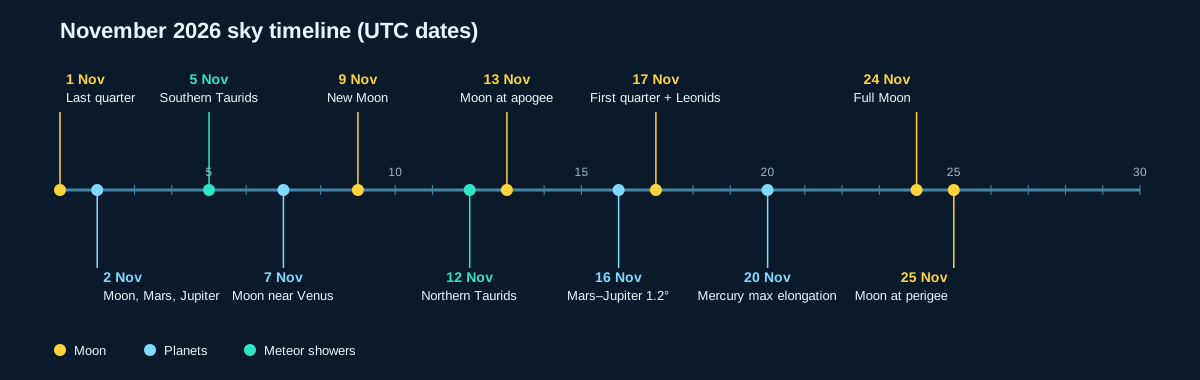 Skywatching GuidesNovember 2026 Night Sky: Mars and Jupiter, Leonids and a Near-Perigee Full MoonSkywatching Guides · Oct 30, 2026
 Skywatching GuidesHow to Use Live Sky AR: Direction, Permissions and AlignmentSkywatching Guides · Oct 1, 2026
 Skywatching GuidesHow to Plan a Night Sky Session from Your LocationSkywatching Guides · Oct 1, 2026
