
Leonid Meteor Shower 2026: When, Where and How to Watch
The Leonid meteor shower 2026 peaks on the night of 17-18 November, with the Moon setting around midnight. Our guide covers the best viewing time, the radiant in Leo, expected rates, the shower's famous storms and simple photo tips.

Every November, Earth ploughs through a stream of dust left behind by a comet, and the result is one of the most famous meteor showers in the sky. The Leonid meteor shower 2026 peaks on the night of 17 to 18 November. It won't be a storm this year, but the conditions are kind. The Moon sets around midnight and leaves the best hours of the night dark. If you have never watched the Leonids properly, this is a good year to start.
This guide covers when to look, where to look, how many meteors to expect, and the small tricks that make a big difference. For a live view of what's active tonight from your location, keep our meteor shower tonight page open on your phone.
Leonids 2026 at a glance
- Peak night: 17–18 November 2026. Most guides put the peak around 23:45 UTC on 17 November.
- Best viewing time: after midnight until the first light of dawn, local time.
- Expected rate: up to about 10–15 meteors per hour under dark, clear skies.
- Active period: roughly the first week of November to the end of the month, with low rates away from the peak.
- Moon: close to first quarter. It sets around midnight, so the pre-dawn hours are dark.
- Speed: about 71 km per second, among the fastest of any annual shower.
NASA's November skywatching guide gives the same advice: look before dawn on the 17th and 18th, after moonset.
Where do the Leonids come from?
The meteors are tiny grains of dust, most no bigger than a grain of sand, shed by Comet 55P/Tempel-Tuttle. This comet swings around the Sun once every 33 years or so. Each time it passes, it leaves a fresh trail of debris along its orbit. Every year in mid-November, Earth crosses that path. The grains hit our upper atmosphere at enormous speed and burn up about 100 km above the ground. That burning is what we see as a shooting star.
Because the Leonids meet Earth almost head-on, they arrive very fast. That gives them a special look: quick, bright streaks, and sometimes a glowing trail called a persistent train that can hang in the sky for a second or two after the meteor has gone.
Finding the radiant in Leo
If you trace the paths of the Leonid meteors backwards, they all seem to come from one spot in the constellation Leo, the Lion. That spot is called the radiant. It lies inside a pattern of stars shaped like a backwards question mark, known as the Sickle, which forms the Lion's head and mane. The bright star Regulus marks the bottom of the Sickle. You can find more about the brightest stars and how to recognise them in our brightest stars guide.
Leo rises in the east around midnight in mid-November and climbs higher until dawn. This is why the shower gets better after midnight: the higher the radiant, the more meteors reach your part of the sky.
How to watch the Leonids: a simple plan
You do not need a telescope or binoculars for a meteor shower. In fact, they get in the way, because they show only a tiny patch of sky. Your eyes are the best tool. Here is what works:
- Get away from lights. Even a short drive out of town can double the number of meteors you see. A rooftop with no nearby lamps is better than a bright street.
- Wait for the Moon to set. In 2026 it goes down around midnight. After that the sky is at its darkest.
- Lie back and look up. Face roughly east or overhead, not straight at the radiant. Meteors seen about 40 to 60 degrees away from the radiant often have longer, prettier trails.
- Give your eyes 20 minutes. It takes time for your night vision to fully adjust. One glance at a bright phone screen resets the clock, so use red light mode or dim your screen.
- Be patient. Meteors come in clusters with quiet gaps. Plan for at least an hour.
- Dress for the cold. November nights are chilly in most of the Northern Hemisphere. A blanket, a reclining chair and a hot drink make a real difference.
Observers in the Southern Hemisphere can see the Leonids too. Leo rises later and stays lower, so rates are usually a bit lower, but the hours before dawn still give a decent show.
Storms of the past
The Leonids have a wild history. In some years Earth has hit a dense, young trail from the comet, and the sky has filled with meteors. In November 1833, observers in North America saw so many that people woke their neighbours, convinced the stars were falling. The storm of 1966 was even more intense. For a short time, watchers in the western United States counted dozens of meteors every second. Strong displays also returned around 1999 to 2002, a few years after the comet's last pass.
Comet Tempel-Tuttle is next due back near the Sun in the early 2030s. Experts at groups like the International Meteor Organization will study the dust trails closely to work out whether a storm is possible then. For 2026, expect a normal, steady shower: not a blizzard, but a lovely one.
Want to photograph a Leonid?
Catching a meteor on camera is easier than it sounds. Use a camera that allows manual settings, put it on a tripod, and choose a wide-angle lens. Set the focus to infinity, open the aperture wide, use an ISO between 1600 and 3200, and take exposures of 15 to 25 seconds. Then let the camera shoot continuously for an hour or two. Most frames will be empty, but a fast, bright Leonid may cross one of them. Point the camera about halfway up the sky, a little to one side of Leo, for the best chance of a long trail.
More to see on the same night
While you wait for meteors, look around. Before dawn in mid-November, Mars and Jupiter shine close together low in the east-southeast. On 15 and 16 November they are only about a degree apart, and the pair stays close for days afterwards. Our planets visible tonight tool shows their exact position for your city. If you love Jupiter, read our Jupiter opposition 2027 guide to plan ahead for its best view of the decade.
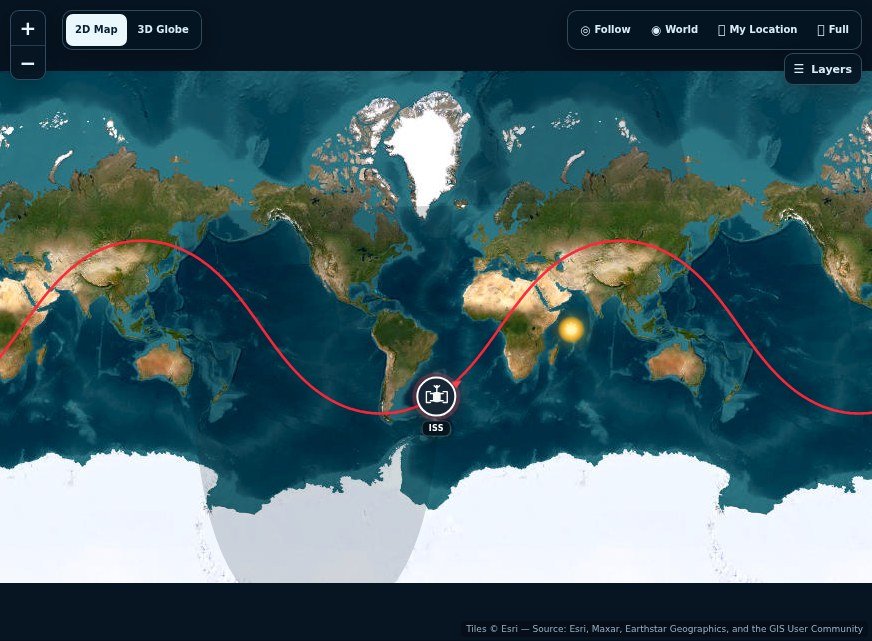
You may also spot satellites gliding steadily across the sky. A fast, smooth light that doesn't flicker or fade quickly is usually a satellite, not a meteor. The ISS tracker will tell you if the space station is passing over during your session.
What comes after the Leonids?
November keeps going. A full supermoon rises on 24 November, and Uranus reaches opposition on 25 November. Then in mid-December comes the Geminid meteor shower, usually the strongest of the year. You can find all these dates, with times converted for your location, on our upcoming space events page. For background reading on the shower itself, NASA keeps a helpful Leonids explainer.
So mark the night of 17 November, set an alarm for the small hours, and head outside. Even a handful of fast, bright Leonids is a great reminder that the space around Earth is never really empty.

Keep exploring
All guides →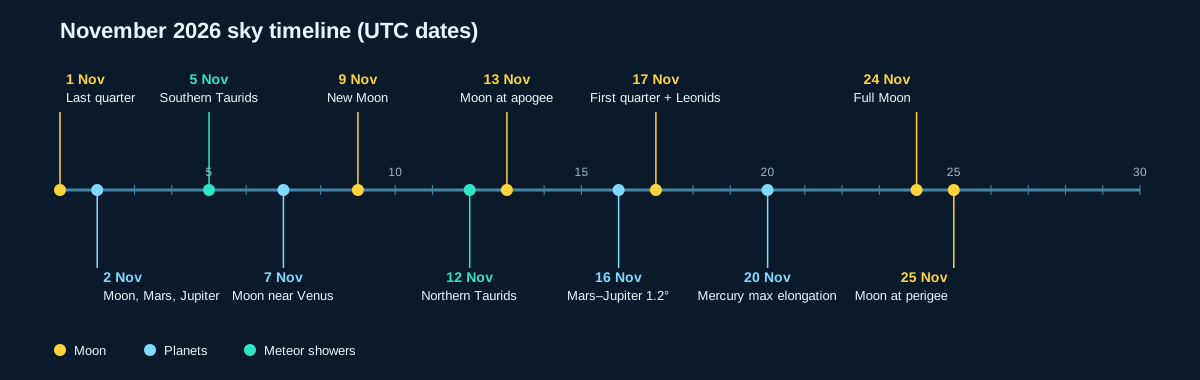 Skywatching GuidesNovember 2026 Night Sky: Mars and Jupiter, Leonids and a Near-Perigee Full MoonSkywatching Guides · Oct 30, 2026
 Skywatching GuidesWhere to Look for Satellites: Azimuth and ElevationSkywatching Guides · Aug 21, 2026
 Skywatching GuidesAstronomy Calculators: Units, Equipment and Useful ResultsSkywatching Guides · Oct 1, 2026
