
Shine Bright for Voyager: How to Flash VGR to Voyager 1 on 17 November
NASA is inviting people everywhere to flash V-G-R in Morse code at the sky after sunset on 17 November, hours before Voyager 1 becomes the first spacecraft one light-day from Earth. Here is how to take part, which way to point, and what time the milestone falls where you live.

On the evening of Tuesday 17 November, NASA wants the night side of Earth to blink. Its Shine Bright for Voyager's Light-Day campaign asks anyone with a torch, a bike light or a phone to point it at the sky after sunset and flash three letters in Morse code: V, G and R. Hours later, on Wednesday 18 November, Voyager 1 becomes the first object people have ever built to sit a full light-day away from home.
We covered the milestone itself in our earlier report on Voyager 1 reaching one light-day from Earth. This piece is the practical companion. It explains how to take part in Shine Bright for Voyager, which part of the sky to aim at, what time the crossing happens where you live, and why the flashing is a salute rather than a message the spacecraft can actually read.
What NASA is asking you to do
The instructions are short. After sunset on 17 November, pick up any light you have: a flashlight, a glow stick, a solar lantern, a bike lamp or your phone. Point it upward and spell out VGR. A dot is a quick flash of less than a second. A dash is a longer flash of about one second. Leave a small gap between the flashes inside a letter, wait a second or more before the next letter, and keep repeating the whole sequence for about a minute.
- V: dot, dot, dot, dash (three quick flashes, then one long)
- G: dash, dash, dot (two long flashes, then one quick)
- R: dot, dash, dot (quick, long, quick)
If counting flashes in the cold does not appeal, NASA has built a browser flasher at go.nasa.gov/vgr. Open it on a phone or tablet, hold the screen toward the sky and it blinks the code for you. Covering a torch with your hand or a piece of card works just as well as clicking the switch, and it is kinder to cheap switches. NASA also suggests filming or photographing your signal and sharing it with a tag for @NASA, and it encourages people to see whether neighbours, schools or local landmarks want to join in with a building-sized flash.
Why VGR? It is the short label the mission has used for decades. On the Deep Space Network's public displays, Voyager 1 appears simply as VGR1. Three letters also suit a beginner: V and R are mostly dots, G is mostly dashes, and the whole message takes only a few seconds to send.
When Voyager 1 reaches one light-day in your time zone
NASA puts the crossing at 5:16:07 a.m. Eastern Standard Time on Wednesday 18 November 2026. That is 10:16:07 UTC. The countdown on NASA's What Is a Light-Day? page shows the same moment. If you have seen 06:16 UTC quoted elsewhere, go with NASA's own figure. Here is how 10:16:07 UTC converts for some major cities:
| City | Local time of the crossing |
|---|---|
| Los Angeles | Wed 18 Nov, 02:16 PST |
| Chicago | Wed 18 Nov, 04:16 CST |
| New York | Wed 18 Nov, 05:16 EST |
| São Paulo | Wed 18 Nov, 07:16 |
| London | Wed 18 Nov, 10:16 GMT |
| Paris / Berlin | Wed 18 Nov, 11:16 CET |
| Johannesburg | Wed 18 Nov, 12:16 SAST |
| Dubai | Wed 18 Nov, 14:16 |
| Karachi | Wed 18 Nov, 15:16 PKT |
| New Delhi | Wed 18 Nov, 15:46 IST |
| Singapore | Wed 18 Nov, 18:16 |
| Tokyo | Wed 18 Nov, 19:16 JST |
| Sydney | Wed 18 Nov, 21:16 AEDT |
| Auckland | Wed 18 Nov, 23:16 NZDT |
For most of the world the official light show on 17 November comes before the crossing. Readers in Tokyo, Sydney and Auckland have a bonus: the moment itself falls after dark on 18 November, so they can flash VGR again at the exact second. A light-day, by the way, is a distance, not a length of time. It is how far light travels in 24 hours, which NASA gives as 25,902,068,356 km (16,094,799,096 miles). Our astronomy distance converter turns that into AU, light-hours or anything else you prefer.
Which way to point your light
Voyager 1 is far too faint to see with any telescope, but it does have a real direction in the sky. The spacecraft lies in the constellation Ophiuchus, at a right ascension of about 17h 15m and a declination of about +12°. On these dates that puts it roughly 40° east of the Sun, so in the early evening it hangs in the western sky and sets a few hours after sunset.
We calculated where it sits 45 minutes after sunset on 17 November. From New York it is about 31° up toward the west-southwest and sets at around 20:06. From London it is about 33° up in the south-west to west-southwest and sets at around 20:32. From New Delhi it is about 28° up almost due west and sets at around 20:17. From Los Angeles it is about 29° up in the west-southwest. The simple rule for the northern hemisphere: face west, turn a little to the left, and aim about a third of the way up the sky.
Southern hemisphere viewers have a harder time. From Sydney, Voyager 1 sets only about a quarter of an hour after the Sun, so point low toward the west-northwest as soon as the Sun has gone down. Nobody needs to be precise, of course. The gesture counts, not the aim. If you want to know what else is above the horizon while you are outside, check tonight's night sky guide or the list of planets visible tonight for your location.
A salute, not a message
No torch on Earth will reach Voyager 1 in any way the spacecraft could notice. A flashlight beam spreads out within metres, and over 25.9 billion km its light thins to nothing. Voyager 1 also has no working eyes pointed at us: its cameras were switched off in 1990, shortly after it took the famous Pale Blue Dot image of Earth. Real conversations happen by radio, through the giant dishes of NASA's Deep Space Network in California, Spain and Australia. Our guide on how NASA communicates with Voyager explains how a whisper of a signal is pulled out of the noise.
From 18 November onward, every command sent to Voyager 1 takes more than a day to arrive, and the reply takes more than a day to come back. A simple question and its answer will be about two days apart. You can try the numbers yourself with our light-travel time calculator.
There is a nice quirk in the timing. Light leaving Earth on the evening of 17 November would, in principle, reach Voyager's distance about 24 hours later. For someone in Sydney or Tokyo flashing just after sunset, that is an hour or two before the 10:16 UTC crossing, while the spacecraft is still just inside one light-day. For someone in New York or London, it is after the crossing. It changes nothing for the probe, but it makes a good fact to share while you are out with a torch in the cold.
A scare in October
The celebration comes only weeks after a worrying silence. NASA's Jet Propulsion Laboratory said that the Deep Space Network could not detect Voyager 1's radio signal on 18 and 19 October 2026, and that the signal returned on 20 October before engineers had sent any commands. Voyager mission manager Kareem Badaruddin said the team was relieved to be back in contact and keen to understand what had happened. The details are in JPL's update on the communications pause.
Power is the long-term worry. Voyager 1 runs on heat from decaying plutonium, and its supply falls by about 4 watts every year. In September 2026 engineers carried out a power-saving job nicknamed the "Big Bang", switching off three devices and replacing them with three lower-power alternatives so the remaining science instruments can keep running a little longer. You can follow the probe's distance and speed on our Voyager 1 live tracker, which updates as the light-day line comes closer.
The details are in JPL's update on the communications pause, and we told the full story in our report on Voyager 1 losing contact for two days.Voyager 2, and a very long road ahead
Voyager 1's twin is not far behind on this list. Voyager 2 took the longer route past Uranus and Neptune and moves a little more slowly, and NASA expects it to reach one light-day in November 2035, nine years from now, if it is still talking to us by then. The Voyager 1 vs Voyager 2 comparison explains why the two paths split, and the Voyager 2 tracker shows where the second probe is today.
One light-day sounds enormous, and it is: about 173 times the distance from Earth to the Sun. Yet the nearest star, Proxima Centauri, is about 4.24 light-years away, which works out at more than 1,500 light-days. Voyager 1 is heading roughly toward the star Gliese 445 (also catalogued as AC +79 3888), and according to NASA it will pass within about 1.7 light-years of it in about 40,000 years. By then it will have been silent for a very long time, carrying its Golden Record through the dark.
Your quick checklist for 17 November
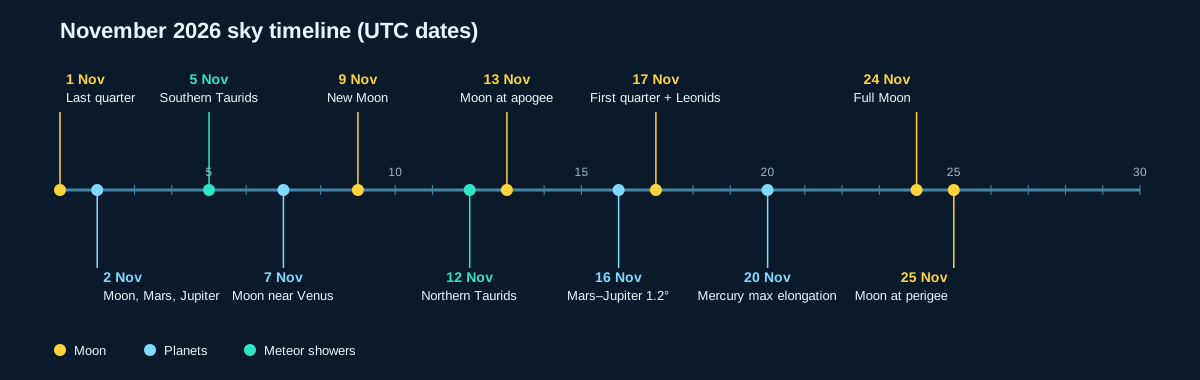
Wait until after sunset on Tuesday 17 November. Face west, a little to the south if you are in the northern hemisphere, and aim about a third of the way up. Flash V (dot dot dot dash), G (dash dash dot) and R (dot dash dot), pausing between letters, and repeat for about a minute, or let NASA's flasher do it for you. Then stay out a little longer: the Leonid meteor shower peaks on the night of 17 to 18 November, and our meteor shower tonight page shows the best times for your sky.
Shine Bright for Voyager will not change a single number on the spacecraft. But Voyager 1 has spent more than 49 years carrying a greeting from Earth outward. For one evening, the people of Earth get to send a small flash of light after it. NASA keeps a live count of both probes on its Where Are Voyager 1 and 2 Now? page if you want to watch the numbers tick past the line on 18 November.
Source: NASA Science (Shine Bright for Voyager's Light-Day; What Is a Light-Day?); NASA JPL (Voyager 1 communications pause update)

More to read
All astronomy news →


 From our guidesNovember 2026 Night Sky: Mars and Jupiter, Leonids and a Near-Perigee Full MoonSkywatching Guides · Oct 30, 2026