
BepiColombo Mercury Orbit Insertion: What Happens on 21 November
ESA says BepiColombo’s two orbiters will be captured into orbit around Mercury on 21 November 2026. Here is how the capture works, why Mercury is so hard to reach, what follows through April 2027 and where the planet will be in our sky.

One of the hardest arrivals in planetary exploration is now close. On 21 November 2026, ESA's Mercury Planetary Orbiter and JAXA's Mercury Magnetospheric Orbiter, known as Mio, are due to be captured into orbit around Mercury while still joined together. The date comes from ESA, and it is the climax of an eight-year journey that began with an Ariane 5 launch in October 2018. This guide explains what BepiColombo Mercury orbit insertion involves, why it is so difficult and what happens afterwards. You can follow the mission on our BepiColombo tracker page.
What will happen on 21 November 2026
The spacecraft that reaches Mercury is a stack of three parts. ESA's Mercury Planetary Orbiter (MPO) does most of the work, JAXA's Mio rides on top of it, and a sunshield structure called MOSIF protects Mio from the heat. On 3 September 2026 the Mercury Transfer Module, the electric-propulsion stage that carried the stack for years, was released. Since then MPO's own thrusters have steered everything, as ESA explains in its BepiColombo arrival updates.
That update also reports that on 24 September MPO fired its thrusters in the new configuration for a push of 11.4 metres per second, the first planned correction after the transfer module left. More small correction slots were planned before the main insertion sequence. ESA's operations team describes the insertion as a sequence of 16 burn manoeuvres that starts on 21 November and continues into March 2027, according to ESA's article on the arrival simulations. So 21 November is the start of a campaign, not a single dramatic moment.
A gentle capture, not a big engine burn
Many readers expect a planet arrival to be one long rocket burn. BepiColombo is designed differently. ESA's mission pages describe a "weak stability boundary" capture: the spacecraft drifts into the region where Mercury's gravity begins to dominate and needs only a small manoeuvre to be captured. The first orbit is a stretched ellipse of about 674 by 178,000 kilometres, according to ESA's Getting to Mercury page. ESA says this approach is more flexible and more robust against failures than the traditional single big burn.
The far end of that first orbit, 178,000 km, is roughly half the distance from Earth to the Moon, while the near end is only 674 km above Mercury. Our deep space mission tracker lists BepiColombo alongside the other probes we follow, so you can compare how far each spacecraft is from home.
Why Mercury is so hard to reach
Mercury is the closest planet to the Sun, yet it is one of the hardest to orbit. ESA's BepiColombo factsheet says the Sun's gravity makes it so difficult that even more energy is needed than for a mission to Pluto. A spacecraft falling toward the Sun gains speed, so it must brake for years to be captured by a small, fast planet.
BepiColombo did this with nine planetary flybys, one of Earth, two of Venus and six of Mercury, plus ion thrusters on the transfer module. ESA's Journey to Mercury page notes that these thrusters accumulated the highest total impulse ever achieved in a space mission. The mission was meant to arrive in December 2025, but a thruster power problem found in September 2024 forced the team to replan the approach, which moved arrival to November 2026.
Only two earlier missions reached the planet. NASA's Mariner 10 flew past three times in 1974 and 1975, and NASA's MESSENGER orbited it from 2011 to 2015. BepiColombo will be only the second mission to orbit Mercury, and the first to put two spacecraft there at the same time.
Two orbiters, two jobs
MPO studies the planet itself: its surface, its interior and its composition. ESA lists instruments such as the BELA laser altimeter, the MERTIS thermal infrared spectrometer, the MPO-MAG magnetometer and the ISA accelerometer. Mio, built by JAXA, studies Mercury's magnetosphere, the region of space shaped by the planet's magnetic field and by the solar wind that blows past it.
Together the two orbiters give scientists a view from the inside out: what the planet is made of, how its magnetic field behaves and how the Sun's particles shape both. ESA calls Mercury the least explored planet of the inner Solar System, so even basic maps and measurements from the new orbiters will matter.
The timeline after capture
Capture is only the first step. ESA's arrival timeline lists the stages that follow:
- 21 November 2026: MPO and Mio, still stacked, are captured into a polar orbit around Mercury.
- 9–10 December 2026: MPO releases Mio onto its own elliptical polar orbit of 590 by 11,640 km. ESA says this separation officially marks BepiColombo's arrival.
- 16 December 2026: MPO sheds Mio's sunshield and uses its thrusters to descend toward its own orbit.
- 10 March 2027: MPO reaches its final orbit of 480 by 1,500 km.
- April 2027: the main science phase begins.
Where Mercury will be on 21 November
We calculated Mercury's position from standard planetary ephemerides. At midday UTC on 21 November, Mercury will be about 151.6 million kilometres from Earth, so a radio signal needs about 8.4 minutes to travel one way. You can test other distances with our light travel time calculator. At that delay the spacecraft cannot be flown by joystick, and its manoeuvres run from planned command sequences. Compare that with the one-day delay to Voyager 1 in our guide to how NASA talks to Voyager.
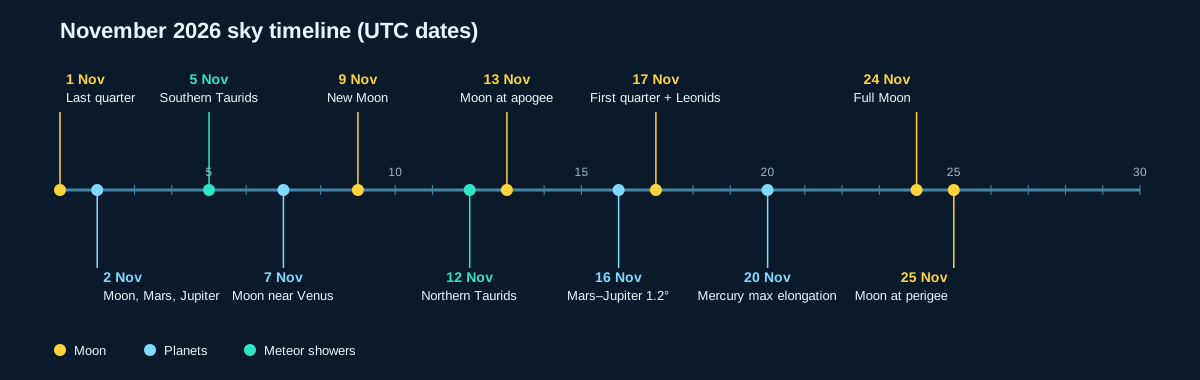
On the same day Mercury is only about 51 million km (0.34 AU) from the Sun. By our calculation it reaches its greatest western elongation, 19.6 degrees from the Sun, at about 23:35 UTC on 20 November. That makes it a morning object, low in the east before sunrise. Our planet parade article and the November 2026 night sky guide cover the other planets in that sky, and the planets visible tonight page shows what is up from your location. The spacecraft itself is far too small to see from Earth, so what you can watch is the planet.
What to watch for
- ESA's confirmation that MPO and Mio were captured, and the first health reports from the stack.
- The next trajectory manoeuvres in the 16-burn sequence that runs into March 2027.
- The release of Mio on 9–10 December, when ESA says the arrival becomes official.
- The first images and measurements from orbit, which ESA has not scheduled in the pages we used.
ESA's pages give the date of capture but, in the sources we read, not the hour, so check ESA's official channels before planning to follow it live. Our Solar System Live map shows where Mercury sits relative to Earth, and our latest astronomy news section will carry the result.
Sources
This article draws on ESA's BepiColombo arrival updates, factsheet, Journey to Mercury, arrival timeline, Getting to Mercury and arrival simulations pages, and NASA's MESSENGER page. Distances and elongation were calculated by SpaceTracker.live Team. Mission dates can change, so confirm them on ESA's official channels.
Source: ESA (BepiColombo arrival updates, factsheet, Journey to Mercury, arrival timeline); NASA (MESSENGER)

More to read
All astronomy news →


 From our guidesNovember 2026 Night Sky: Mars and Jupiter, Leonids and a Near-Perigee Full MoonSkywatching Guides · Oct 30, 2026