
Volcanic Activity on Mars? Gas Spotted Above Alba Mons Fissures
ESA's ExoMars Trace Gas Orbiter has detected hydrogen chloride above fresh fissures near the Alba Mons volcano, always in early northern summer. Scientists say it may come from magma deep underground, a possible sign that Mars is dormant rather than dead.

For a long time, Mars has been described as a dead planet. Its giant volcanoes are real, but most of them stopped erupting billions of years ago. A new study suggests that picture may be too simple. Researchers using the European Space Agency's ExoMars Trace Gas Orbiter have found small amounts of hydrogen chloride gas right above fresh cracks near Alba Mons, a huge volcano in the north of the planet. On Earth, this gas is often released by hot magma, so the finding is being read as a possible sign of volcanic activity on Mars deep under the surface.
Nobody has seen lava flowing, and the scientists are careful to say so. But the result adds an important new clue. If you have been watching Mars rise in the morning sky this month on our planets visible tonight page, here is why that red dot may be a little less "dead" than you think.
What the scientists found
The study was published on 4 November 2026 in the journal Science Advances. The international team was led by Alexander Trokhimovskiy, with Daniel Mège of the Space Research Centre of the Polish Academy of Sciences as a co-lead author.
They used an instrument on the orbiter called the Atmospheric Chemistry Suite. It works by watching the Sun rise and set through the thin Martian air. As sunlight passes through the atmosphere, each gas absorbs particular colours of light and leaves a fingerprint. This method is called solar occultation, and it can pick up gases at extremely low concentrations.
Over two Martian years, the orbiter made 78 of these measurements near the Alba Mons region. Eight of them showed a clear signal of hydrogen chloride (HCl). What made the team sit up was where and when the gas appeared: always in the same small area, above volcanic fissures on the flanks of Alba Mons, and always in early northern summer.
Why the timing is so strange
Hydrogen chloride is not new on Mars. The same orbiter first detected it in 2021. Elsewhere on the planet, though, it behaves in a predictable seasonal way. It builds up during the dusty part of the Martian year and largely disappears once the dust settles. That pattern suggests the global gas is linked to dust and water chemistry in the air.
The Alba Mons signal breaks that rule. It turns up in the quiet season when HCl is normally hard to find, and it stays tied to one location instead of spreading across the globe. A gas that keeps appearing over the same cracks, at the same time of year, looks much more like something coming out of the ground than something made in the sky.
The "frozen lid" idea
So how could a deep source produce a gas that only shows up for a short time each year? The researchers propose a neat explanation. Through the cold months, frost and ice coat the ground around the fissures. Gas seeping up from magma far below gets trapped under this frozen lid. When the seasons turn and the frost turns straight into vapour, the trapped gas is released in a pulse, and the orbiter catches it.
The team also points to fresh-looking fissures and patches of discoloured ground in orbital images of the same area. Those features fit the idea of an active but quiet system, which geologists would call dormant rather than extinct. In their words, Mars may not be dead inside, just sleeping. You can read a clear summary of the work on Phys.org.
Meet Alba Mons, the widest volcano on Mars
Most people have heard of Olympus Mons, the tallest volcano in the Solar System. Alba Mons sits to the northeast of it and is a very different beast. It is surprisingly low, only around 7 km high, but its lava flows spread out over a region well over 1,000 km across. By area and volume it is one of the largest volcanic structures on any planet. Because it is so broad and flat, it is easy to overlook in photos. Yet it may now be one of the most interesting places on Mars to study.
How sure are scientists?
This is a strong hint, not proof, and it is worth being honest about the limits.
- No eruption has been seen. There is no sign of fresh lava, and no clear hot spot has turned up in thermal images.
- The amounts are tiny. The gas was detected at very low levels and only in a handful of measurements.
- Other explanations exist. Chlorine-bearing salts are common in Martian soil, and chemistry at the surface could in principle release some HCl. The team argues that the location and timing point more strongly to a deep source.
The orbiter will keep watching the region in future Martian years. If the same pulse shows up again in the same place and season, the volcanic explanation will get much stronger.
How this fits with other clues
The new result does not stand alone. NASA's InSight lander recorded more than a thousand marsquakes between 2018 and 2022. Many of the strongest came from Cerberus Fossae, a young system of cracks where some lava flows look geologically recent. Other studies have found signs of a warm plume in the mantle below that area. Put together, these pieces suggest Mars still has some internal heat moving around, even if it rarely reaches the surface.
If you enjoy following the outer planets, our Jupiter opposition 2027 viewing guide explains how to catch the giant planet at its best.
Why it matters for the search for life
Heat is one of the key ingredients for life as we know it. On Earth, places where magma warms underground water, such as hot springs and deep-sea vents, are full of microbes. If Mars still has pockets of heat under Alba Mons, there could be places beneath the surface where ice melts into liquid water, at least from time to time. That does not mean anything lives there. It does mean that volcanic regions like this could be good targets for future missions, including ESA's Rosalind Franklin rover, which is designed to drill below the surface. Learn more about the orbiter behind this finding on ESA's ExoMars page.
See Mars yourself this month
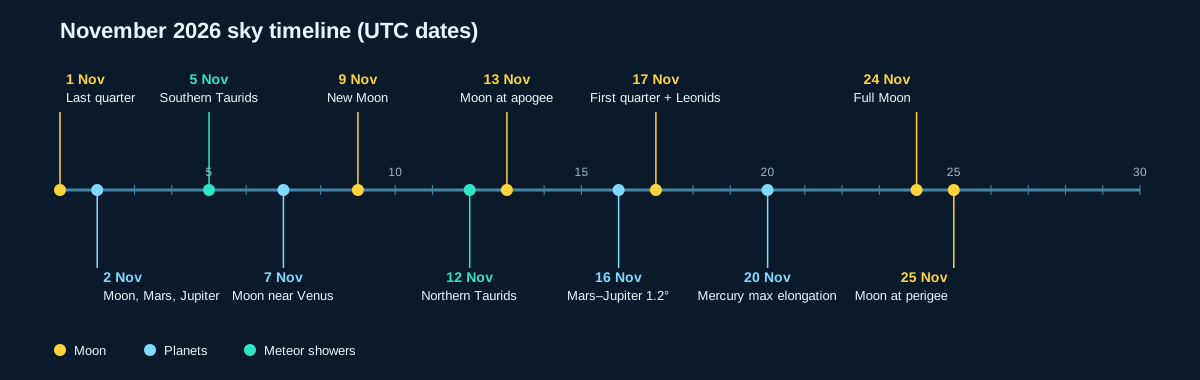
You can't see Alba Mons from your backyard, but Mars itself is easy to find in November 2026. It shines in the morning sky before sunrise, and on 15 to 16 November it sits only about a degree from bright Jupiter. Check our upcoming space events list for exact dates. Next time you spot that small orange point of light, remember it may be hiding a sleeping volcano.

More to read
All astronomy news →


 From our guidesNovember 2026 Night Sky: Mars and Jupiter, Leonids and a Near-Perigee Full MoonSkywatching Guides · Oct 30, 2026