
SN 2026ahvu: Nearby Supernova in NGC 1433 Set to Peak From 18 to 23 November
A young Type Ia supernova, SN 2026ahvu, has appeared in the galaxy NGC 1433, about 50 million light-years away. It is expected to peak at magnitude 10.5 to 12.1 between 18 and 23 November, within reach of amateur telescopes in the Southern Hemisphere.

A star has exploded in a nearby galaxy, and it is still getting brighter. SN 2026ahvu was spotted on 2 November 2026 in NGC 1433, a barred spiral galaxy about 50 million light-years away in the southern constellation Horologium, the Pendulum Clock. It is a Type Ia supernova, the kind astronomers use to measure distances across the universe, and it was caught very early. According to NSF NOIRLab, it should reach its maximum brightness, somewhere between magnitude 10.5 and 12.1, between 18 and 23 November. That puts it within reach of backyard telescopes, especially for observers in the Southern Hemisphere.
How SN 2026ahvu was found
The discovery came from ATLAS, the Asteroid Terrestrial-impact Last Alert System. ATLAS is a network of survey telescopes built to scan the sky for dangerous asteroids, and along the way it catches many exploding stars. It recorded the new point of light at about 04:20 UTC on 2 November, and the object was first listed as AT 2026ahvu, also known as ATLAS26ncp.
The next day, a Caltech team used the DEIMOS spectrograph on the Keck II telescope in Hawaii to split its light into a spectrum. They classified it as a young Type Ia supernova, as reported in AstroNote 2026-311 on the Transient Name Server. With that confirmation it received its permanent name, SN 2026ahvu.
It has been brightening fast. At discovery it was around magnitude 17, far too faint for most amateur equipment. Within days, observers measured it near magnitude 13.5, and the Bright Supernova list recorded magnitude 12.3 on 10 November. Remember that on the magnitude scale, a smaller number means a brighter object.
What a Type Ia supernova is
A Type Ia supernova is the explosion of a white dwarf, the dense, Earth-sized core left behind when a Sun-like star dies. On its own, a white dwarf is stable. In a close pair, though, it can pull material from a companion star. Once it grows too heavy, runaway nuclear fusion tears it apart in seconds, and for a few weeks it can outshine billions of suns. For a look at what can surround a white dwarf long before any explosion, see our story on a dead star with two rings of debris.
Because these explosions reach a similar true brightness, astronomers call them "standard candles". Comparing how bright one looks with how bright it really is reveals its distance. Measurements of distant Type Ia supernovae showed that the expansion of the universe is speeding up, an effect blamed on dark energy. Missions such as Euclid, whose first data release we covered this week, attack the same mystery from another direction. NOIRLab says catching the peak of SN 2026ahvu will also sharpen the distance estimate to NGC 1433 itself.
Why astronomers are excited
Many supernovae are found after they have already brightened, so their earliest stages are missed. SN 2026ahvu was caught while it was still faint and young, in a galaxy close enough to study in detail. That lets scientists follow the explosion almost from the start and record clues that fade as the debris expands. NOIRLab is coordinating observations across the telescopes it operates and has invited other observatories to join.
New images from the Gemini South telescope in Chile, taken with its GMOS instrument, show the supernova as a bright point to the right of and slightly below the galaxy's centre. The Dark Energy Camera on the Blanco telescope had already photographed NGC 1433 before the explosion during the Dark Energy Survey, so astronomers also have a "before" picture to compare with.
There is already an intriguing early idea. A preprint posted on arXiv links the supernova to two young, ultraviolet-bright star clusters in the galaxy. If that link is right, the white dwarf exploded unusually soon after it formed, making SN 2026ahvu a possible "prompt" Type Ia. The paper has not yet been peer-reviewed, so treat it as a promising lead rather than a settled result.
Can you see SN 2026ahvu?
Yes, if you live far enough south and have a telescope. At magnitude 11 to 12 the supernova is far too faint for the naked eye or ordinary binoculars, but in an amateur telescope it shows up as a faint, star-like point beside the galaxy's glow. A telescope of about 150 mm (6 inches) or larger under a dark sky is a comfortable choice. Smaller instruments may just show it from a very dark site when it is at its brightest.
The supernova lies at right ascension 03h 41m 55.5s and declination −47° 13′ 39″, about one arcminute east and 20 arcseconds south of the galaxy's centre. That is deep in the southern sky. Our calculations for 20 November show how high it climbs at its highest point, which comes around local midnight:
- Sydney: about 77°
- Santiago: about 76°
- Johannesburg: about 69°
- Mumbai: about 24°
- Miami: about 17°
- New Delhi: about 14°
- Los Angeles: about 9°
From Australia, South America and southern Africa it is an easy target, high in a dark sky for several hours. From southern India it stays low but is possible near midnight if your southern horizon is clear. From northern India and most of the United States it barely clears the horizon, and from Europe it never rises. Our deep-sky objects tonight page and night sky tonight planner help you check conditions where you are.
Watch out for the Moon
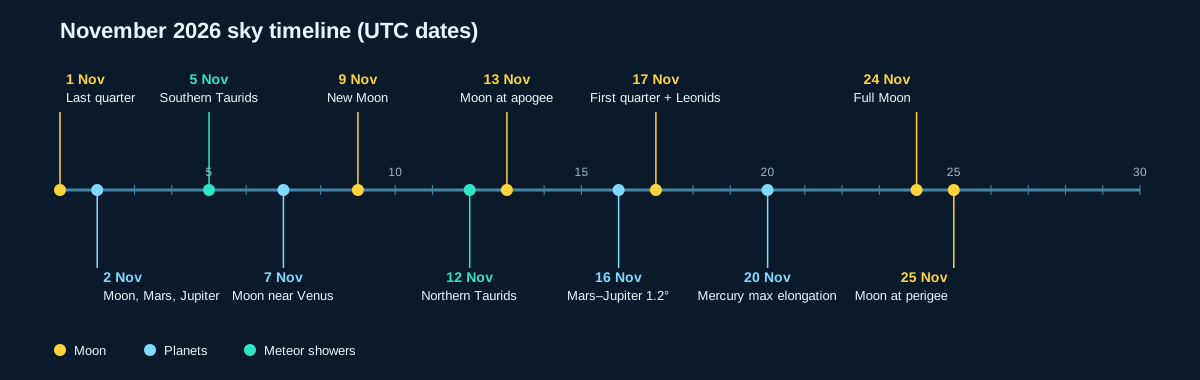
The peak window overlaps a growing Moon. By our calculations it is about 55% lit on 18 November and about 96% lit on 23 November, with full Moon around 24 November. Moonlight brightens the sky and hides faint objects, so the earlier nights in the window are better. Try to observe after moonset if you can, and use our Moon phase tonight page to plan. Comparing what you see with a photo of the galaxy taken before the explosion is the easiest way to be sure you have spotted the new "star".
A rare chance to watch a star die
A supernova this bright, this young and this close is a gift to professional and amateur astronomers alike. Over the coming weeks it will fade slowly, and its changing light will tell scientists how much nickel the explosion made and how the white dwarf blew apart. If you want to explore more exploding stars, browse our supernovae catalogue or see which ones are visible on the supernovae tonight page.
Source: NSF NOIRLab (release noirlab2628); Transient Name Server AstroNote 2026-311; Rochester Astronomy Bright Supernova list

More to read
All astronomy news →


 From our guidesNovember 2026 Night Sky: Mars and Jupiter, Leonids and a Near-Perigee Full MoonSkywatching Guides · Oct 30, 2026