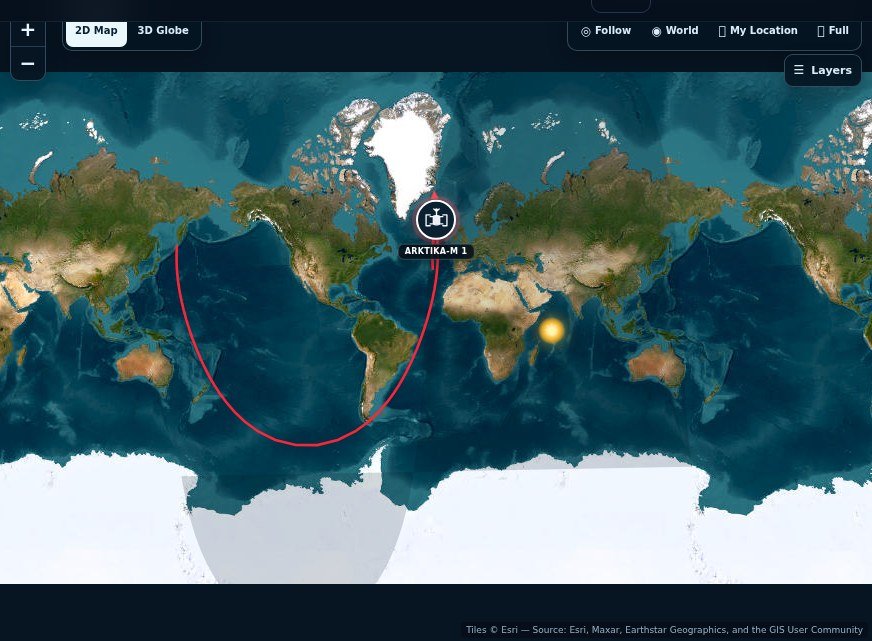
Satellite Passing Over Me Tonight: How to Find Satellites From Your Location
Learn how to find satellites passing over your location tonight and how to interpret pass time, direction, elevation and visibility.
If you searched for a “satellite passing over me tonight,” the most important word is “me.” Satellite passes are location-specific. A prediction for another city can be useless even if it is only a few hundred miles away. Set your observer location in SpaceTracker.live, then interpret the pass using time, azimuth, elevation and lighting conditions.
A pass prediction begins with two moving pieces: the satellite’s propagated orbit and the observer’s fixed location on Earth. From those, the site can calculate rise direction, maximum elevation and set direction for a given time window. CelesTrak’s orbital-data conventions provide the background for the propagation side of that calculation.
How to find satellites passing over your location tonight
Start with the tracker for the object you care about—such as the ISS, Starlink, Hubble or a weather satellite. Set your location, review the upcoming passes and choose a pass with a useful elevation. A nationwide schedule is not a substitute for an observer-specific calculation.
What a satellite pass prediction actually calculates
A pass prediction estimates when a spacecraft rises above your local horizon, how its direction changes, the maximum elevation it reaches and when it drops below the horizon again. The calculation combines orbital data with your geographic coordinates and time.
Why higher elevation usually helps
A low pass can remain close to trees, buildings, terrain and atmospheric haze. A high pass crosses a larger, clearer portion of your sky. Maximum elevation therefore gives you a quick way to compare two otherwise similar opportunities.
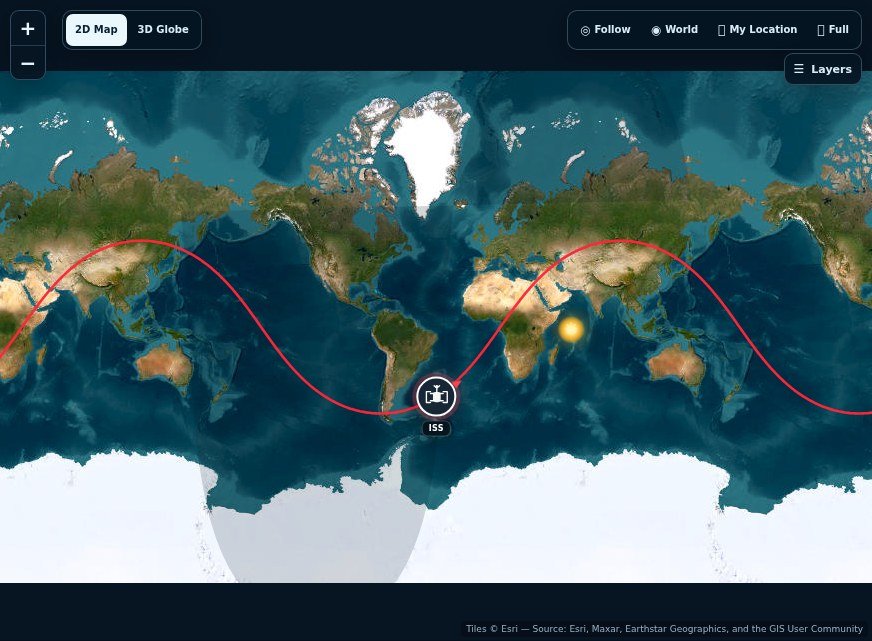
How fresh orbital data affects accuracy
Earth-orbit trackers commonly propagate recent orbital element data forward in time. Predictions are strongest when the source elements are current and the object is behaving predictably. Maneuvers, atmospheric drag and stale elements can increase error. This is why a tracker is a prediction tool rather than a promise that an object will cross an exact pixel in the sky.
What information should you write down before going outside
- Local pass time
- Appearance direction
- Maximum elevation
- Disappearance direction
- Expected duration
- Cloud and sky conditions
For help translating angles into sky directions, use our azimuth and elevation guide.
Your observer location is part of the calculation
A pass prediction is not a universal timetable for a satellite. It is calculated for a specific observer latitude, longitude and usually an assumed ground elevation. Move hundreds of kilometres and the rise time, direction, maximum elevation and even whether the spacecraft clears the horizon can change. That is why using the correct location is one of the most important steps before trusting a local pass table.
Geometric passes and visible passes are different products
The orbital calculation answers whether the spacecraft is above the selected horizon. Visual observing also requires suitable illumination and brightness. The ISS can be an easy naked-eye target on one predicted pass and effectively invisible on another. Starlink satellites vary greatly in apparent brightness, and many other satellites are too faint for casual viewing even when their orbital position is known accurately.
Start with Satellites Above Me for current geometry, then use the naked-eye viewing guide to understand brightness and illumination. For timing uncertainty, see How Accurate Are Live Satellite Trackers?.
The calculation searches for horizon crossings
To find a pass, software follows the satellite through a sequence of future times and compares its direction with the observer's horizon. It looks for the interval in which the object rises above the chosen elevation threshold, reaches a maximum, and drops below that threshold again. Refining those crossings produces the rise and set times in the table. A display can use zero degrees or a higher minimum, so compare settings before comparing results.
This explains why two services may list different durations for the same orbit. One may count the entire geometric crossing while another excludes the low sections near the horizon. A viewing service may also remove the portion that is not illuminated. None of those choices can be judged from a time alone. Read the pass definition, elevation threshold and visibility assumptions before deciding whether the forecasts disagree.
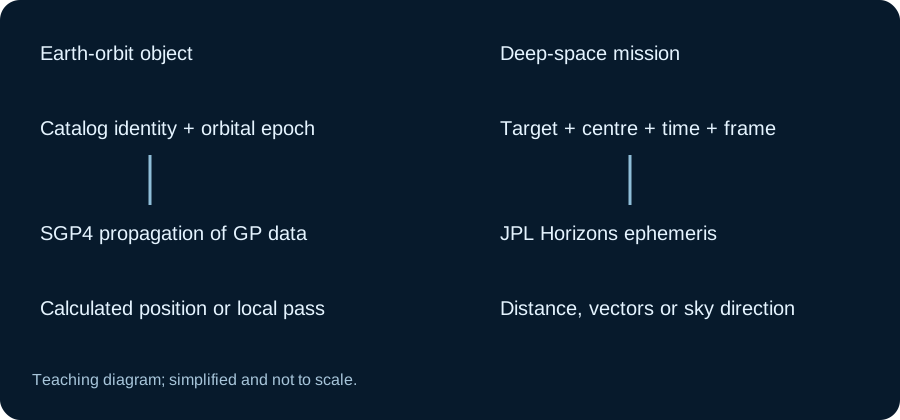
A useful pass prediction combines your location with time-dependent orbital geometry. Recheck the pass close to the observing time because fresh orbital elements, horizon obstruction and local viewing conditions can change what you actually see.
Your horizon is more complicated than the model
A mathematical horizon does not include the apartment block across the street or the hill behind your house. If a satellite rises at a low angle, it can remain hidden until it climbs above those obstructions. Choose a site with an open view in the appearance direction, particularly when the forecast's maximum elevation is modest. A high peak is of little help if the useful illuminated part lies behind your local obstacle.
For repeated observations, make a rough sketch of your usable horizon. Mark which directions are clear and where trees or buildings block the view. That small practical record complements the computed pass table. You can then prefer events that cross the open part of the sky instead of discovering the same obstruction every evening. The orbital calculation supplies the moving track; your observing notes supply the landscape.
Time standards deserve a quick check
A forecast can show UTC, device-local time or a time zone tied to the chosen city. The same instant has different clock labels in each system. This matters especially when a pass occurs near midnight: the local date may differ from the UTC date. Record the time zone with the time if you share an opportunity with someone elsewhere.
An accurate device clock is helpful because a low-orbit spacecraft does not wait for an observer. If you arrive several minutes late, the pass may already be near its end. Check the date and clock before blaming a missing light on the orbit model. For a group session, agree on the same location and time zone in advance. A screenshot cropped to just the countdown can leave out the two pieces of context needed to interpret it.

Recalculate when the question changes
Changing location, selecting a different spacecraft or requesting another date creates a different prediction problem. Even nearby observing sites can see slightly different rise directions and peak elevations. Newly deployed satellites and objects making maneuvers can also benefit from fresher orbital elements. Use the latest available prediction shortly before observing rather than relying on a table saved long ago.
After a sighting, compare your record with the predicted sequence. If the light appeared late but followed the expected path, an obstruction may explain it. If the time and direction match a different object, check the catalog identity. If no match is convincing, leave the sighting uncertain. Pass prediction works best as a tool for testing an identification, not as permission to label every moving light with the first satellite name in the list.
Frequently asked questions
What satellite is passing over me right now?
Use a live location-based tracker and compare the current sky position with your observer coordinates. Multiple satellites can be above the horizon at the same time.
How accurate are satellite pass predictions?
They can be very useful when recent orbital data is available, but accuracy varies by object, data age, maneuvers and the length of the forecast.
Why is the satellite early or late?
Small timing differences can result from orbital-data age, propagation uncertainty or the difficulty of judging the exact moment you visually acquire a faint object.
Is a low-elevation pass worth watching?
It can be, but buildings, trees and haze make low passes harder. Higher passes are generally easier for casual observers.