
Are you curious about the Where Are Voyager 1 And Voyager 2 now? These legendary NASA probes, launched in 1977, continue to make history as the farthest human-made objects from Earth. On SpaceTracker.live, we track the latest positions, distances, and status of these interstellar explorers. As of January 2026, both Voyagers are deep in interstellar space, far beyond the heliosphere, sending back precious data about the cosmos.
Here’s everything you need to know about the current location of Voyager 1 and Voyager 2(Where Are Voyager 1 and Voyager 2 Now), including real-time distances, key milestones, and what’s next for these iconic spacecraft.
Where Are Voyager 1 and Voyager 2 Now
Where Is Voyager 1 Right Now?
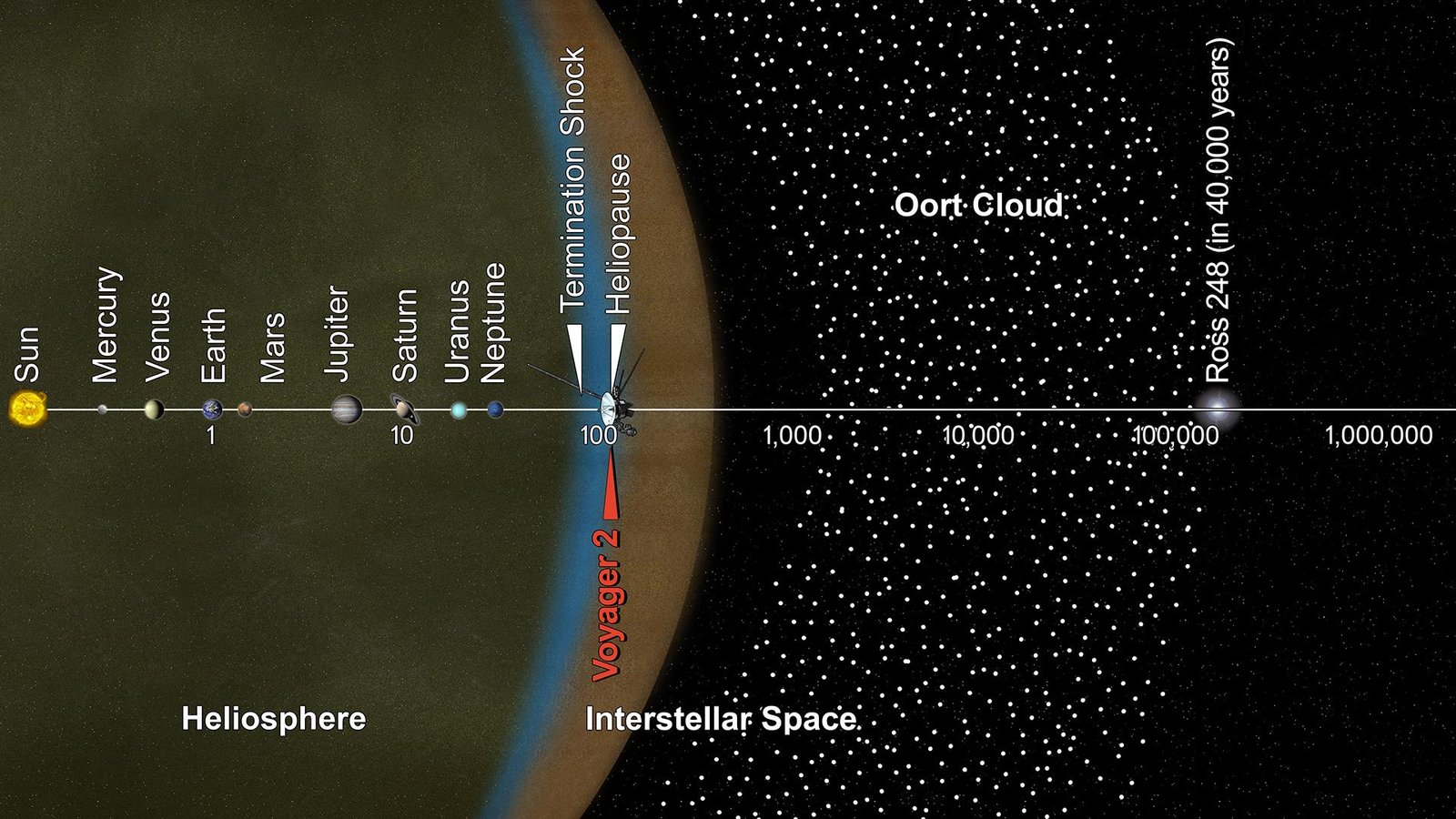
As of January 9, 2026, Voyager 1 — the most distant human-made object — is approximately 25.43 billion kilometers (15.81 billion miles) from Earth. This equates to about 170 AU (astronomical units, where 1 AU is the Earth-Sun distance).
- Constellation: Ophiuchus
- Speed: ~38,000 mph (61,000 km/h) relative to the Sun
- One-way light time: ~23 hours 34 minutes (meaning it takes this long for signals to travel one way)
Voyager 1 crossed into interstellar space in 2012 and is now exploring the interstellar medium, measuring cosmic rays, plasma, and magnetic fields.
Here’s a stunning visualization of the scale and Voyager 1’s position in the vastness of space:
Where Is Voyager 2 Right Now?
Voyager 2, the only spacecraft to visit Uranus and Neptune, is currently about 21.32 billion kilometers (13.25 billion miles) from Earth, or roughly 142.5 AU.
- Constellation: Pavo
- Speed: ~35,000 mph (56,000 km/h)
- One-way light time: ~19 hours 45 minutes
Voyager 2 entered interstellar space in 2018, providing unique data from a different direction compared to its twin.
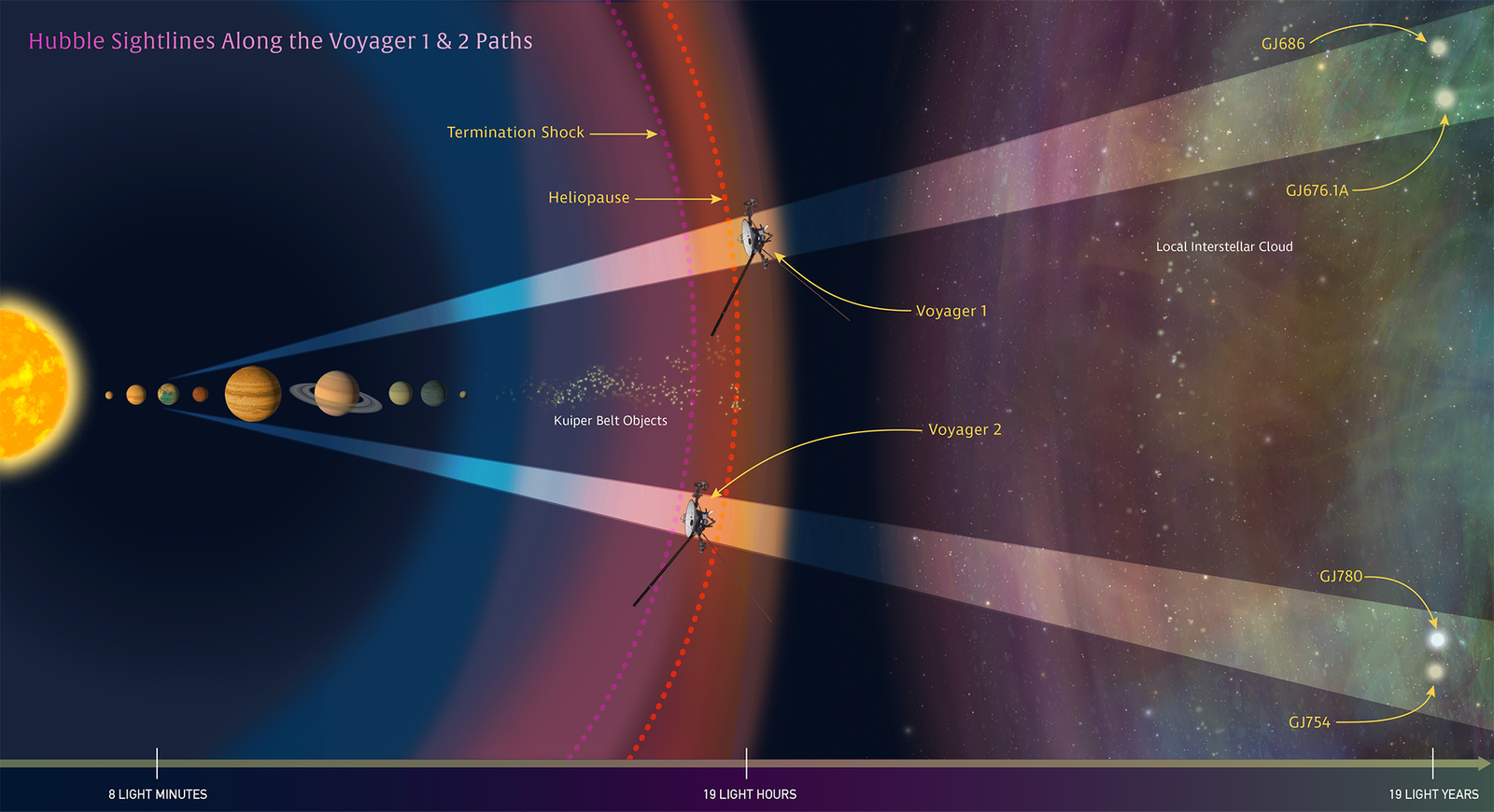
Check out this road map showing the trajectories of both Voyagers into interstellar space:
Hubble Provides Interstellar Road Map for Voyagers’ Galactic Trek …
Upcoming Milestone: Voyager 1 Reaches One Light-Day in 2026
A major historic event is approaching! In November 2026 (around November 13–15), Voyager 1 will become the first human-made object to reach one light-day from Earth — about 25.9 billion kilometers (16.1 billion miles). At that point, it will take a full 24 hours for a radio signal to travel from Earth to the spacecraft (and another 24 hours back).
This milestone highlights the incredible scale of space and the enduring legacy of the Voyager program.
Here’s an illustration of the heliopause — the boundary both probes have crossed:
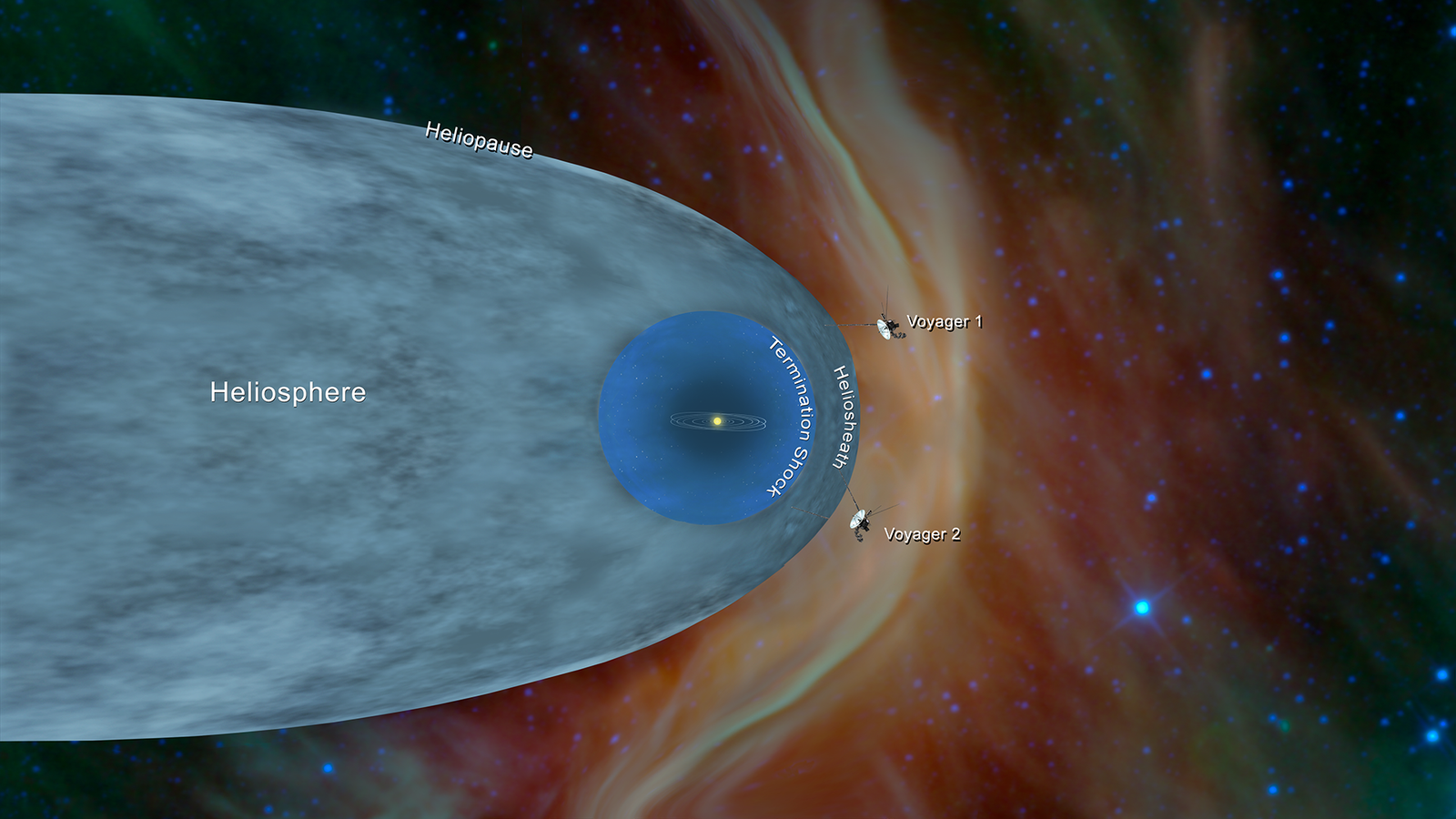
Heliosphere – Wikipedia
Frequently Asked Questions (FAQs) About the Current Location of Voyager 1 and Voyager 2
Q1: What is the current distance of Voyager 1 from Earth in January 2026? A: Approximately 25.43 billion km (15.81 billion miles / 170 AU). It’s the farthest human-made object ever.
Q2: Where is Voyager 2 located right now? A: About 21.32 billion km (13.25 billion miles / 142.5 AU) from Earth, in the constellation Pavo.
Q3: Are Voyager 1 and Voyager 2 still active and sending data in 2026? A: Yes! Both probes continue to operate with limited instruments (cosmic ray detectors, plasma waves, magnetometers). NASA powers down systems as RTG power declines, but science data is still flowing into the late 2020s or early 2030s.
Q4: When will Voyager 1 reach one light-day from Earth? A: Expected in mid-November 2026 (around November 13–15). Voyager 2 won’t reach this milestone until around 2035.
Q5: How long does it take for signals to reach Voyager 1 and 2? A: Voyager 1: ~23.5 hours one way. Voyager 2: ~19.75 hours one way. Round-trip communication can take nearly two days for Voyager 1!
Q6: What have the Voyagers discovered in interstellar space? A: They’ve measured stronger-than-expected interstellar magnetic fields, a hot plasma boundary at the heliopause (30,000–50,000 K), increased galactic cosmic rays, and more — data no other mission can provide.
Q7: Will the Voyagers ever stop working? A: Power from their radioisotope generators is fading. Scientists expect science operations to continue until roughly 2030–2035, after which they’ll drift silently forever.
Q8: Where are Voyager 1 and 2 headed next? A: Voyager 1 is heading toward the constellation Ophiuchus and will pass near star Gliese 445 in about 40,000 years. Voyager 2 is bound for Pavo.
Both carry golden records — messages from humanity — as a time capsule for any future discoverers.
Here’s a close-up of the famous Voyager Golden Record cover:
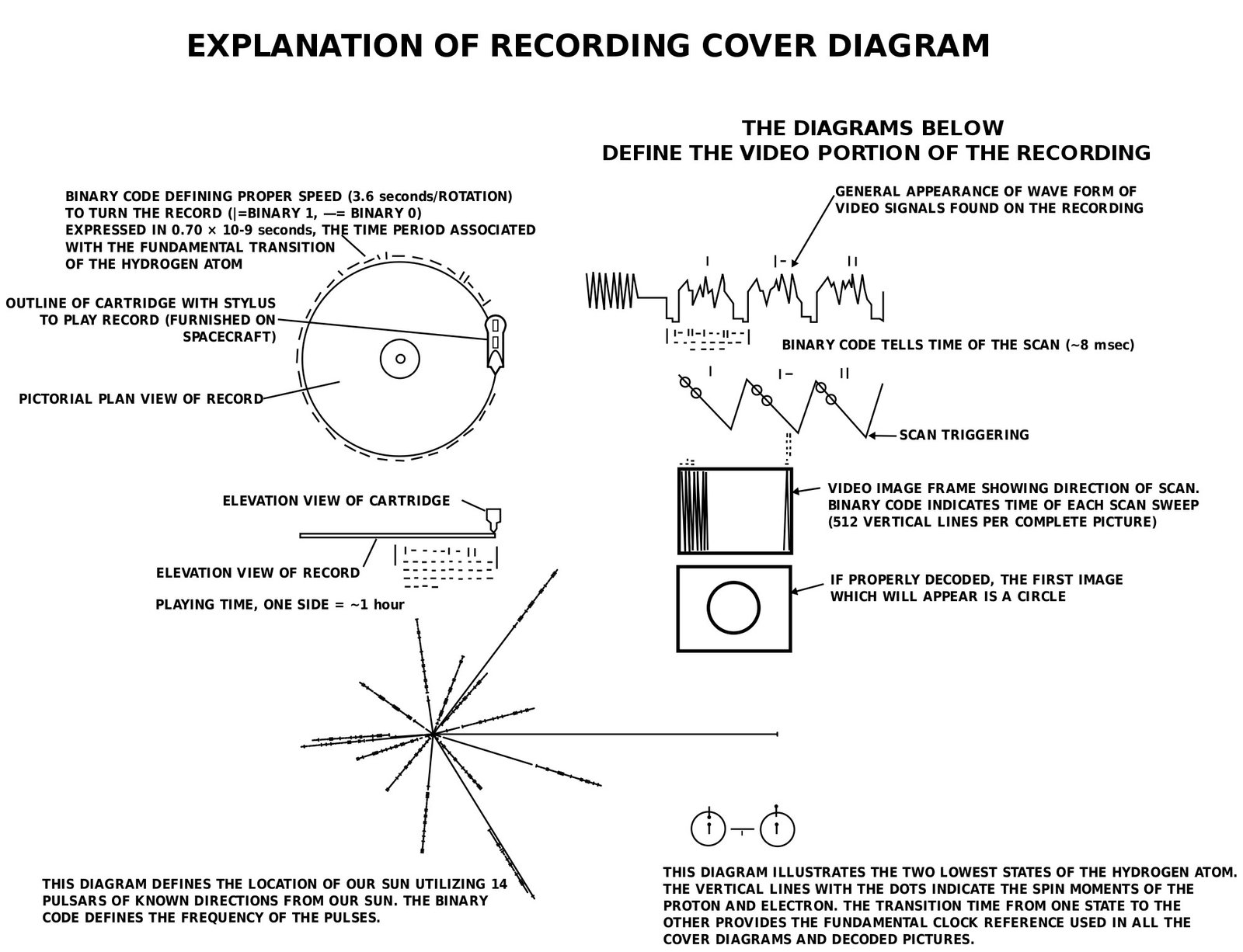
Golden Record Cover – NASA Science
Why Track the Voyagers on SpaceTracker.live?
At SpaceTracker.live, we bring you real-time updates on the current location of Voyager 1 and Voyager 2, along with other satellites, space stations, and deep-space missions. These probes remind us of humanity’s boundless curiosity — nearly 50 years after launch, they’re still teaching us about the universe.
Bookmark SpaceTracker.live for the latest Voyager updates, interactive maps, and more space tracking tools. What milestone excites you most? Let us know in the comments!